Tuesday, October 31, 2006

Happy All Hallows Even


The youth of my parish had a Hallowe'en party yesterday and one of them apparently saw fit to immortalize the visage of her rector in the medium of a sculpted pumpkin. Well, not "immortalize" exactly; the pumpkin will rot, as indeed will I, though, I hope, somewhat later.

I am barely even an amateur psychologist. I know enough to be dangerous. (I know what you're thinking: "Is he any better a psychologist than he is a statistician?") And while I don't uncritically accept everything Carl Jung ever wrote, he is something of a taproot for me. And in that vein, my concern-that-is-not-quite-anxiety over sharing a fate with the carved pumpkin that represents me gets to the spiritual heart of Hallowe'en. Tomorrow is All Saints' Day (All Hallows)--a luminous feast in which the Christian family celebrates its essential unity across not only space but also across time, and therefore also across the exquisitely thin membrane that separates this world from the world to come. I've long thought that Thornton Wilder's play Our Town offers a wonderful insight into the mystery of the creedal affirmation of "the communion of saints." (In the era of my own youth, at least, this was produced by virutally every high school drama department approximately every four years.) During the course of the action, characters die, and move to the village graveyard, which consists of a couple of rows of chairs on one end of the stage. There the deceased are not silent, however; they observe and comment on what's happening at the center of the stage. There's a divide, but it's a porous divide. Everybody is on the same stage, part of the same story.

All Hallows' Eve is the Jungian dark side of the light-filled feast of All Saints. Tonight we confront our uneasiness about the fact of our mortality, not yet with the triumphant assurance that we have been "knit together in one communion and fellowship" (Book of Common Prayer, Collect for All Saints), but by mocking, trivializing--in street vernacular, "disrespecting"--the powers by which we feel threatened. We thumb our noses at death and decay by dressing up in it and making it the subject of a burlesque. I would suspect that the genre of horror movies, which have been inescapble to channel surfers for about the last month, and which will mercifully go away after tonight (I don't like them), is an attempt to do the same thing.

Now, I realize that there are some Christians who in recent years have worked up a lather trying to trash Hallowe'en as nothing more than a pagan holiday. Well, yes, there was a northern European pre-Christian observance that had some of the themes we associate with Hallowe'en. But I would suggest that those who carry such concerns might consider doing three things: 1) learn about All Saints' day and the doctrine of the communion of saints, 2) read some Jung, and 3) stop celebrating Christmas, at least on December 25th, because it too is linked to a pagan celebration.

Saturday, October 28, 2006

Anecdotal Taxonomy

What follows is not in any way scientific. I have no training in the science of statistics anyway. I’m not sure it can even be called an educated guess. But it’s more than just a shot in the dark. It’s an estimate based on a lot of anecdotal experience. I “get around” some in the Episcopal Church.

On the “far left”—there are certainly some Episcopalians who would have to cross their fingers in a big way to say the creed. They are not at all committed to traditional theological categories and language about such things as Incarnation, Atonement, Resurrection, or even the personal nature of God. They believe Jesus was the proverbial “great moral teacher” who “shows us how to live.” One honestly wonders (at least I honestly wonder) why such persons even call themselves Christians, let alone Episcopalians. The retired Bishop of Newark, John Shelby Spong, would be the poster boy for this category of Episcopalians. My guesstimate is that they represent 2%-4% of the clergy and maybe somewhere in excess of 5% of the laity, especially in the major urban dioceses.

Slightly to the right of this group is a class of Episcopalians who cross their fingers while saying the creed, but only loosely. They would affirm much of the language of traditional Christian theology, but substantially qualify their assent to the concepts themselves. They believe in some sort of personal God, and that Jesus is somehow an expression of that God, and that the world would be a better place if more people shared those beliefs. They are attached to the liturgical and sacramental ethos of traditional Christian practice, even while rejecting (or at least benignly neglecting) the underlying theology. Many of them are immensely faithful in worship and active in their parishes. Markus Borg and the Jesus Seminar would be the poster children for this group. My intuitive guess is that around 15%-20% of the clergy and a roughly equal percentage of laity fall into this category. However, they are collectively “louder” than many others, and, hence, it seems like there are more of them than there actually are.

Moving in the same direction, we next have a category of Episcopalians who can recite the creeds with a fair amount of integrity, and would certainly have a self-perception as “orthodox,” in that, by and large, they would wish to retain the language and categories that arose from the great Christological and Trinitarian debates of the third through fifth centuries. So they are not overly antagonistic to the Prayer Book—in fact, they have made something of a shibboleth of the “Baptismal Covenant”—and may profess genuine fondness for some very traditional elements of Christian spiritual practice (the Daily Office, spiritual direction, meditative prayer, for example), though most of them would want to delete, or at least significantly dilute—masculine pronouns about God, and other terms they consider loaded (Lord, Kingdom). They understand both theology and mission in largely social terms, as if everything the church does, in order to be authentic, must be ordered toward the unified objective of “peaceandjustice.” Ironically, while they observe institutional authority quite strictly much of the time, they have the capacity to sit very loosely to what might be called “meta-authority” in the church (like scripture and organic tradition). Both the Presiding Bishop and the Presiding Bishop-elect could stand as representative symbols of this group. I would suspect that something in the neighborhood of 50% of the clergy could be included in this category; it represents the paradigm that has been engendered in most of our seminaries for a number of decades now. However—and this might be the actual big story in my non-scientific analysis—I believe that only about half this percentage of laity fit such a description. There is a huge discrepancy here between the ordained leadership of the Episcopal Church and those entrusted to their pastoral care.

Sidebar: Without a doubt, virtually 100% of those in the above-defined groups would be at least conceptually supportive of the church providing blessing rites for same-sex relationships and removing any restriction on ordaining persons involved in such relationships, although some (less than a third, I would say) might be open to exercising restraint in those areas for the purposes of maintaining ecclesial communion.

Next we have a category that is diverse within itself—comprehending elements from both the Catholic and Evangelical (including the Charismatic) strains of Anglicanism—but is united in a transparent affirmation of both the language of the creeds and their underlying theology. The classical categories touching on human sin, the person and work of Christ, discipleship and growth in holiness make sense to them and energize their faith and practice. They are not “fundamentalist” in the popularly-accepted sense, in that they have a capacity for major-league scholarship and intellectual sophistication, and much of their theological expression can be quite irenic. While cautiously suspicious of modern biblical criticism, they do not dismiss its insights out of hand. They see themselves without affectation as the mainstream heirs of the Anglican tradition. Instead of a representative individual, I would suggest the periodical The Living Church as an appropriate emblem of this category. My intuitive guess is that nearly 30% of Episcopal clergy could be numbered here, but probably two-thirds of the lay membership, mirroring the discrepancy noted above. (Full disclosure note: I number myself in this category.)

Note: The great majority of Episcopalians in this last group would be opposed to the sort of blessings and ordinations that are favored by the other categories, though a relatively small number might believe that the subject is worthy of further exploration and discernment.

Finally, there is a small percentage of Episcopalians who might legitimately be labeled as fundamentalists. They would adopt an inerrantist view of scripture, believe in a literal six-day creation, and be adamantly hostile to the insights of modern biblical criticism. My sense is that this category might include 1% of the clergy and maybe 2% of the laity.

My point? We all need to be wary of using too wide a brush with which to paint our picture of the Episcopal Church. Simple (simplistic?) “two religions under one roof” analyses offer a certain appeal, but leave an awful lot un-accounted for.

Tuesday, October 24, 2006

Keeping First Things First

Somehow it seems like cheating for a blogger who's also a preacher to post a sermon. But I'm feeling a little naughty tonight--just a little, that is, so I'm only going to post the last four paragraphs. (Should you be so masochistic as to want to see the entire text, go to my parish website and follow the yellow brick road.)

But a setup is necessary: The gospel yesterday was from Mark 10, with the Zebedee boys asking Jesus if they can be his special go-to guys after the inauguration, the other ten pitching a fit, and Jesus setting them all down to say, "Whoever wishes to become great among you must be your servant, and whoever wishes to be first among you must be slave of all." And now we join my sermon in progress, as I come in for a landing:

In the economy of the Kingdom of God, time is too short and the mission of the Church is too important to give much slack at all to anyone’s ego, whether that ego is individual or collective. A stagnant church is full of egos that want stroking. A dying church is full of egos that get stroking. But a healthy church, a faithful church, is by necessity and definition also a servant church.

Thinking locally, as St John’s continues to live into the vocation that was embraced by our founders 156 years ago, we will know ourselves more and more to be a servant church. We will develop a collective heart for our neighbors—our weekday neighbors downtown, our 24/7 neighbors all over central Stockton, and our regional neighbors throughout San Joaquin
County
. We will be so consumed by serving our neighbors that we will have little time for anxiety about mere institutional survival. The primary sign of our servant ministry today is that we are on the brink of closing the Budget Shop. Our reasons for doing so are sound, but the way we do it, and how we use the resource of that property, will speak volumes about our commitment to servanthood.

Thinking at a diocesan level, we will know ourselves to be a servant church, not by bathing indefinitely in the refined waters of our theological and moral orthodoxy, but by how we use the gifts that have been entrusted to us—including the gift of orthodoxy—for the furtherance of the larger Church’s mission. The decisions we make in this diocese, including and especially some decisions we will make in convention on the first weekend of December, will have a tangible impact not only on ourselves, but on other Episcopalians throughout the country and other Anglicans throughout the world. When the clergy and lay delegates assemble in Fresno six weeks from now, we will make faithful decisions only to the extent that we know ourselves to be a servant church.

Finally, thinking at the level of the worldwide Anglican Communion, to the extent that we pat ourselves on the back for our open-mindedness, good taste, and beautiful worship, and then retire to the wine and cheese reception, we will have betrayed our inheritance. Anglicanism, quite frankly, was conceived in sin and midwifed by political expediency. We have no abiding reason to remain permanently separate from either the mainstream of western Catholicism from which we diverged four and a half centuries ago, or from the evangelical movements, symbolized by Methodism, that diverged from us two and a half centuries ago. We have prided ourselves on being a “bridge” church. Right now, we have some gaps in our own living room that need to be bridged. Either we will claim the grace to bridge those gaps, or, I suspect, God will just bench us and send in replacement players. We will learn how to be a servant church or we will no longer be a church. My prayer is for the former, of course—that Anglicans will persist in our willingness to forego all preferences of our own, and grow a heart for the unity of the whole church, that we may serve God’s kingdom not by our pride, but by our willingness to become extinct for the greater glory of God and for the one, holy, catholic, and apostolic Church of Jesus Christ. To Him be the glory for ages of ages. Amen.

Wednesday, October 18, 2006

A Must Read for Anglicans

When I started blogging, I determined not to become too cannibalistic, and just pass on links to other blogs. To date, I have successfully resisted this temptation. So, forgive me, but, if you're an Episcopalian or any other sort of Anglican who is concerned about the ills that beset us, you will not want to miss this address by Bishop Jeffrey Steenson of the Diocese of the Rio Grande. It is the finest, most penetrating, and thoroughly Christian assessment of our situation I have yet read. If I could do cartwheels to get everyone to read it, I would.

The Manager is Fired, Long Live the Manager


The Chicago Cubs have introduced Lou Piniella as the latest designated Messiah. Indulging the fantasy that my opinion matters to anyone, I add my voice of welcome and best wishes as he acclimates himself to the friendly confines of beautiful Wrigley Field. I welcome him as one would welcome a sailor to the Bermuda Triangle. I welcome him as Saul welcomed David to do battle with Goliath. And if he brings a World Series title (what the heck...even a World Series appearance) to the north side of Chicago, I will invite him into my heart to stay. But I'm not getting my hopes up. I had hope for Leo Durocher. How long ago was it when he announced, "This is not a ninth place ballclub"? He was right. They finished tenth his first year.

Monday, October 16, 2006

Live-Blogging "Six Feet Under"

I tend to bring up the rear of the popular entertainment parade, one indication of which is that I don't have HBO. But Six Feet Under has now finished its premium cable life and is now available to the rest of us who have something more than basic cable. So I'm catching up...at this very moment...as I write.

I've already slipped into the "Hollywood doesn't understand religion" niche with respect to Studio 60 on the Sunset Strip. I hadn't planned on diversifying, necessarily, but here it is, right in front of me. My interest was piqued anyway because, way back in a previous lifetime (aka the mid seventies, when I was a graduate student in music history), I worked part-time in a mortuary. And as a priest, of course, I have had a couple of hundred opportunities to interact professionally with the funeral industry. In a way, morticians are para-colleagues of mine.

Now, I don't go looking for reasons to play the curmudgeon. They just find me. In the episode before the one currently showing, David, one of the members of the mortuary-owning Fisher family, anounces that he is being considered as a "deacon" in his church. (We discover this when he explains to his gay lover why they won't be available to get together on Sunday.) Well, that's fine. I grew up Baptist, and deacons were the elected lay leaders of the congregation, the governing board. Very shortly thereafter, however, I'm hearing language that is familiar to my ears: "For David, chosen deacon in your church, let us pray to the Lord," to which a congregation responds, "Lord, hear our prayer." Then follow the next several petitions from the Litany for Ordinations, right out of the Book of Common Prayer. There's a clergyman, vested in alb and purple stole, presiding over a congregation gathered in a large gothic structure. (Later we learn that it's called St Bartholomew's.) And there's David. Is he kneeling, wearing an alb, with a bishop somewhere in the picture? No, he's wearing a business suit, standing next to the clergyman, looking quite beatific.

Obviously, the script writers have chosen to combine the ecclesial and liturgical trappings of the diaconate as it is understood by churches in the Catholic tradition with the function of the diaconate as it is understood by churches of the left-wing Reformation tradition. That's their prerogative, I guess. It's their show. I'm not the dispenser of artistic license, and if I were, I don't think I would be particularly stingy. But it bothers me. It's like when the secular news media mess up on their coverage of religion (which, as far as I can tell, is most of the time). It makes me distrust them when they talk about things of which I am truly ignorant. If the writers and producers of Six Feet Under can't find a way to just pick a church for the Fishers--any church, it doesn't matter--and represent that church accurately and without affectation, what makes me think they can represent, say, the funeral industry, or teenage girls, or middle-aged widows, or not-quite-completely-out gay men, or single straight men who have just moved from Seattle to Los Angeles?

Oh wow...a chance for a live update. Now watching the beginning of the episode I came in during the middle of. David meets the clergyman on the steps of St Bartholomew's and addresses him as "Father." Then Fr Jack, right there on the church steps after a Sunday service, casually mentions that he would be happy to recommend David (who just told him, apparently falsely, that he's been attending another church--St Stephen's in the west valley--for the last several weeks) to the Bishop for consideration as a deacon, since, after all, his late father was one. Makes sense to me. Later, Fr Jack takes David to meet a purple-shirted bishop in an Anglican "dog collar." The bishop promises to let David know of his decision in a week. (I know several aspirants to the diaconate who would like that bishop's address and phone number.) Do you see my point? Most of the outward signs suggest that Fr Jack and the Fishers are Episcopalian. But it's a kind of Episcopalian bad dream.

Even more troubling, of course, is the fact that none of the members of the church-going Fisher family seem to integrate their religious practice--let alone actual faith--into their lives away from church. In this they are certainly not unique, even in the real world (quoth the jaded pastor). But between the four of them, only David's brother Nate confesses any actual faith in God, and then only in a vague "force," something quite a few degrees removed from the God of Abraham, Isaac, and Jacob, the God and Father of our Lord Jesus Christ. Lord, have mercy.

Sunday, October 15, 2006

It's All About Ecclesiology, Stupid

I’m not actually trying to insult anyone with that title. Just trying to get some mileage from the mantra that some say got Bill Clinton elected president in 1992.

(Note to non-Anglicans: There’s going to be some inside jargon in this post. My apologies. Please deal with it as best you can. If you’re insanely curious, contact me privately and I’ll ‘splain things to you. Or you can just take a pass until I next step into my media critic persona.)

Some of my best friends are Evangelicals. (I use the upper-case ‘E’ to denote both the amorphous genre of what might also be called “orthodox Protestants” and also the more definable “party” within the Anglican stream, and to distinguish both from “evangelicals” in the pure semantic sense—i.e. anyone who proclaims good news.) I was raised in that subculture (just a few miles from Wheaton, Illinois, which used to be the center of the Evangelical universe before it moved to Colorado Springs some years ago). Purebred Anglican Evangelicals have been a bit of a rare species in United States for about the last 150 years, but I do know a few, including one presbyteral colleague here in my diocese (San Joaquin) who hails from New Zealand, and with whom—amid our good-natured sparring over theological and liturgical minutia—I have a relationship of great affection and esteem. We’re together on the core issues of Christian faith and discipleship.

It’s no secret that if Evangelicalism—either the generic variety or the Anglican party—has a theological Achilles heel, it’s in the area of ecclesiology. It’s not so much that Evangelicals have no theology of the Church as that they have a underdeveloped theology of the Church, one lacking in the sophistication and nuance that characterizes, say, their soteriology (how does Jesus save us?).

Consequently, Evangelical theology turns out to be somewhat of a blunt instrument when dealing with the questions that are on the Anglican table at present—questions that focus on the visible superstructure and institutional infrastructure of the Body of Christ, and how relationships within those structures ought to be carried on. So when we find that there are church members and church leaders who are, for whatever reason, unable or reluctant to use certain language to talk about, say, the uniqueness of Christ as the bearer and agent of human salvation, or who studiously avoid the classical Trinitarian language of “Father” and “Son,” a crisis ensues, not merely a dispute, but a crisis of communion, of ability to co-exist in the same community of faith.

This is not difficult to understand if one sees the Church as a voluntary society of like-minded believers who come together for common worship and mutual support rooted in a shared experience of faith or perception of certain cardinal realities. If it turns out that there is, in fact, no shared experience or perception, no like-mindedness, there is no energy to hold such a society together. Maybe there once was an authentic commonality, which creates a certain degree of inertial momentum that can sustain institutional unity for a time. But, eventually, that momentum spends itself, and there is an inevitable atomization, and possibly a reconfiguration of the constituent parts.

In short, from an Evangelical perspective, there is no reason to keep company with unbelievers as though they were believers. It is dishonest to all concerned, and dishonors that very gospel that it is the vocation of Christians to proclaim. Hence, we hear clarion calls from Evangelical Anglicans to “come out from among them” and “be not unequally yoked,” etc. etc. There are “two religions” within the one institution of the Episcopal Church, and what should one, after all, have to do with the other? Would it not be better to make a clean, honest break, and have everyone get on happily with their lives?

Like I said, some of my best friends are Evangelicals. But I’m a Catholic. We may have our weak points, us Catholics, but ecclesiology isn’t one of them. Ecclesiology is our thing. The Catholic vision of the Church is richer, more refined, more resilient, and more versatile than that of “some of my best friends.” For a Catholic, the Church is less of a voluntary society of the like-minded and more of an organic family of the like-born—or reborn, to be precise. The Prayer Book states that “the bond that God establishes in baptism is indissoluble”—admittedly, a very Catholic notion. In the organic family of the Catholic Church, we don’t get to choose our relatives. When some of them misbehave and embarrass us to tears, we can avoid them and hang out with those we get along with, but we cannot, in the end, deny them. No one will be fooled; the family resemblance is too striking. When they say foolish things at family gatherings, we can get angry, but they’re still family. When they act in ways that are contrary to the traditions of the family, we can roll our eyes, but they’re still family. Even when they betray the vital interests of the family, we can see that they are subject to discipline, but they’re still family.

In short, from a Catholic perspective, schism and excommunication are, like divorce, always signs of failure, never of success. Is it not striking that, among those sectors of Christianity that have an organic ecclesiology, there is a high degree of sacramental fellowship and institutional unity, even in the midst of wildly diverse spirituality and culture, while among those sectors that have a voluntary association ecclesiology, there is atomization to an exponential degree? Theological integrity, yes. But an astonishing amount of division.

It was an e-mail from an old friend, a priest in another (very mainstream) diocese, that got me thinking along these lines. So I will conclude by quoting from his very insightful reflections:

The longer I serve as a priest, the deeper (I think) I am understanding the meaning of obedience. Over the years, I've read a fair amount regarding Benedictine matters, and find that this practice challenges my selfish and anxiety-borne tendency to panic or seek quick, satisfying solutions to challenges in discipleship. … [A]n authentic witness in our setting requires us to embrace obedience to our vows much in the same way as Christ embraced the Cross in obedience to His work of reconciliation, rather than pushing the schism button before the Mind of Christ is laid out by the Instruments in a clearer, more truly Catholic sense.

Amen!

Wednesday, October 11, 2006

Harriet Hayes Update

Last week I wrote about the "openly Christian" character in the new NBC series Studio 60 on the Sunset Strip, one Harriet Hayes. (No, I'm not going to give you a link; just look upstream a couple of posts.) I opined that she is a symbol of irony, because one of the axes she grinds is that Hollywood doesn't get Christianity, but the very ways the script writers have her make that point only serve to demonstrate that they, in fact, do not get Christianity.

Anyway...I told you so. In last night's episode, while trying to achieve that elusive quality of clarity in her relationship with ex-boyfriend and current boss Matt, Harriet says something along the lines of, "Of course it would have never worked out between us. You're an east coast Jewish atheist and I'm a Southern Baptist who believes you're going to burn in hell." (I assume she meant Southern Baptist and not southern Baptist--there is a significant difference, but would Aaron Sorkin actually know that?) OK, even allowing for a certain element of hyperbole, that is more than a little over the top. Now, I will grant you, there are Christians who are inordinately fascinated by questions of who gets to burn in hell. I even know a couple. But I don't think there are nearly as many such Christians as there are non-Christians who are incensed that such Christians exist in any quantity whatsoever and who salve their indignation by projecting the offending attitude onto the entire class of Christians. Poor fictional Harriet Hayes is only the most recent victim of such religious profiling.

I'm tempted to conclude by saying something like, "If you don't agree with me you can just go burn in hell." But then someone might not get that I'm trying to be wry and ironic, and that would not be good.

Monday, October 09, 2006

Stretching the Comfort Zone

I don't dislike animals. Often I even enjoy them. I've toyed with the idea of getting a talking bird, and teaching it liturgical responses. (OK, I'm a liturgy geek. There are worse things.) But I'm realistic enough to realize that I would not be happy as a pet owner. It's a big responsibility, and there are too many other worthwhile things going on in my life that I want to pay attention to.

That said, the same concerns, alas, are not shared by those who have shared and continue to share my domestic life. At present, my living space is invaded by a five-year old Border Collie named Lucy (aka Lucifer) who belongs to my wife Brenda and a six-year old psychotic male orange tabby who is a vestige of my younger daughter's need to decompress when she lived at home for a few months following her college graduation. Brenda also feeds an eleven-year old long-haired female tabby who abandonded us some years ago for the front porch of some neighbors two houses up the street.

Given my general temperament, then, I have never, in seventeen years of ordained ministry, succumbed to the increasingly popular practice of liturgically blessing animals on or around the feast day of St Francis of Assisi. Until now. Maybe I've had a pastoral epiphany. Maybe I'm getting all emotionally squishy in my old age. Maybe my Jungian uncounscious really adores animals. Or maybe I'm shamelessly pandering to popular demand. But with comparatively little publicity, 31 humans, an uncounted number of dogs, one (very brave) cat and one (rather oblivious) fish turned up in the Hoffman Memorial Garden at St John's this afternoon for the Blessing of Animals. There were only a couple of minor canine scuffles. Beyond that, everything went smoothly and expeditiously, and everyone (the humans, at any rate) seemed pleased.

When I was first ordained, the rector whom I served as curate told me he had abandoned the practice because some child's pet rodent had keeled over and died immediately upon receiving a blessing. Such events raise rather tricky issues of pastoral theology that a prudent cleric would want to avoid if at all possible. By God's mercy, I was spared such a fate today, for which I am immensely grateful. So I suppose I'll do it again next year.

I do apologize to St Francis, though. He has, I fear, been kidnapped by the cult of cute. Were he alive today and doing what he did, there are several diagnosis codes in DSM IV that would apply to him, and he would probably be institutionalized, or at least under a conservatorship. He was crazy for the sake of the gospel, and I'm not sure that blessing pets does justice to the virility of his witness.

Thursday, October 05, 2006

Media Watch

I can't remember ever not being cynical about the way movies and television (not to mention the literature of the last century or so) generally portray religion and people who seriously practice religion. One favorite archetype is the Elmer Gantry figure--a venal hypocrite whose inevitable downfall casts not-so-subtle aspersions on the whole faith that he purported to espouse. Another is Father Mulcahey from Mash--likable and well-intentioned enough, but definitely running on a low dose of testosterone--in short, a wimp. The Camden family from Seventh Heaven is at least allowed to be somewhat real, but in a very syrupy way; I mean, who can really take that much sweetness? Plus, the nitty gritty of their religious practice is never exposed; everything is kept rather superficial. Eric Camden is some sort of (mainline?) Protestant minister, but that denotes a wide universe, and to keep it that general also keeps it proportionately unrealistic. Then there was the short-lived Book of Daniel, which was overtly Episcopalian, and I actually kind of enjoyed. But it was also bizarrely Episcopalian, an exaggerated caricature of every weird thing the Episcopal Church is currently into, which is no mean feat, since the Episcopal Church is currently into some very bizarre and weird things.

This Fall's primetime network fare features two new programs--both on NBC--that attempt once again to integrate "people of faith" (I really do hate that expression, but...whatever) into the cast and plotlines. One is Friday Night Lights, based on the movie of the same name, and therefore focusing on small-town Texas' obsession with high school football. My brother Steve (yeah, literally my brother) has some pertinent comments about this program on his own blog. I haven't seen it myself, but from two eyewitness accounts I have read, it is a dead-on accurate and unaffected representation of the dominant Christian piety of west Texas.

The other entry is Studio 60 On Sunset Strip (Monday, 10 Eastern & Pacific). This show marks the return of the writing and producing team of Aaron Sorkin and Thomas Schlamme, who distinguished themselves in the first four seasons of The West Wing. I am openly a West Wing junkie, still in serious grief over its demise, so I've watched the first three episodes of Studio 60 in seach of a fix. It's cruel. Sorkin and Schlamme have an unmistakable literary style in the dialogue they write, and a trademark technical and narrative style as well. Plus, one of the lead roles is played by Bradley Whitford, whose Josh Lyman was a mainstay of the Bartlett administration. The other leading character is played by Matthew Perry, who had a several-episode gig on "the wing" as deputy White House counsel. So there is the patina of the experience of watching The West Wing (did I mention that the music is done by the same person as well?), but, alas, it's not.

Enough of my whining. One of the characters in Studio 60 is Harriet Hayes (Sarah Paulson), who is--Is there a better way to say this?--"openly Christian." She (the character, that is) is a comedic actor who is a member of the cast of the show for which Whitford and Perry's characters are the writers (it's clearly a stand-in for Saturday Night Live). In every episode so far, she has been in a position to make a point about how Hollywood just doesn't "get" Christians or Christianity. She appropriately rolls her eyes and grimaces and throws out "Aren't you clueless?" one-liners. Now, this has to be one of the biggest ironies of the decade, because the character of Harriet Hayes is a neon illustration of how Hollywood--are we ready for this?--just doesn't "get" Christians or Christianity. In contrast to the honest if unsophisticated piety of Friday Night Lights, Harriet's Christianity tries to be uber-chic and sardonic. Tries, but fails. In an effort to be cool and avoid the sticky sweetness of a Seventh Heaven, as well as the hypocrisy and primness of the classic archetypes, Sorkin and Schlamme have turned Harriet into...well, I don't know what, exactly. Just not a believably authentic Christian of any stripe (the implication is that she is an evangelical). I could illustrate with prayers for falling objects on ex-boyfriends and malicious riffs on the theme of "accepting Jesus Christ as your personal savior," but the hour is late.

In order to write convincingly, you have to write from the inside. (That's why I never believed that, had The West Wing been allowed to continue, Arnold Vinck [Alan Alda] would have been allowed to win the presidency. I don't know that Hollywood can do Republicans any better than they can do Christians!) You can't just learn some of the vocabulary and some of the symbols and throw them into a script. Practice makes perfect, though. Maybe someday they'll get it right.

Wednesday, October 04, 2006

On Intercessory Prayer

A long time friend of mine recently eMailed me about her concern for a friend of hers who has just been diagnosed with serious illness, asking for prayers, of course, but also reflecting on the experience of intercession and petition. I thought our exchange worth sharing:

[It's been said that ]one prayer is enough; that the instructions in the Bible about prayer are aimed at keeping us in communion and communication with God. After
all, God doesn't keep a balance so when x number of people have prayed for something or someone the answer changes from no to yes. I once read that prayer is laying hold of God's highest willingness. Whether all of this makes sense or not, I'm sure it's so: one prayer is enough. Amazing grace! Your thoughts?

Intercessory prayer is certainly a mystery. Yes, once is enough. At the same time, Jesus seems to encourage us to "pester" God. So while the former seems more natural to me, I make myself do the latter as a matter of obedience and discipline. Lately, I like to think of intercession and petition, particularly when suffering is the subject, as a way of making ourselves--i.e. our sufferings--"available" to God for him to use in his redemptive re-weaving of the fabric of creation. Rather than passively or grudgingly tolerating suffering, it makes more sense to me to actively embrace it, intentionally identifying it with the sufferings of Christ and, hopefully (in the words of the Book of Common Prayer) "find [the way of the cross] none other than the way of life and peace." Of course, I also find that I'm never too keen on embracing my actual sufferings. It works better in the abstract! But, however imperfectly, I try.


Tuesday, October 03, 2006

San Joaquin's Constitution

Word is now out in cyberspace that the Episcopal diocese in which I serve, San Joaquin, will be considering a proposal at its next convention (first weekend in December) that, if passed in two successive regular annual conventions (the second time by a concurrent two-thirds vote among both the clergy and the lay delegates), would amend our constitution in such a way as would effectively remove us from the Episcopal Church. This is a pretty big story, and I expect that it might dominate Anglican discourse in this country for the next couple of months.

I have a lot to say about this. For the time being, however, I'm not going to be saying it in venues that extend beyond the Diocese of San Joaquin. Like this blog. By means of our diocesan intranet, I have invited my brothers and sisters here to similarly restrict their public comments. This is something we need to debate in good faith locally, and it will not be helpful if we are trading broadsides in the blogsphere and on message boards. My own commitment, of course, is contingent on buy-in from others. If members of the diocese choose to carry on the debate in front of the whole world, I reserve the right to do the same. But I hope this doesn't happen.

Monday, October 02, 2006

MLB 2006, R.I.P.

What?! you say. This is just the end of the regular season. There's nearly a month of exciting playoff action yet. (Isn't there something sick and twisted about playing baseball practically until Hallowe'en?)

Well, I'm cursed with being a Cubs fan, so--yes--the season is over. I was ten years old when I first started following them in 1962. (I can still give you the starting lineup from that year, plus most of the pitching staff. Anybody interested?) When I left for college in California at the beginning of September 1969, the Cubs had an eight game lead in the N.L East. But I'm not ready to talk about that yet. The pain is still too fresh. I have not lived in the Chicago area since Richard Nixon lived in the White House. Yet, despite the advice of several friends-cum-therapists, the Cubs are still in my system. The year after next, after all, is the centennial of their last World Series title. Maybe there will be poetic justice.

Dusty Baker will get fired tomorrow. That will be sad for me. I have an autographed picture of him wearing a Cubs uniform, hanging on the wall of my study. (A parishioner of mine is an off-season fishing buddy of his.) It says, "To Father Dan Martins: Keep praying for us. We'll get there." I believe it, Dusty. Just not during your tenure and probably not in my lifetime!

Can anybody tell me why Greg Maddux was traded? Sure, it wasn't a Brock-for-Broglio boondoggle, but still. He was at least a person one could root for even if the team was tanking.

There is an arcane theological concept called Eschatological Dualism. It's an attempt to name the paradox that, while the Kingdom of God is upon us--the power of sin and death is defeated, and Jesus reigns--there is still considerable residue of the old order for us to still deal with. There is a tension between the "now" and the "not yet." Cubs fans intuitively understand Eschatological Dualism. We're well accustomed to the tension between "maybe this year" and "wait til next year." Cubs fans live in a never-ending sense of waiting, hope, and expection--always Advent and never Christmas. That Christ will come again I am well assured. Whether the Cubs will win a World Series before that happens I can't say. Maybe the latter will happen right before the former. How cool would that be?

Saturday, September 30, 2006

Hanging In There with the Episcopal Church

The conservative wing of the Anglican blogsphere has been all atwitter for the past few days [once again, I haven’t mastered the embedded hyperlink thing yet, but google “Stand Firm” if you’re curious] over whether the effect of the Camp Allen meeting is positive, neutral, or negative with respect to the future of Anglican Christianity in this country. I’ve already weighed in on the subject (see the post before last): I think it’s positive. It’s a small but solidly significant step in the direction of a reinvented Anglicanism that I think I’ll like better than the current version.

As a “Camp Allen Optimist,” trying to read the “Camp Allen Pessimists,” I note that one of the anxiety-riddled themes that comes up repeatedly is a disgust with the prospect of any involvement with the institutional structures of the Episcopal Church for one second longer than is absolutely necessary. Whether the impetus for disassociation comes at a diocesan level, as in my own diocese of San Joaquin and our still-standing request for Alternate Primatial Oversight, or at a more local level, as in the case of Windsor-sympathetic parishes in Windsor-resistant dioceses, there is a pervasive sense that there will be no “winning back” the Episcopal Church through the regular constitutional and canonical processes. Consequently, why prolong the agony? Why do anything that will retard the process of initiating the new incarnation of American Anglicanism, leaving the Church-of-General-Convention to continue to wither into the statistically insignificant liberal protestant sect that seems to be its destiny?

I think there are some good reasons to put the brakes on any headlong rush to abandon the institutional structures of TEC. (Yes, the ability of the Church Pension Fund to make astonishing amounts of money no matter what the market conditions are, funds that eventually inure to the benefit of the clergy, is on my list of reasons, but pretty near the bottom.) But first, let me stipulate to the point that there is no long-term hope in TEC for American Anglicans who wish to be full constituent partners in the worldwide Anglican Communion. I hold no such expectation.

Nonetheless, I hope to remain an Episcopalian for a good long while yet, probably several years. My reasons fall into two broad categories: First, I want to let the Archbishop of Canterbury, the Primates’ Meeting, the Lambeth Conference, and, in time, even the Anglican Consultative Council (yes, remember them? the Instruments of Unity?) take the lead and light the way for us. I’m not saying we should be totally passive and let others do everything on our behalf. It’s a delicate dance, and we have to take our part. But I get a little nervous when we act preemptively, or try to force someone’s hand. Those sorts of bold moves sometimes work, and sometimes they come back to bite us. This is a pretty high-stakes poker game we’re in here—a game, I might add, that seems to be trending in favor of those who take a traditional theological and moral stance—and we can’t afford too many wrong moves. When the Instruments of Unity give the word to jump ship, I’ll be in the water with everyone else. But I don’t want to get wet too soon. I want to make sure there’s a rescue vessel real close, and that it’s going to take me where I want to go, namely, a vibrant Catholic Anglicanism that is in full communion with the ancient See that is our ancestral connection to the apostles’ teaching and fellowship. In the meantime, I am willing, and believe it prudent, to tolerate some of the anomalies of life in our denomination until the kairos of God is fully evident.

Second, the same word from the Lord that chastened the prophet Elijah when he was all morose and self-pitying and wanted to die is, I think, a word to us as well. There are plenty of Episcopalians who have not bowed the knee to Baal. They’re all over the country, in every diocese. Some of them are naïve, and perhaps even misled, and are unaware of the dire straits the larger institution itself is in. Others have come to a good faith conclusion that the traditional sexual ethic needs to be revisited. I think they are profoundly mistaken, but I am not prepared to write them off as heretics and apostates. They are not my enemies; they are my friends. Most of them say the Creed enthusiastically without crossing their fingers. It is a mistake to tar them all with the broad brush of John Spong and Markus Borg and company. They honestly intend to be disciples of the same bodily-risen-from-the-dead Jesus whose disciple I endeavor to be. Many of them have extraordinarily disciplined devotional lives, and are exemplary in worship, service, and stewardship. Again, while I believe them to be in serious error, I have no reason to question their sincerity in any of this. They are brothers and sisters in Christ, baptized in the same water that gave me new birth, formed by the same sacred scriptures that shape my soul, and partaking regularly of the same sacred Body and Blood that are my spiritual sustenance. In the end, some will no doubt choose to remain on a sinking ship even as it goes down. For that I will grieve. But I cannot blithely turn my back on them in the meantime. Not if I believe what the Prayer Book says about the bond that God establishes in baptism being indissoluble.

So I pray for the virtues of patience and prudence, for myself and for others. One could surely do worse than to aspire to such things.

Friday, September 29, 2006

Outrage or No Outrage?

I'm going to do some thinking out loud about a question I presently have a divided mind on. (I'm in the middle of reading The Contrarian's Guide to Leadership by Steven Sample, in which the first chapter is about "thinking gray"--holding off on making snap judgments until one has processed all the relevant information.) For the handful of you that actually read this blog, I would appreciate your feedback!

A parishioner of mine forwarded an appeal someone had sent to her, and asked my opinion. It originates from Donald Wildmon and the American Family Association. Now, right away, my defenses went up just because of the source. Though I may share some of the core values of that organization, I have usually been put off by their tactics, and, as I will probably get around to explaining, I may have a basic problem with their entire paradigm.

Anyway, what they're all heated up about is the plan (and I have not corroborated this information) for NBC to air a Madonna special in November, during which she will stage a mock crucifixion of herself, complete with a fake crown of thorns. There's a UTube clip on their site that shows part of it. (Technical note: I have not yet mastered the learning curve of inserting hyperlinks in blog text, and don't have time to mess with it at the moment. In due course, I'm sure I will.) They're trying to gather a million protesters to lobby NBC not to air the program, or at least that portion of it.

The AFA considers Madonna's act an outrage, a slam against Christ, Christianity, and Christians. At one level--one might call it the visceral level, the level of the gut--I agree. I passionately agree, and I can feel my anger rising even now. My agreement gets even more intense when it is pointed out (as the AFA is not hesitant to do) that such a public parody of the central symbol of any other religion would not be countenanced. (Have you seen the story this week about the opera company in Berlin that canceled a production of Mozart's Idomeneo because it includes a scene featuring a headless prophet Mohammed, and was therefore considered a security risk?) Can you imagine the howl that would erupt if a performer wrapped himself in a rabbi's shawl and performed a stylized circumcision on stage? It does seem that western society is hyper-sensitive to the possibility of insulting even the most obscure sect as long as it has nothing to do with the religion that in fact constitutes the foundation of that society. (OK, South Park did poke some pretty pointed fun at Scientology recently--and yes, I really enjoyed it; what does that say?--but with all due respect, South Park is not Madonna.)

So, yes, I'm outraged. But then it gets murky. You see, I'm outraged because I am a Christian, and so it's easy for me to take it personally. But then I hear the words of Jesus in the gospels about persecution being a rather ubiquitous feature of the Church's experience. I remember how tradition records that all twelve of the apostles, save John, witnessed to the gospel with their shed blod, and John died in exile. I remember the historical example that a persecuted church is a thriving and faithful church, for which the blood of the martyrs it itself the seed. I remind myself that the book has pretty much been closed on Christendom, how this is really a post-Christian culture we're living in, and persecution is going to get more, not less, frequent and severe. And in the light of all that, what Madonna is doing just seems petty and inconsequential, and the AFA's campaign just looks like a petulant attempt to recapture the era of Christian cultural hegemony, which isn't going to happen, but which I'm not even sure would be a good thing anyway, since the Church seems to be leaner and healthier in the midst of persecution. (Moderate persecution, please; I'm not hankering to literally be thrown to the lions.)

So for now, at least, until somebody sets me straight, I'm not going to join the AFA protest. Rather than risk the Church being seen as a bully, I'd rather let social forces that are not overtly Christian be the source of the pressure. Surely there is still an interest in pure justice out there in the body politic. But I also have to admit that I do hope they get their million, and that NBC executives feel some genuine fear. I'm still cross with them.

Monday, September 25, 2006

The Week That Was

I'm of an age to remember a short-lived satirical news show from the late '60s called "This is the Week That Was." For Anglican Christians, and those interested in Anglican Christianity, last week was "the week that was." I'm assuming that anyone reading this probably knows his or her way around the blogsphere well enough to garner the raw data, and most of the interpretation. If not, send me a private email and I will hook you up.

I will simply add my voice to many others to the effect that both the Camp Allen and the Kigali meetings were good things, and their outcomes positive for the future of Anglicanism. In fact, I'm almost ready t0 say that, in my 33 years as an Anglican-Episcopalian, I've never felt more optomistic about the future of this speciation of the One, Holy, Catholic, and Apostolic Church. Yes, the official behavior of my own denomination--the Episcopal Church--has made me uneasy for most of those three decades. Very uneasy. I have sweated through ten General Conventions--eight as a distant observer, two as a close-up deputy. I have bitten my fingernails, and then shed tears, at the actions of those conventions. I have been privately chagrined and publicly embarrassed by the actions of my church. This has happened so much, and persisted for so long, that it feels normal. Friends and family of other persuasions (my family of origin doesn't have reunions; we have ecumenical councils) wonder why I stick with it. I have often wondered the same thing.

But now--for about the past six months, actually, ever since the buzz generated by the leaking of contents from the Special Commission report at a House of Bishops meeting--I'm cautiously optomistic. The Episcopal Church started developing amnesia about its apostolic roots even before I joined up, but when it really started going south about 20 years ago, no one could have foreseen the confluence of forces that have come into play since then. Let me just name three big ones:

1. The churches planted by the flowering of Anglican missionary activity in the nineteenth century came of age and demanded to sit with the grownups in the main dining room. They're now known as the "Global South," and they are feeling their oats. They are flourishing while the older provinces are stagnating. One might offer many explanations as to why this is so, but I suspect it may have something to do with actually believing the basics of the gospel and acting as if they're true, rather than joining the deconstructionist frenzy of the post-Christian west.

2. The internet happened. It is difficult to overstate the importance of this technological development, a sacramental sign of which is the very existence of this blog. In 1981 or so, I read that Timex was selling a computer for $100, and I thought that was an amount I could probably afford, but then I couldn't imagine what I would actually use a computer for! Five years later, I bought (used) one the original IBM PCs--the ones with two floppy drives--purely for word processing while in seminary. Even then, few, if any, could have imagined the impact that the internet would have on access to information, the democratization of the exchange of information, and the breaking of the monopoly that a few news organizations held on what people know and think. There is no way we would be at the place we are in the evolution of Anglicanism without the internet.

3. Rowan Williams was appointed to the See of Canterbury. I've admitted in other arenas that I initially found this a disappointment. My man was the Bishop of London. Now I repent. Dr Williams is the right man at the right time--to borrow from Luther, "the man of God's own choosing." Intellectual brilliance complemented by humility, charity, and patience is just what we need at the helm of ecclesia anglicana at this time. More than anything, the scope of his vision, the breadth of the context in which he is able to view current events, is astonishing. On top of all this, he refuses to pander, despite what have to be enormous temptations from all directions. I hold him in my prayers constantly.

So, the Episcopal Church has the dubious distinction of pushing the envelope far enough and fast enough to put these and other forces into play in such a way that something truly creative and renewing is happening. Anglicanism is on the verge of emerging from its adolescence and beginning to behave like an adult. Oh, there will still be occasions for weeping, lots of hard work, and lots of confusion. My own generation may not be around to enjoy the fruits of what I believe God is up to. We hunger for defining moments, but we'll only know them in retrospect, long after the fact. Perhaps last week will be one of those moments.

I think I see an icicle melting in Narnia.

Monday, September 18, 2006

Well Done, South Carolina

I am honored to count Father Mark Lawrence a colleague and friend in the Diocese of San Joaquin for the last nine years. As the schedule of diocesan business would have it, I was with him last Saturday when he got the phone call notifying him of his election as next Bishop of South Carolina. That was an exciting moment, and I cannot imagine that the convention in Charleston could have made a better decision. Fr Lawrence is wise, mature, balanced, intelligent, well-read, Spirit-filled, and humble--quite a rare combination of gifts! We will miss him in San Joaquin, be he will take his place in the councils of the church in a powerful and effective way, and be a salubrious influence on the emerging re-invented Anglicanism.

Sunday, September 17, 2006

The Actual "Carioca Confession"

This is, strictly speaking, old news, but a handful of people have asked me to post the travelogue I recently wrote on my trip to Brazil last month. My son, Jordan, lives there with his new wife Angela, where he is pursuing a Master of Fine Arts (he paints) at the Federal University of Bahia in Salvador, the country's third largest city and old colonial capital.

Friday, 11 August
We arrived in Rio after a journey of some 20 hours, beginning with a drive to Modesto (impressed that they had the ability to check our bags all the way to Rio) yesterday morning (and dealing with the new carry-on restrictions in light of the latest terrorist plot), an hour-long flight to LAX, dealing with a long and slow line at the American Airlines check-in, barely having time to grab some "fast" food in the terminal before they shut the door on our flight to Miami, and an eight-hour flight from Miami to Rio that took off an hour late due to three different technical difficulties (the last one being finding a "pushback" crew at midnight). A gracious flight attendant, when we ordered champagne to celebrate really being on our way overseas, went to First Class and got us some of the "good stuff." When we arrived in Rio, I took the advice of a crew member and went to the line for Brazilian passport holders, along with my American wife. The official did not take kindly to my inability to speak Portuguese, however, and rudely shunted us to the other line (but in the front of it, which made me feel even more awkward). No harm done, however.)

Jordan and Angela were there waiting for us when we cleared customs. After hitting the ATM for some Brazilian cash, Jordan negotiated a cab ride for us (disgusted that is costs more to go from the airport than to the airport) and we soon found ourselves at Evandro (my late father's brother) and Irene's (his wife) Copacabana apartment. We were delighted to find that Jordan is completely fluent in Portuguese, and Angela is not far behind. Plus, Irene speaks English quite well. So communication was comparatively easy.

Just in the category of "the way people live," I was immediately impressed by two things: no screens on the windows and no carpet on the floors. This, we would learn, is simply the norm in Brazil (or in the parts of Brazil we traveled in, at least). I rather enjoyed it, though I think it only works when there is a rather narrow range of temperature variance, both between summer and winter and between day and night. The boundary between indoors and outdoors is much more porous than it is anywhere in the U.S, that I am aware of, which was refreshingly enjoyable. In the chill of even a San Joaquin winter, however, I'm glad for rugs on the floors.

After resting for a bit, Evandro took us all to a local restaurant (to which we walked—Copacabana is one of the most densely populated neighborhoods in the world, full of high-rise apartment buildings), a place that sells food by weight, a concept that is apparently ubiquitous at lunchtime in Brazil. The trick is to learn how to take what you want, but only what you will eat, so as not to pay for wasted food. This is not a skill we mastered the first time, but we got better. The array was at the same time sufficiently exotic and sufficiently familiar that we really enjoyed it.

After some more visiting during the afternoon, the four of us set out, at first with the intention of catching a cab to Sugar Loaf to watch the sun set over Rio from that lofty perch, but we discovered that it was already veiled in fog. So we strolled up and down the Avenida Atlantica, learning quickly that if you take a picture of somebody's sandcastle, they expect you to pay for the privilege. Brenda was introduced to the delicacy of coco gelado, the juice of a highly-chilled immature coconut—still green, so the liquid has not yet acquired its more familiar milky consistency. It's apparently high in electrolytes, a sort of natural Gatorade. Eventually, we made our way (all on foot) to the adjacent Ipanema neighborhood and found a place to have dinner, in the open air, of course—across the street from the beach, where, even with passing traffic, we could hear the sound of crashing surf while we ate. Brenda, who worked as a waitress for many years when we were young, found it difficult to accept the fact that, in Brazil, one does not tip. A service charge of 10% is automatically added to the bill, but even that, Jordan tells us, can be declined. Still, Brenda insisted on tipping the restroom attendant, which only served to confuse everyone. She didn't try it again.

The kids introduced us to the unofficial Brazilian national cocktail—the caiparihna. The primary ingredient is cachaça, which is technically a rum, since it's made from distilled sugar cane, but it's rather less refined than anything José Cuervo puts out. Along with some lime juice and sugar, it's served on the rocks. We each had a couple.


Saturday, 12 August
We awoke to a typical Brazilian breakfast, consisting of an array of fresh tropical fruit (guava, papaya, melon, passion fruit), bread (mini-baguettes would be my best description), fresh-squeezed juice, sliced ham, cheese, and strong coffee. More visiting with Evandro and Irene. Then we got a cab to the Botafogo neighborhood, where we looked up the address in my mother's old passport, the building where I lived with my parents on the eighth floor. The doorman, when my extroverted son explained things, was kind enough to let us in the lobby. I don't know what it was like fifty years ago, but now it's a rather swank building in a swank location. Overlooking Botafogo Bay, and with a view of both Corcovado (the landmark "Christ the Redeemer" statue) and Sugar Loaf, it's a hard view to match. Then on to the Rio Botanical Gardens, where the majority of the flora were, of course, exotic to our experience, and hence quite interesting. The collection of carnivorous plants and ferns that don't look at all like ferns, along with huge stands of bamboo, were of particular note. We walked up to a nearby place for a late lunch (open air, of course), and then caught a cab back to Copacabana.
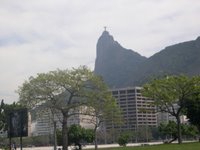
Later in the afternoon, we attempted once again to do the sunset-from-Sugar Loaf thing. My cousin Paula had alerted me that there was a promotion that day. Those who could prove they were born in Rio (and hence bear the moniker carioca) would be admitted for half price provided they present a kilo of donated food. I was provided with a bag of rice and brought my Brazilian passport with me. Being a walking irony—a carioca who doesn't speak Portuguese—I needed Jordan to do the talking for me, but I got my half-price ticket. I soon had feelings of regret however—the same feelings I have when I board a roller coaster and the train reaches the top of its first hill. Once the cable car got moving, I was petrified. Those things really swing and sway. Can they really be safe? They are, of course, but I've seen too many movies where Clint Eastwood or somebody has a fight on the roof while a crowd of terrified tourists look on. When we got to end of the ride and I got off, I was immensely grateful for safe passage. The view was magnificent, though we were just a few minutes late for actual sunset. Then, to my dismay, I learned that we were only halfway there. This was only an intermediate stop, not the actual Sugar Loaf. So back on for another white-knuckle ride. My courage was amply rewarded, as the view of Rio at night from there is unparalleled.


Sunday, 13 A
ugust
The four of us had decided to attend the celebration of the Eucharist at the IEAB (Episcopal Anglican Church of Brazil) cathedral (St Paul the Apostle) for the Diocese of Rio, though we weren't certain whether it began at 10 or 11, so we just got in a cab when we could (taxis are as ubiquitous and easy to hail in Rio as they are in New York, though they are consistently smaller and the drivers uniformly aggressive in the performance of their primary duties). Jordan and Angela knew where St Paul's was located because it happened to be in the same neighborhood (Santa Teresa) where they had spent their first night in Rio, at a sort of B&B owned by the friend of a friend. Santa Teresa is an atypical area of town—very old, hilly, with narrow and curvy cobblestone streets, and relatively quiet. There has been a significant amount of gentrification in recent years. We arrived at the church steps at about 10:15, but it turned out the service was at 11, so we explored the area, particularly a chic store that I'm sure depends on tourist trade.

St Paul's is about a 75 year-old English gothic building, originally constructed, so their website says, for British expatriates, but the congregation is now thoroughly Brazilian. Even by Brazilian standards, however (which are more relaxed about the fact that buildings age and start to decay, but this does not negate their usefulness), there are some unaddressed deferred maintenance issues, I would say. There were only about 25 people in attendance, including a handful of children. The music was led energetically by two men—one playing a mediocre electronic organ and both singing loudly. The liturgy included "Seek Ye First" and "Faith of Our Fathers" (it was Brazilian Father's Day), with texts rendered into metrical Portuguese, a couple of Taizé pieces (including the familiar Ubi Caritas), and couple of "Christian contemporary" songs that I suspect are indigenously Brazilian. The Brazilian BCP is clearly modeled on the American 1979 version, though, for some reason, we started in Rite I (which is, of course, not distinguishable by linguistic style, since there is no equivalent of Elizabethan pronouns and verb inflections, but by the presence of the Summary of the Law and the verbiage of the General Confession) and switched to Rite II (their equivalent of Prayer D) somewhere along the way. Their rubrics permit the Apostles' Creed as an alternative to the Nicene at the Eucharist, an option which the celebrant exercised. The presider-preacher gave an extemporized sermon of some goodly length, my Portuguese being good enough only to certify that it made some reference to "bread" and "life" (the gospel was from John 6). Jordan said later that some Father's Day themes were also woven in as well.

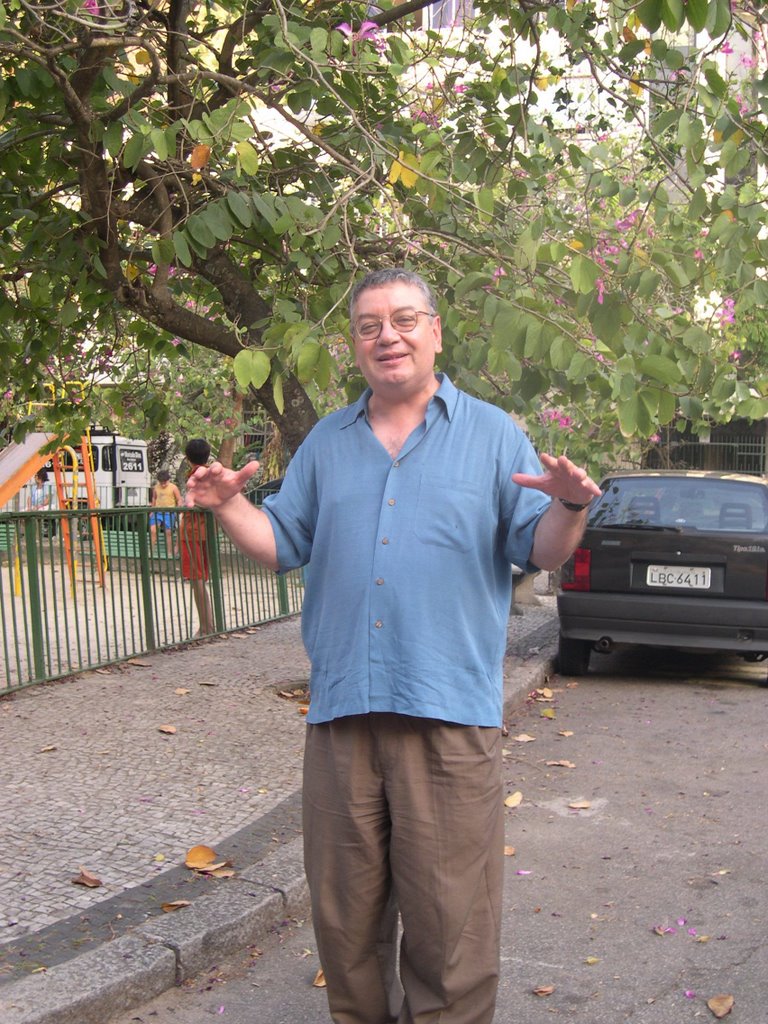
There was a planned lasagna (delivered) lunch back at the apartment, along with Evandro and Irene's two daughters, Claudia (whom I remember being "introduced to" in absentia by my parents by the diminutive Claudihna) and Paula, along with Paula's adopted five-year old daughter Isabela. Paula works as a translator and Claudia works in the foreign exchange student field, so their English is quite conversant. Then all of us went, in the two cars owned by Paula and Claudia, since their parents do not own one, to the neighborhood of Urca, which is not far from Botafogo and near the base of the Sugar Loaf cable car, but, because of certain topographical idiosyncrasies, is off the beaten path of traffic and therefore enjoys a secluded feel. This is where Irene is from (after spending her first ten years in Manaus), and where she and Evandro lived before moving to their current building in Copacabana fifty years ago. They showed us the apartment building where my parents and I moved in with them for a time (they say several months, my mother says three weeks!) prior to our move to Chicago in 1953. Here I had a quite uncanny experience. I’ve always carried around a sort of “pre-memory,” just a vignette of a scene, and the way the air felt—a quiet afternoon in a quiet urban neighborhood, cobblestone streets opening out into a sort of plaza, somewhat sultry but not overpoweringly so, with a familiar feminine presence. I’ve never known whether I was making it up, or if it really was a memory. But when I got to Urca, particularly to the plaza (now a children's playground) in front of the apartment building, I knew instantly that it was the location of the vignette. It felt like I had been there before, because I had!
Later, with Evandro and Irene, we looked at the DVD my brother-in-law Larry made for Dad's funeral (January 2005). They had seen it before, but this time we were able to put names to faces for them in a lot of the pictures, and they did the same for us in a couple of the older shots.


Monday, 14 August
This was a travel day to Salvador. The kids had an earlier flight, so we took separate cabs. When Irene put Brenda and me in a cab on the street in front of her building, she was careful to tell the driver that we do not speak Portuguese, so he was appropriately mute all the way to the airport. Our TAM flight was delayed an hour because the aircraft itself was late getting into Rio from whatever other runs it had on its itinerary for the morning. I therefore learned what atrasado means when it appears on a departure information screen. While we waited, I must have displayed some discernible interest in a souvenir map in one of the shops, because the proprietor did not hesitate to demonstrate what may have been the extent of her command of English: "Big discount!" On the two hour flight to Bahía, I was seated next to a Petrobras employee traveling on business. He was eager to practice his English on me. It was a good bit better than my Portuguese at the time, but maybe not so much better than my Portuguese at the end of the whole trip a week later.

Once again, Jordan and Angela were waiting. My cousin Leda had been kind enough to send her car and driver. (A limo it was not—a rather modest Brazilian incarnation of VW. Most of the cars in Brazil are from manufacturers that Americans would be familiar with, including Ford and Chevy, but the models are drawn from a completely different palette. The overwhelming majority—99 %, probably—would be considered "compact" or smaller by American standards. Both the cars Brenda and I drive, which are of quite unremarkable size, would be behemoths in Brazil.)

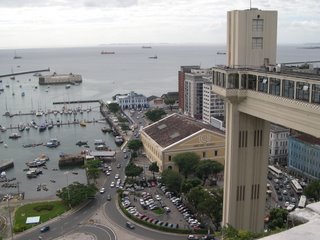
Salvador has grown and changed remarkably in the 36 years since I last visited. Jordan provided an ongoing social narrative as we took a modern four-lane controlled-access highway from the airport into the heart of the city. It is a place of deep contrasts—wealth and poverty, beauty and squalor, pride and neglect, creativity and slavery to habit, imagination and stultifying bureaucracy. About 45 minutes later, we were deposited in front of their apartment building in the Rio Vermehlo neighborhood. More ambiguities: Full security and a rather attractive covered outdoor pavilion as an entry way, the apartment itself with wood and ceramic floors, somewhat spacious, but the view out the window is of the backs of other buildings, and no one seems to care how terrible their own building looks in the eyes of others; it actually seems quite "third world" from that perspective. Anyway, this is our first chance to check email, and we do so.

Then we change clothes, repack in a downsized fashion, and catch a cab to the dock area in the old city. Our plan is to spend the night on Ihla Itaparica, about a 45 minute ferry ride into the Bahía de Todos os Santos from downtown Salvador. Jordan has a place in mind for us to stay, but we have no reservation. All turns out well. After asking a couple of questions in the dockside town of Mar Grande, we find our way to a pousada (Bed & Breakfast is the best dynamic equivalence translation I can think of). It's an old mango plantation. We're the only guests (double whammy of off-season and weekday). The owner is an easy-going middle-aged guy, sort of an aging hippie. He shows us the available rooms (which effectively amounted to all the rooms!) and we elect a pair for $R99 each (about $45USD). "Quaint," "exotic," and "picturesque" don't even begin to describe the place. Again, by American standards, one might have called it "seedy," but not if one factors in the general Brazilian tolerance for edificial entropy. As it turns out, the owner is also the chef (as one might imagine—and his lone employee wore many different hats, including bartender), and has had one of his creations featured in a prominent travel magazine. In time, we repair to the "restaurant and bar" section of the facilities (once again, completely out of doors, under only a thatched canopy). It is a languorous experience, as the entire meal is prepared from scratch by one person. Our drinks—variations on the caiparihna theme—feature sections of citrus (lime and tangerine) in the bottoms of our glasses. As I recall, the tab was $R148, around $65USD for dinner for four, including drinks and dessert. We are enjoying the contrast in the strength of the dollar between Europe and Brazil.

The night is marred a bit by mosquitoes. The rooms were equipped with mosquito nets, but Brenda never could get ours deployed to her satisfaction, and I got claustrophobic when inside it. If we had only discovered that there was a working ceiling fan before the light of day...


Tuesday, 15 August
We spent the whole day on the island, first just lazing around the pousada, then doing some shopping (Brenda and I both neglected to pack bathing suits) and then indulging in a bayside lunch, wherein Brenda and I were introduced to moqueca, which I might describe as the element in Brazilian cuisine that corresponds to ettoufé in Louisiana cooking, in that, after a couple of essential elements (coconut milk in the case of moqueca), there is an almost infinite number of variations. We had two kinds—one with fresh local fish, and one with shrimp. Then Jordan negotiated flat rate taxi transit to the ruins of the Igreja Vera Cruz, reputed to be the second oldest church building in Brazil, constructed in 1552 (55 years before the first permanent English settlement in Virginia), in an isolated location almost clear across the island from Mar Grande. It has long since been abandoned—I would suspect for a couple of hundred years or more—and the structure is now literally being held up by a giant tree that has grown in and around the walls. Without the tree, I think the whole building would be just a heap of rubble. Interestingly, while the church is derelict, the adjacent graveyard is not. Somebody is maintaining it. There are fresh graves, and a new concrete fence is going up. But it wasn't just the destination that was interesting; it was the getting there too. For most of the way, the road was in unbelievably poor condition, with deep potholes every few feet. In the dark, it would be impossible to even drive on safely. Our kidneys got a good workout. The journey also gave us a look at rural Brazilian poverty, as distinguished from the urban variety that was more visible for most of our trip. Yet, in a way, it may be "easier" to be poor in rural Brazil than in, say, the rural south in the U.S. The lack of governmental interference by way of building codes and zoning laws makes possible a certain ingenuity that is stifled in a more regulated environment. People adapt and cope in creative ways.

As it got dark, we boarded a ferry back to Salvador, where Brenda and I checked into our hotel, just a few blocks (and significantly downhill) from Jordan and Angela's apartment. It was gorgeous, a comfortable blend of Brazilian authenticity (not a carpet to be seen, indoor/outdoor spaces) and some of the amenities that American and European tourists are accustomed to (like hot water on demand in the bathroom, and air conditioning). We then walked (on crumbling sidewalks, some with cars parked on them so that we had to step out practically into busy traffic lanes to get around them) to a very chic pizza restaurant, with an incredible dessert menu, the ambience and décor of which would have been appropriate in most any American or European city of significant size.


Wednesday, 16 August
A day of touring in Salvador, including Jordan's school, where we met his academic advisor, and the Pelourihno district, the most historic area of colonial Brazil, including the magnificent cathedral church (wherein I observed that the Roman Catholic leadership has finally responded to the challenge of evangelical Protestants and para-Christian groups that made huge inroads over the last couple of decades, by staging their own national evangelization effort), and the hilly-narrow-cobblestone-street shopping area that depends completely on tourism. Brenda did her bit for the local economy, becoming fast, if temporary, friends with two proprietors in the process. We were just seconds too late to watch the sun set over the bay as we refreshed ourselves with caiparihnas.


Thursday, 17 August
After another lovely Brazilian breakfast, the four of us were met by Helcio, my cousin Nicia's husband, who chauffeured us to Praia do Forte, about a 90-minute drive to the north, where my other cousin Leda owns a beach condo, which she graciously invited us to enjoy for the night. So we spent the afternoon walking along and lounging on a drop-dead beautiful Atlantic beach. In the evening, we discovered there was a Mexican restaurant in town. Jordan explained that Mexican food in Brazil is a dicey proposition, the chief reason being that there are no actual Mexicans to make it happen, so it's Mexican food with a heavy Brazilian accent. But we were all hungry for it, so we took a chance. It wasn't bad, and the spices hit the spot, but it was way over-priced. Afterward we found the most unique sorveteria (ice cream shop) I have ever seen—it's a "scoop your own" affair, sold by weight. I like the concept. Even more do I like chocolate com pimento, chocolate ice cream laced with hot pepper! I don't expect Cold Stone to adopt it as a mix-in any time soon. But they should.
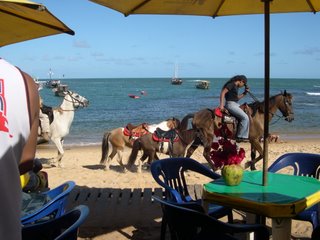
I chose to sleep for the whole night in a hammock on the veranda of our upstairs bedroom. It was idyllic. Under a brilliant starlit sky (without the constellations we're familiar with in the northern hemisphere, of course), with the surf crashing in the background, it was transcendent—probably the spiritual highlight of my trip, and I mean that seriously.


Friday, 18 August
I happened to wake up in the hammock as the eastern sky was beginning to lighten, but the sun had not risen yet. I got up and walked the few yards down to the beach in order to watch the sun rise over the ocean. In a few minutes, one of the clouds on the horizon began to glow. A minute or two later, I had to avert my eyes, and shortly thereafter the entire sun was visible. For someone who has lived so much of his life near the Pacific Ocean, where the sun sets, this was indeed an exotic experience.

We needed to hit the road at a reasonable hour in view of a 1 PM family luncheon engagement in Salvador. This meant catching a scheduled bus. When we got to the appointed location, we found all manner of vehicles and drivers clamoring for our business. Jordan negotiated what we thought was strictly private nonstop transport directly to their apartment for $R80. For four people, and given the distance and the convenience of to-the-door delivery, this seemed reasonable enough. We got taken, however, as the van stopped several times at clearly marked bus stops (with the cobrador sliding open the door as the van slowed down and announcing, “Salvador! Salvador!”) to take on and put off passengers. No sweat, we figured. We would just pay an appropriate amount lower than the negotiated price. In time (more time than we expected) we were delivered to the apartment building in Rio Vermehlo, as agreed. Jordan slipped the cobrador $R50 and moved quickly inside the security fence. The fellow was more tenacious than any of us expected, however, and in the end, after a lengthy and animated dialogue, only reluctantly conceded a $R5 discount.

Lunch was at the apartment of Mabel, widow of my uncle Evarado. Serendipitously, her daughter Babette, who lives in Michigan, was there on holiday. Babette's brother Eduardo ("Duda"), who lives in town, also showed up, along with his 15-year old daughter Juliana. As the saying goes, "a good time was had by all."

Later in the afternoon, the four of us made our way to the lower portion of the old city, to the Museum of Modern Art, where there was a special exhibition of a photographer named Verger, who specialized in Bahian scenes. Once again, drinks on the bayfront just as the sun had set. (Sunset was "early" by our reckoning, about 6:00 PM, due both to the low latitude and the fact that it's actually late winter in the southern hemisphere.)
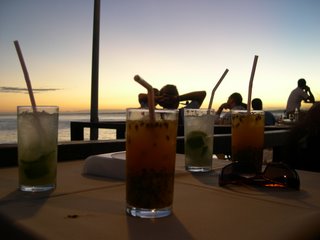
Another cab ride took us to the home of Nicia and Helcio, where we were joined by their two sons, Helcihno (the equivalent of "Helcio, Jr.") and Daniel. (Helcio, by all accounts, hit if off extremely well with Dad, so he jokes that since, in Portuguese, "Helcio" and "Elson" are not only alliterative but almost rhyme, it is appropriate that they both have a son named Daniel!) We are joined shortly by Leda and her husband Jose Antonio. Another cousin, Nicia and Leda's brother Roberto, who lives quite a distance into the interior of Bahia, but happened to be in town, was also there. By means of a webcam and an internet connection, we also visited with Daniel and Helcihno's sister Luciana, who lives in Brasilia and is more than eight months pregnant. (Luciana is one of the primary movers in keeping the American-Brazilian family connection alive.) Then we did the quintessentially American thing and ordered out for pizza! (Interestingly, Brazilians are prone to put ketchup on their pizza, and they eat it with a knife and fork. Hmmm.) Nicia provided a scrumptious homemade dessert, along with some ice cream.


Saturday, 19 August
I knew Brenda had an appointment in the morning for a deep massage from a Japanese-Brazilian woman (second or third generation, she speaks no Japanese) who is also Angela's yoga instructor. The four of us walk to the vicinity of her studio, then Jordan and I head back to the apartment, where I figure we're just going to kill some time. After a while, however, Jordan says "Let's go," and I follow him down the hill (completely turned around, as usual—my normally reliable internal GPS simply did not function in Salvador), where we board a bus that heads up the coastal road. It turns out that plan is for me to have a massage as well, but nobody bothered to clue me in! Oh well, that's the kind of surprise I can handle. The massage-givers are all set up under umbrellas along one of the beaches. So, for about twelve or thirteen dollars, I enjoy a full hour of massage, like nothing I have ever been treated to in my life—and at beachside, no less! I think if I lived in Bahia I would have one every Saturday. By Brenda's account, hers was even more magnificent.
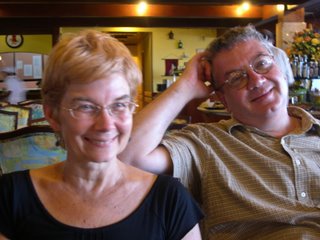
Although by this point in our trip, we had all eaten enough for the rest of the month, one of the items on our to-do list was to eat at a churrascaria, a place that serves a distinctively Brazilian kind of grilled meat. We grabbed a cab and headed up the coastal side of the peninsula, past where I had gotten my massage, to a place that had been recommended to us. It was stunning. For a flat rate of about $22USD per person, plus drinks and dessert, we were treated to an astonishing array of buffet items and meats brought to our table by waiters bearing long skewers. The food was outstanding and the service was unbelievably attentive. (Since labor is so cheap, most service-based businesses are significantly overstaffed by American standards, but this inures to the customer's benefit.) The cab driver who took us there told us he would wait (off the meter, of course), and he did. So we had him drive us down to a supermarket to pick up some Brazilian coffee and some cachaça to bring home. Once again, the driver waited, even while we indulged in some more sorvete—yes, chocolate con pimento again; I couldn’t get enough.

The same driver then drove us a good distance (was this a pretty good day for him?), across the width of the peninsula, first to our hotel so we could unload our purchases, then back to the lower part of the old city (separated from the upper part by a landmark pedestrian elevator that has become an unofficial icon for Salvador) to a flea market called Mercado Modelo. There I hung on the sidelines (until it was time to hit the ATM for cash) while Jordan, on his mother’s behalf, negotiated the purchase of three hammocks for us to bring home and…I’m not sure…do something with…future Christmas gifts, perhaps? Anyway…I picked up a T-shirt for myself in the process, and proudly put my growing prowess in Portuguese on display to order a bottle of water, first specifying that it be carbonated (con gás) and seeking reassurance that it was well-chilled (ben gelado). I didn’t bother to haggle over the price.

Later that evening, even though there was little physical motivation to eat just for the sake of eating, we walked with Jordan and Angela to a plaza next to our hotel for some acarajé—the distinctive Bahian street food, a fritter made from bean meal deep fried in palm oil, laced with some sort of hot sauce and, in our case, small shrimps that one eats whole, shells and all (OK, the heads and tails were removed, but still…). I survived. I even enjoyed it.


Sunday, 20 August
Although being absent from the Lord's Table on the Lord' Day rips crosswise against every fiber of my being, and although I had greatly looked forward to making some contact in the Diocese of Recife, given the tortured state of things there, scrupulosity on this day would have caused great offense, so I had to swallow the horse pill for a reason I pray is, as the Orthodox would say, "worthy of a blessing." Leda and Nicia and their families had extended themselves to rent a covered boat for an all-day excursion into the bay, with stops at two islands. What a beautiful time it was; how utterly different from anything in my normal experience. Paolo, my aunt Eva's son, also joined us with his wife Fernande (a Spaniard who doesn't speak Spanish, it turns out, even as I am a Brazilian who doesn't speak Portuguese), along with a couple of friends of Nicia. However, somehow Brenda and I never got the memo that we were supposed to wear bathing suits under our clothes so we could just jump off and swim to shore when the boat anchored at a beach. So when we got to the first island, they had to first tie up at a dock in order to separate those who were andando from those who were nadando. It was easy enough for me to take my shirt and sandals off and swim in my shorts. But Leda couldn't stand watching Brenda just stand on the beach, so she insisted on walking Brenda up to the conveniently located beachside boutique and helping her pick out a bathing suit, which I happily sprang for. When it came time for us to move on, we were all swimmers, no walkers. The next stop was a little resort on the north end of Ihla Itaparica, where there was a wonderful buffet lunch available. (This time, however, we were ferried to the beach by a shuttle craft.) Then Helcio walked us up the beach to show us the house that had been in his family for years, and was only recently sold. After some more beachside lounging, and one head dip in the balmy water that gave me the fungal and bacterial ear infections I brought home with me, our two crew members hurried us back into the boat in order to get us back to Salvador before dark. We watched the sun sink beneath the horizon from the stern. A delightful day.


Monday, 21 August
Our flight was not until mid-afternoon, so I had time for one more trip to the beach, which was walking distance from the hotel. It was the sort of body-surfable wave action that I remember from my family's two weeks at Praia Itapuá in 1970.

After arranging for a slightly late check-out, the four of us had lunch at a local "kilo" place. Jordan then arranged for a cabbie who had once been one of his English students to drive us to the airport. He was eager to try out what little English he knows, and it didn't seem to bother him that I didn't speak any more Portuguese than he spoke English. We managed to keep the conversation going all the way to our destination, including a small sight-seeing side trip in Itapuá, which he decided we had plenty of time for after I deduced that he was asking me what time our actual departure was. Interesting fellow.

As usual, it seems, our departure was delayed by the absence of an aircraft. But everyone is really hang loose about it, and when the plane finally arrives, they're very quickly ready to board, and instead of making a huge production with groups and rows they just say, in effect, "OK, time to go," and everybody just gets on the plane, and they go. And when you get on, if you want a beer, they bring you a beer, no extra charge. So what do they know that we don't? Not to mention the fact that clearing security is not nearly as traumatic as it is here.

The American Airlines terminal in Rio was not as much of a circus as it was at LAX, but it was bad enough. By the time we had our boarding passes, we knew we would need to eat, but figured there would be something inside the secure zone. We figured wrong, and had to content ourselves with some nuts and chocolate from a duty-free shop. Soon after we were airborne for Miami, Brenda was sick. It may have been the nuts or it may have been a bug she picked up in the bay, but our travel experience headed south even as we were heading north.


Tuesday, 22 August
By the time we pulled in front of our house, it was about 29 hours since the time we kissed Jordan and Angela goodbye in front of their apartment building. Brenda was still feeling horrible.

So what was it like for me being back in the "homeland"? This is a question that elicits a complex answer. At one level, it felt very integrating. My life is so episodic, and the episodes are defined by places. I always appreciate the opportunity to re-connect with the venue of one of my previous episodes (south Louisiana, southeastern Wisconsin, northwestern Oregon, southern California, the Chicago area). The Brazil “episode” is, for obvious reasons, more difficult to re-connect with, so I was glad to be able to do so.

And simply on the level of tourism and vacation, it was a great trip. Rio and Salvador are both fascinating places if one is at all interested in history, geography, the arts, culture, or just the way people live. I got a whole new insight on the phenomenon of favelas, which one usually associates only with abject poverty, but which have a richer and more subtle aspect to them. And winter in Bahia (Salvador is just as often referred to by the name of the state in which it is located) is as close to meteorological perfection as one can imagine outside the Garden of Eden (ranging from the low 80s during the day to around 70 at night, and almost always breezy).

But on another level, particularly as the trip included seeing family, I had strong feelings of embarrassment bordering on shame. The catalyst for these feelings was my inability to speak Portuguese. I felt like a walking irony. Since Jordan and Angela were with us all the time (Jordan is frighteningly fluent, almost accent-free and using slang after ten months in the country and Angela is not far behind), and because many of my relatives speak some English, a few fluently, we were never at a loss for being able to communicate. But I was always “the Brazilian who doesn’t speak Portuguese.” In fact, my birthday happens to be the Brazilian equivalent of the 4th of July, which compounds the irony! It is clear that my relatives there have kept my father’s American progeny more on their radar screens than we (or I, at least) have tended to keep them. And with me, especially, having been born there, they seem to have an investment in my laying claim to my Brazilian-ness. I don’t know if that will, or even can, happen, at my advanced age, and I have some feelings of regret. I surely do wish my father had attempted to keep Portuguese alive at home during my early years, when I really could have learned it. But beyond a handful of words and a couple of phrases, we were a mono-lingual household.