Tuesday, December 19, 2006
An Honor Never Sought
The blog Stand Firm is hosting the 2007 (first annual?) Anglican Blog Awards. My humble and unworthy offering has been nominated--by whom I know not--in the category of Best New Blog. I would never have dreamed or desired such a nomination, but now that it's out there, I fear being reminded that this blog is even more humble and unworthy than I thought. (You see, I don't have a hit counter mainly because I can't figure out where to put the code, but not having one also spares my ego.) I'm getting creamed out there, folks. At the moment I've got all of two votes and I think I know where they both come from! So, while I don't expect to win, or even not come in last--Anglican TV, the runaway favorite, having all the hi-tech wizardry I know nothing about--I do invite those who may be so inclined to help me hold my head a little higher.


Prognosticating
Anyone who has participated on an internet message board has learned that cyberspace is a harshly unforgiving environment. Whatever we write is just out there, and probably stored on an incalculable number of hard drives, ready to be retrieved by ever more clever search engines. Such indelibility leads to a certain circumspection about what one says in the first place. I try to bear that in mind.
The Anglican corner of cyberspace is once again buzzing today, with the announced departure of several parishes from the Diocese of Virginia, representing nearly one-fifth of its total average Sunday attendance. That's a chunk. And it is not an abstraction for me. I served on a General Convention committee with Bishop Peter Lee and had fairly extensive exchanges with (now Bishop) Martyn Minns, who monitored the work of Committee 26 very closely. I have great respect and affection for both men, and it pains me to see them at odds with one another now.
With these "facts on the ground," and with San Joaquin's action earlier this month of releasing the safety and cocking the gun, though not yet pulling the trigger, still hanging out there, attention turns now to the meeting of all 38 Anglican Primates in Dar es Salaam in about two months' time. Speculation is rampant about whether they will allow Presiding Bishop Jefferts Schori to even be seated, and whether the Global South Primates (23 of the 38) will prevail in their insistence that Bishop Robert Duncan of Pittsburgh be seated, effectively in her stead. Such speculation then extends to whether the Primates, or the 2008 Lambeth Conference, or anybody, will "kick the Episcopal Church out of the Anglican Communion."
For whatever it may be worth, I place the odds of a Schori-Duncan switch at about 50/50. (How's that for going out on a limb?!) I'm not predicting this, but it will not surprise me if some deal is brokered that puts both of them in the room on some basis. Just what basis I can't say. But it will be messy and ambiguous. We are, after all, still Anglicans.
And precisely because we are all still Anglicans, I have a firmer sense about whether the Episcopal Church will get "kicked out" of the Anglican Communion. It will not happen--not just like that, at any rate. Not by the Primates, not by the Archbishop of Canterbury, and still less by the Anglican Consultative Council, which I believe is operating on borrowed time, and will soon cease to exist or morph into something quite different under the coming Anglican Covenant. Rather, the conditions will be created under which TEC will pull the plug on itself. Lambeth will approve a draft Covenant and send it to the Provinces. The question on the floor in Anaheim in 2009 will be, "Do we opt in?" It will be an up or down vote, and amending the Covenant will not be one of the options. There will probably be another Special Commission and Special Committee, with lots of witnesses and hearings. But when the vote by orders is tallied, the question will fail. The Anglican train will simply keep moving on to the next station, leaving the Episcopal Church behind.
The Anglican corner of cyberspace is once again buzzing today, with the announced departure of several parishes from the Diocese of Virginia, representing nearly one-fifth of its total average Sunday attendance. That's a chunk. And it is not an abstraction for me. I served on a General Convention committee with Bishop Peter Lee and had fairly extensive exchanges with (now Bishop) Martyn Minns, who monitored the work of Committee 26 very closely. I have great respect and affection for both men, and it pains me to see them at odds with one another now.
With these "facts on the ground," and with San Joaquin's action earlier this month of releasing the safety and cocking the gun, though not yet pulling the trigger, still hanging out there, attention turns now to the meeting of all 38 Anglican Primates in Dar es Salaam in about two months' time. Speculation is rampant about whether they will allow Presiding Bishop Jefferts Schori to even be seated, and whether the Global South Primates (23 of the 38) will prevail in their insistence that Bishop Robert Duncan of Pittsburgh be seated, effectively in her stead. Such speculation then extends to whether the Primates, or the 2008 Lambeth Conference, or anybody, will "kick the Episcopal Church out of the Anglican Communion."
For whatever it may be worth, I place the odds of a Schori-Duncan switch at about 50/50. (How's that for going out on a limb?!) I'm not predicting this, but it will not surprise me if some deal is brokered that puts both of them in the room on some basis. Just what basis I can't say. But it will be messy and ambiguous. We are, after all, still Anglicans.
And precisely because we are all still Anglicans, I have a firmer sense about whether the Episcopal Church will get "kicked out" of the Anglican Communion. It will not happen--not just like that, at any rate. Not by the Primates, not by the Archbishop of Canterbury, and still less by the Anglican Consultative Council, which I believe is operating on borrowed time, and will soon cease to exist or morph into something quite different under the coming Anglican Covenant. Rather, the conditions will be created under which TEC will pull the plug on itself. Lambeth will approve a draft Covenant and send it to the Provinces. The question on the floor in Anaheim in 2009 will be, "Do we opt in?" It will be an up or down vote, and amending the Covenant will not be one of the options. There will probably be another Special Commission and Special Committee, with lots of witnesses and hearings. But when the vote by orders is tallied, the question will fail. The Anglican train will simply keep moving on to the next station, leaving the Episcopal Church behind.
Monday, December 18, 2006
Lessons & Carols Afterglow
It was a lovely service, a full church, a great choir, fabulous music, with the measured unfolding of the drama ("The Mystery of Our Redemption, Part I: The Incarnation") in the words of Holy Scripture--from the narrative of the Fall in Genesis to the luminous prologue to John's gospel--taking us right to the place where we need to be in these last few days of Advent.
My amazing wife--who doubles the size of our parish choir every year for this event with extra singers from around the community through her sheer musical magnetism--also produces a gem that she is often not even given credit for in the program, and that's a series of notes on the carols that are being sung. I wish there were some literary award I could nominate her for, because, quite apart from the texts and music they describe, they are treasures in themselves. I share them herewith:
My amazing wife--who doubles the size of our parish choir every year for this event with extra singers from around the community through her sheer musical magnetism--also produces a gem that she is often not even given credit for in the program, and that's a series of notes on the carols that are being sung. I wish there were some literary award I could nominate her for, because, quite apart from the texts and music they describe, they are treasures in themselves. I share them herewith:
Adam Lay Ybounden: A famous and much-set text not only describes the key points of the ‘fall’ in the garden of Eden, but goes on to revel in that disaster as a catalyst for wondrous grace: “Blessed be the time that apple taken was!” Matthew Larkin’s setting for women’s voices evokes swirling and colliding spirit-winds in the cosmos – a primeval sense of redemption activated, even pre-existing the need.
What Sweeter Music: The apex of mystical poetry is surely represented in this Robert Herrick poem, with its winning images of the world awakening to welcome its king. And certainly nothing can compare with the hushed moment of sweet recognition at the center of this work: ‘We see him come, and know him ours’. Masterfully set by the great Anglican composer, John Rutter.
What Cheer?: The traditional English response is ‘Good Cheer!’ The occasion for ‘this good New Year’ is not a calendar one, but the complete joy and sense of all things being made new in Messiah’s birth, foretold in the Isaiah lesson. William Walton musical setting conjures up a village in celebration, with the cheery greeting and response echoing/reverberating among its reveling and delighted inhabitants.
God is with us: a Christmas Proclamation: John Tavener sets a dramatic musical table here with an interacting set of characters. Men begin with the title drone, evoking a sense of the presence of God underlying all of creation. The full choir plays the role of nomadic evangelists. As they wander, proclaiming their message, one can almost taste the dust of a middle eastern desert and sense whether they’ve arrived in the next town or are directly in front of us, by their dynamics. The solo evangelists give the star message, proclaiming the good news of the prophet Isaiah. These three components interact and weave together, with the choir picking up the drone, which rises to an excited pitch that almost drowns out – or at least joins – the evangelists. The final declaration, “Christ is Born!” is punctuated by a new character – the organ – as it speaks a visceral amen from the throne of God.
I Wonder as I Wander: John Rutter arranges this traditional Appalachian carol with his signature, characteristic sweet warmth. Not the only carol to span redemptive time, it connects the birth and foreshadowed death of Jesus, mixing images of the sweet birth of the newborn king with the poignancy of His future chosen sacrifice.
There is No Rose: Robert Young has been described as a “master at keeping 20th century music tasteful.” This lush setting of a traditional text, extolling Mary as the Rose that bears the fruit of the tree of Jesse, hearkens back with chant-like phrases and captures contemporary imaginations with its energy and complex harmonies. Each verse of text concludes with a trinity of Latin phrases.
Corpus Christi Carol: Lullaby carols typically use the sweet “lully, lullay” phrase to portray the effect of a mother cooing to her child. In this carol, that refrain becomes more and more anguished as Mary has a premonition of her Son’s death. The medieval text portrays God as a ‘falcon’, Mary as a ‘maid’, and Jesus as a mortally wounded knight. Her final vision is of a headstone with the inscription “
Lux Arumque: Eric Whitacre is an expert in galactic sounds of the human spirit. His glittering, impressionistic effects transform the concept of a well-defined gold ring ‘halo’ into something closer to light’s essence of liquid gold. The overall sound evokes the texture of angels’ wings.
In Time of Softest Snow: John Carter matches the sweet-storytelling of Mary Kay Beall with music that poetically and palpably punctuates the nativity story. Can you feel the ‘softest snow’ on your mittens? Perhaps you’re pushed aside as three kings hurry to the child? Arriving wise men take time to ponder; hearts almost stop at mention of the ‘pure and gentle Lamb’. And then - the striking awe of ‘the great I Am’! The Christmas scene is painted, and we’re drawn in to the action: nativity characters in their traditional places catch our observer eyes and you just might feel the invited singers kneeling in love…under the stage light of ‘the Star’.
Silent Night: What can we say? This is the first time, in our nine years of presenting this service that we’ve included a traditional, recognizable carol – a melody that everyone can hum! Mark Johnson’s captivating setting frames a stacked-up, expansive, universe-reaching middle verse with pure, holy night verses by the women (opening) and then the men (closing). Sheer ‘ah’…
While All Things Were in Quiet Silence: This carol hearkens back to where we began with our first carol. Hints of swirling spirit expand, taking on ever more form and presence in surrounding an unspeakable event – the leaping of The Word from the throne of God. Rorem’s compositional vehicle might be compared to a musical spaceship that, with ever transitioning harmonies, hints at touching down, but only settles at the holy end.
Sunday, December 17, 2006
A Shameles Plug
For any of you out there in blogland who happen find yourselves in central California this weekend, come on over to Stockton and experience the Ninth Annual Festival of Lessons & Carols at St John's Church. Your soul will thank you.
For those of you who are aficionados of the genre, we do it "Sewanee style"--that is, beginning very much in Advent (with the Palestrina Matins responsory "I Look from Afar") and then sliding in to full-out Christmas by the end (with "Once in Royal David's City").
The choir is serving up an incredibly rich fare, with nothing written before 1960!:
Adam Lay Ybounden (Matthew Larkin)
What Sweeter Music (John Rutter)
What Cheer! (William Walton)
God Is With Us (John Tavener)
I Wonder as I Wander (arr. Rutter)
There Is No Rose (Robert H. Young)
Corpus Christi Carol* (Trond Kverno)
Lux Aurumque (Eric Whitacre)
In Time of Softest Snow (John Carter)
Silent Night (arr. Mark David Johnson)
While All Things Were in Quiet Silence (Ned Rorem)
*my personal favorite--you must check it out!
It's at 6:00 PM. For directions see the St John's website.
Since I sleep with the choir director, I'm obligated to say that it's the best L&C west of the Continental Divide. But even if I weren't obligated, it would still be true!
For those of you who are aficionados of the genre, we do it "Sewanee style"--that is, beginning very much in Advent (with the Palestrina Matins responsory "I Look from Afar") and then sliding in to full-out Christmas by the end (with "Once in Royal David's City").
The choir is serving up an incredibly rich fare, with nothing written before 1960!:
Adam Lay Ybounden (Matthew Larkin)
What Sweeter Music (John Rutter)
What Cheer! (William Walton)
God Is With Us (John Tavener)
I Wonder as I Wander (arr. Rutter)
There Is No Rose (Robert H. Young)
Corpus Christi Carol* (Trond Kverno)
Lux Aurumque (Eric Whitacre)
In Time of Softest Snow (John Carter)
Silent Night (arr. Mark David Johnson)
While All Things Were in Quiet Silence (Ned Rorem)
*my personal favorite--you must check it out!
It's at 6:00 PM. For directions see the St John's website.
Since I sleep with the choir director, I'm obligated to say that it's the best L&C west of the Continental Divide. But even if I weren't obligated, it would still be true!
Friday, December 15, 2006
The Anglican News Day
This is not a news blog. I don't attempt to scoop anyone. And I try to avoid fomenting what seems to me much of the time to be a highly cannibalistic Anglican blogsphere. So, since I neither originate news nor, except incidentally, spread news, I depend on the worthiness of my reflections and comments. Or, from time to time, the worthiness of others' comments, i.e. those that are not generally accessible to the public.
I spoke on the phone today with a good friend of mine, a priest of another diocese, and he read me an eMail message to another, mutual, presbyteral friend, and I thought it so incisive and apposite with respect to the present Anglican angst, that I asked him to send it to me as well, for the express purpose of doing what I'm doing now--that is, sharing it.
But first, the news...in digest. Two items came out today that are of broad interest to Anglicans. The primate of Uganda, Henry Luke Orombi, issued a statement re-affirming an earlier declaration that his province is not in communion with the Episcopal Church, that they will take no more money from TEC or entities thereto related, save for those bishops, dioceses, parishes, and institutions that are related to the Anglican Communion Network, that they will send no students to Episcopal seminaries, except for TESM and Nashotah, and--here's the important part--he will join in a request to Canterbury that the Presiding Bishop of TEC not be seated at the Primates' Meeting set for February in Tanzania, and that a bishop representative of the Network be seated in her stead. This gives some further traction to the Kigali Statement issued by the Global South Primates last September.
We also heard today of a meeting between representatives of a large contingent of Church of England evangelicals and Archbishop Williams, wherein His Grace was presented with a list of what amount to demands that British evangelical Anglicans be freed from some of the political and bureaucratic procedures that they feel shackle them in their work and witness and deprive them of a level of power that would be commensurate with their numerical strength. Their demands were articulated in the form of a proposed "Covenant," upon which it is that my friend comments:
I'd grabbed the "covenant" off of the "Mainstream" website before I got your forward and was enthusiastic at the thought that something significant had begun. Maybe it has. Unfortunately, it is in a direction that I cannot go. I've come to realize that all the talk of restoration, reformation, and renewal contrasts deeply with my own conviction that what Anglicanism needs is renunciation, repentance, and return. I could almost say "romanization," but that would imply a dismissal of the Orthodox that I neither intend or believe. It would also suggest a contentment with the way our latin fellowship manages being the church, and that too would be incorrect. RCism is a mess. At least it is Church.Either of today's developments would have noticeably raised the heat under Dr Williams. Together, they cannot be contributing to his peace of mind. Neither do they contribute to my own! Anglicanism is in a high stakes poker game at the moment. Nobody knows exactly who's holding what cards, or who's got the best poker face. In the dead of the night, my blood runs cold with premonitions of the sort of escalating fragmentation that my friend describes. He is a conservative Anglo-Catholic; I dare say, more conservative than I am. So he's no Episcopal Church corporatist trying to get everyone to "stay at the table."
Like all of our protestant kin, we have inherited the tendency of perpetual division and fragmentation. Calls for renewal and reform always mean some form of overthrow of tradition and its divine authority. It always tends to exclusive fellowship centered in the local (formerly congregational). And it always spawns further fragmentation in the next generation. I grew up in what was then seen as an extreme offshoot of that tendency. Now it is rather mainstream, and the newer megachurches have taken over its former market.
Jesu, mercy. Mary, pray.
Monday, December 11, 2006
The Nativity Story
The youth group of St John's made an outing to the cineplex across the street from the church this afternoon to take in The Nativity Story, and they very kindly invited their Rector to accompany them, which I was all too happy to do. I enjoy movies, and I am, by professional commitment if nothing else, a fan of the nativity story, generically construed, so it was a no-brainer.
In my alter ego fantasy world, where I am a film maker (among several other things), I have long fantasized about doing a project of this sort. I don't think it's ever been done particularly well. There are a couple of what I consider worthy efforts that deal with the other end of Jesus' life on this planet--Scorcese's The Last Temptation of Christ and Mel Gibson's more recent The Passion of the Christ. But nothing of comparable edginess--nothing that I am aware of, at any rate--has been done with the beginning of the story.
I walked into the theater with modest expectations, and was therefore only slightly disappointed. It has been slammed by critics as being essentially a Sunday School Christmas pageant with a big budget and great costumes, and that assessment is not far from the mark. There were some bright spots: Framing the story as a flashback from the slaughter of the innocents of Bethlehem, and then weaving three distinct strands--the folks in Nazareth, Herod & Company in Jersusalem, and the Magi making their way in from Persia. The musical score, while not outstanding, showed some imagination by just hinting at several classic Christmas carols without ever indulging in a clear and complete statement of any of them. Depiction of village life in Nazareth--particularly life on the edge of economic viability and in constant fear of Roman tyranny--was nicely done. And, like I said, the costumes were great.
Broadly speaking, however, the film is...How shall I put this?...unchallenging. It may as well have been made by Hallmark. It's a harmonized redaction of the gospel material from Luke and Matthew, garnished with a sprinkling of John (from a most unlikely source--one of the Magi commenting on his gift being fit for a God who has been made flesh), then amplified with such creative details as the arranged betrothal of Mary to Joseph (Mary was not pleased) and the way in which her pregnancy was revealed to all concerned.
That said, I have two comments: First, The Nativity Story does no harm. It does not fail to achieve what it attempts, because it doesn't attempt much. If it is not high art, neither is it bad catechesis. I was glad to have our youth group there. Reinforcing the gospel infancy narratives--narratives that will shortly figure prominently in their liturgical experience--and doing so in a dramatic and compelling way, is not a bad thing. As a pastor, I was grateful for it.
But as a lover of the cinematic arts, I was left hungry. And I have finicky tastes. If I'd like to see something that transcends the level of greeting card piety, that doesn't mean I'm looking for something that is scandalous or iconoclastic. I'm not looking for a film that distorts or mocks how Christians have apprehended the biblical story of Jesus' birth just in order to shock, or just because it can be done. No, I am looking for something that is apparently elusive, because I'm not aware of it ever having been done. I'm looking for something that is sympathetic to--or at least respects--Christian piety, but is also imaginatively speculative both in presenting the details that the gospel evangelists do give us and in filling in what they leave blank. In other words, something edgy. I've got a few ideas, but I'll save them for when a producer contacts me!
In my alter ego fantasy world, where I am a film maker (among several other things), I have long fantasized about doing a project of this sort. I don't think it's ever been done particularly well. There are a couple of what I consider worthy efforts that deal with the other end of Jesus' life on this planet--Scorcese's The Last Temptation of Christ and Mel Gibson's more recent The Passion of the Christ. But nothing of comparable edginess--nothing that I am aware of, at any rate--has been done with the beginning of the story.
I walked into the theater with modest expectations, and was therefore only slightly disappointed. It has been slammed by critics as being essentially a Sunday School Christmas pageant with a big budget and great costumes, and that assessment is not far from the mark. There were some bright spots: Framing the story as a flashback from the slaughter of the innocents of Bethlehem, and then weaving three distinct strands--the folks in Nazareth, Herod & Company in Jersusalem, and the Magi making their way in from Persia. The musical score, while not outstanding, showed some imagination by just hinting at several classic Christmas carols without ever indulging in a clear and complete statement of any of them. Depiction of village life in Nazareth--particularly life on the edge of economic viability and in constant fear of Roman tyranny--was nicely done. And, like I said, the costumes were great.
Broadly speaking, however, the film is...How shall I put this?...unchallenging. It may as well have been made by Hallmark. It's a harmonized redaction of the gospel material from Luke and Matthew, garnished with a sprinkling of John (from a most unlikely source--one of the Magi commenting on his gift being fit for a God who has been made flesh), then amplified with such creative details as the arranged betrothal of Mary to Joseph (Mary was not pleased) and the way in which her pregnancy was revealed to all concerned.
That said, I have two comments: First, The Nativity Story does no harm. It does not fail to achieve what it attempts, because it doesn't attempt much. If it is not high art, neither is it bad catechesis. I was glad to have our youth group there. Reinforcing the gospel infancy narratives--narratives that will shortly figure prominently in their liturgical experience--and doing so in a dramatic and compelling way, is not a bad thing. As a pastor, I was grateful for it.
But as a lover of the cinematic arts, I was left hungry. And I have finicky tastes. If I'd like to see something that transcends the level of greeting card piety, that doesn't mean I'm looking for something that is scandalous or iconoclastic. I'm not looking for a film that distorts or mocks how Christians have apprehended the biblical story of Jesus' birth just in order to shock, or just because it can be done. No, I am looking for something that is apparently elusive, because I'm not aware of it ever having been done. I'm looking for something that is sympathetic to--or at least respects--Christian piety, but is also imaginatively speculative both in presenting the details that the gospel evangelists do give us and in filling in what they leave blank. In other words, something edgy. I've got a few ideas, but I'll save them for when a producer contacts me!
Saturday, December 09, 2006
Interpreting Scripture
For reasons that are not entirely clear to me, I remain a subscriber--and an occasional (formerly frequent) poster--to the House of Bishops/Deputies listserv. (Bishops and recent Deputies may participate; others may watch as "kibitzers.") Today one of the Deputies--someone whose positions could fairly be characterized as "liberal" on the divisive questions of the day--asked for help in understanding the "traditionalist" approach to the following question: "How do you decide which parts of scripture (Hebrew and Christian) to follow and which no longer need to be followed?"
So I took the bait. Originally I intended it to be a private response, but eventually thought my contribution worth sharing, so I posted it to HoB/D, and do so here as well. Subsequently, another member of the listserv told me my answer was "too academic to preach." Oh, well. I hadn't intended it to be a sermon. And it is a little academic, I suppose. But it's an important question, and worth struggling with.
You have posed a fair and legitimate question. However, as you might guess, I have trouble accepting its premise-i.e. that some parts of scripture "still" need to be followed and some parts "no longer" need to be followed, and the question is deciding which parts belong in which category.
The way I look at it is like this: There's a tension between reading scripture as "one book" and reading it as "many books." Since the advent of critical methodology, most in the historic mainstream denominations have emphasized the latter, and we have lots of fun picking things apart, ranging from the "four source" theory of the Pentateuch more than a century ago to the Jesus Seminar in our own time. I really haven't got a problem with this. I find that the insights of critical scholarship often inform my preaching in very positive ways.
Reading the Bible as "many books" leads to judgment questions such as you pose. But we need to maintain the tension. The Bible is also "one book." There is a meta-narrative that runs like a golden thread from Genesis to Revelation. Moreover, both the "Bible-as-one-book" and the unifying meta-narrative are the property of the Church, the community of disciples throughout space and time. The Church, in turn, is a community of mutual accountability. Yes, tradition is dynamic and variegated. But I would submit that there is a discernible core, a center of gravity, in which a consistent and fruitful hermeneutic can be grounded. Different chronological eras and different geographical areas and different sub-strata of piety and spirituality all act as an organic system of checks and balances through which, I would suggest, the Holy Spirit guides the Church into all truth, including the true interpretation of scripture.
Interpreting scripture, then, becomes a matter of "thinking with the Church."
So I took the bait. Originally I intended it to be a private response, but eventually thought my contribution worth sharing, so I posted it to HoB/D, and do so here as well. Subsequently, another member of the listserv told me my answer was "too academic to preach." Oh, well. I hadn't intended it to be a sermon. And it is a little academic, I suppose. But it's an important question, and worth struggling with.
You have posed a fair and legitimate question. However, as you might guess, I have trouble accepting its premise-i.e. that some parts of scripture "still" need to be followed and some parts "no longer" need to be followed, and the question is deciding which parts belong in which category.
The way I look at it is like this: There's a tension between reading scripture as "one book" and reading it as "many books." Since the advent of critical methodology, most in the historic mainstream denominations have emphasized the latter, and we have lots of fun picking things apart, ranging from the "four source" theory of the Pentateuch more than a century ago to the Jesus Seminar in our own time. I really haven't got a problem with this. I find that the insights of critical scholarship often inform my preaching in very positive ways.
Reading the Bible as "many books" leads to judgment questions such as you pose. But we need to maintain the tension. The Bible is also "one book." There is a meta-narrative that runs like a golden thread from Genesis to Revelation. Moreover, both the "Bible-as-one-book" and the unifying meta-narrative are the property of the Church, the community of disciples throughout space and time. The Church, in turn, is a community of mutual accountability. Yes, tradition is dynamic and variegated. But I would submit that there is a discernible core, a center of gravity, in which a consistent and fruitful hermeneutic can be grounded. Different chronological eras and different geographical areas and different sub-strata of piety and spirituality all act as an organic system of checks and balances through which, I would suggest, the Holy Spirit guides the Church into all truth, including the true interpretation of scripture.
Interpreting scripture, then, becomes a matter of "thinking with the Church."
Friday, December 08, 2006
The Mystery of Prayer
I just got an eMail from a friend two-thirds of the way across the country. My friend said, "I remembered you in prayer at Mass." He said it so matter-of-factly that one might be tempted to think he was speaking of something quite trivial, when he was actually telling me something of astonishing significance. He was accessing an untellably powerful mystery, and doing so, somehow, on my behalf.
Some years ago, on a visit to the parish church from which I was launched to seminary many years before that, one of the older saints of that community (every parish has them, I think--usually they're women) told me, almost as casually as my friend's eMail, "I pray for you every day." Every day! I was stunned. I still am, because I don't doubt that she's still doing it.
"Such knowledge is too wonderful for me." (Psalm 139:6) And it would be quite too much to bear, actually, except for the knowledge that it is so not "all about me," but, rather, all about web into which I have been knit (see the Prayer Book collect for All Saints) by the love and grace of God.
I don't pretend to be able to define--or even remotely comprehend--what any of this means. I'm a board member of a fledgling organization in my city that aims to galvanize resources to address some of the weak spots in the social fabric, and do so in the name of Jesus. My colleagues on the board, save one (who is my parishioner!), are all Evangelicals of one stripe or another. They believe in both the necessity and the power of prayer, and, probably not completely realizing what they're doing, they've put me in charge of the Prayer Committee. Now, these are good people, and I truly honor their faith and their dedication. But one of the things I've already begun to challenge them on is their limited notion of what prayer even is. In their universe, it could pretty much be defined as "verbalizing requests to God." Yesterday I suggested that just being together intentionally in God's presence, even if completely silent, with no words to articulate any requests, fully qualifies as prayer. Nobody said I was nuts (well, they were in my conference room, so at least they were polite!), and there were even some "Aha!" expressions.
I don't know whether my friend who prayed for me at Mass tonight asked for anything specific on my behalf. But it doesn't matter to me. What matters is that he prayed for me. And the fact that he did it in the context of corporate eucharistic worship gives it a whole added dimension. And I rather doubt (even hope) that the saintly woman from my home parish is keeping tabs on whether her particular requests on my behalf are being "answered" or not. It is sufficiently humbling, and life-giving, to know that she holds me in her heart when she comes intentionally into the presence of the Holy One, and that, in her doing so, we are both participating in the redemption of the universe.
Some years ago, on a visit to the parish church from which I was launched to seminary many years before that, one of the older saints of that community (every parish has them, I think--usually they're women) told me, almost as casually as my friend's eMail, "I pray for you every day." Every day! I was stunned. I still am, because I don't doubt that she's still doing it.
"Such knowledge is too wonderful for me." (Psalm 139:6) And it would be quite too much to bear, actually, except for the knowledge that it is so not "all about me," but, rather, all about web into which I have been knit (see the Prayer Book collect for All Saints) by the love and grace of God.
I don't pretend to be able to define--or even remotely comprehend--what any of this means. I'm a board member of a fledgling organization in my city that aims to galvanize resources to address some of the weak spots in the social fabric, and do so in the name of Jesus. My colleagues on the board, save one (who is my parishioner!), are all Evangelicals of one stripe or another. They believe in both the necessity and the power of prayer, and, probably not completely realizing what they're doing, they've put me in charge of the Prayer Committee. Now, these are good people, and I truly honor their faith and their dedication. But one of the things I've already begun to challenge them on is their limited notion of what prayer even is. In their universe, it could pretty much be defined as "verbalizing requests to God." Yesterday I suggested that just being together intentionally in God's presence, even if completely silent, with no words to articulate any requests, fully qualifies as prayer. Nobody said I was nuts (well, they were in my conference room, so at least they were polite!), and there were even some "Aha!" expressions.
I don't know whether my friend who prayed for me at Mass tonight asked for anything specific on my behalf. But it doesn't matter to me. What matters is that he prayed for me. And the fact that he did it in the context of corporate eucharistic worship gives it a whole added dimension. And I rather doubt (even hope) that the saintly woman from my home parish is keeping tabs on whether her particular requests on my behalf are being "answered" or not. It is sufficiently humbling, and life-giving, to know that she holds me in her heart when she comes intentionally into the presence of the Holy One, and that, in her doing so, we are both participating in the redemption of the universe.
Wednesday, December 06, 2006
Feeling Blue
After the momentous convention vote last Saturday, during a break, I was speaking with a lay delegate from another parish, someone who has served both the diocese and the Episcopal Church long and well. She asked, "How can something that's the right thing to do make me feel so bad?" I immediately identified with her sentiment. After the vote was taken, but before the results were announced, I used "personal privilege" to exhort the convention to refrain from any demonstrations when the tallies were made public. Contrary to the report of a popular conservative blogger, the convention indulged me on that one, and I was grateful.
On Monday, I was interviewed by a reporter free-lancing for the Church Times (London). After covering factual matters, he asked me the question that always makes me cringe when I hear a reporter put it to someone else, "How does all of this make you feel?" My immediate response was, "It makes me feel very sad." It still does. I am more acutely aware than ever that I have made myself complicit in something that could turn out to be a huge mistake.
I am also more acutely aware than ever of the pernicious influence in my diocese of what I call "digital thinking," whereby everything is framed into an either/or disjunction. I know this is the digital age, but when it comes to thought processes, the old analog model has a lot to commend it, I think. We are ill-served by rhetoric that casts every Episcopalian as either "Jesus-loving scripture-affirming orthodox" or a "scripture-distorting heresy-spewing apostate." There are countless degrees of gradation between those extremes. To presume to know where the definitive line should be drawn is...well...presumptuous.
(Of course, we are equally ill-served by rhetoric from the left that casts all Episcopalians as either "peace-loving justice-affirming followers of Matthew 25" or "misogynistic homophobic neo-Puritans.")
So I'm singing the blues today. I find it impossible to be a single-minded partisan on any corner of this conflict. There's a piece of me everywhere. I'm quite literally disintegrated.
On Monday, I was interviewed by a reporter free-lancing for the Church Times (London). After covering factual matters, he asked me the question that always makes me cringe when I hear a reporter put it to someone else, "How does all of this make you feel?" My immediate response was, "It makes me feel very sad." It still does. I am more acutely aware than ever that I have made myself complicit in something that could turn out to be a huge mistake.
I am also more acutely aware than ever of the pernicious influence in my diocese of what I call "digital thinking," whereby everything is framed into an either/or disjunction. I know this is the digital age, but when it comes to thought processes, the old analog model has a lot to commend it, I think. We are ill-served by rhetoric that casts every Episcopalian as either "Jesus-loving scripture-affirming orthodox" or a "scripture-distorting heresy-spewing apostate." There are countless degrees of gradation between those extremes. To presume to know where the definitive line should be drawn is...well...presumptuous.
(Of course, we are equally ill-served by rhetoric from the left that casts all Episcopalians as either "peace-loving justice-affirming followers of Matthew 25" or "misogynistic homophobic neo-Puritans.")
So I'm singing the blues today. I find it impossible to be a single-minded partisan on any corner of this conflict. There's a piece of me everywhere. I'm quite literally disintegrated.
Sunday, December 03, 2006
The Convention
Well, we did it. Here's the language of the new Article II of our diocesan constitution if it passes next year on a second reading:
I proposed an amendment that would have added the following material after "The Diocese of San Joaquin": ", in organic continuity with the ecclesial life of the Protestant Episcopal Church in the United States of America,". My intent was to enable us to lay claim to our heritage as Episcopalians, to not surrender that identity to the Church-of-General-Convention. I did not make my case persuasively enough. It was perceived, I think, as an attempt to weaken the main motion, a back door into being under the thumb once again of "the national church." Such is the level of ire and disgust against the enormities of General Convention, Executive Council, and '815,' that even acknowledging where we've come from was a non-starter. To my disappointment, my amendment was roundly defeated.
When it came time to debate the main motion, here is what I said:
I was not surprised that the amendment passed, but I was surprised by the margin. It carried by well more than three-quarters in the clergy order, and by
88% among the laity.
Also...for what it's worth...I was elected to the Standing Committee.
The Diocese of San Joaquin is constituted by the Faith, Order, and Practice of the One, Holy, Catholic, and Apostolic Church as received by the Anglican Communion. The Diocese shall be a constituent member of the Anglican Communion and in full communion with the See of Canterbury.
I proposed an amendment that would have added the following material after "The Diocese of San Joaquin": ", in organic continuity with the ecclesial life of the Protestant Episcopal Church in the United States of America,". My intent was to enable us to lay claim to our heritage as Episcopalians, to not surrender that identity to the Church-of-General-Convention. I did not make my case persuasively enough. It was perceived, I think, as an attempt to weaken the main motion, a back door into being under the thumb once again of "the national church." Such is the level of ire and disgust against the enormities of General Convention, Executive Council, and '815,' that even acknowledging where we've come from was a non-starter. To my disappointment, my amendment was roundly defeated.
When it came time to debate the main motion, here is what I said:
"Right Reverend sir, I rise to speak in support of the motion that is presently before the convention, but I do so reluctantly, and with a heavy heart. I believe we are doing the right thing at the wrong time. The Episcopal Church is a sinking ship. The senior officers have run it into an iceberg. They are in denial about the extent of the damage, but there are plenty of junior crew members who realize that she has taken on water to a point that most probably cannot be reversed. Yet, big ships sink slowly. The engines have quit, but the power is still on, and many of the passengers are dancing the night away in the ballroom, or are peacefully asleep in their cabins. If the crew members, who are awake and alert and know the danger, abandon ship now, what will become of those innocent passengers? They will perish. Now, we can blame the officers on the bridge, who elected not to sound an alarm. Or we could assess the situation with clear eyes and realize that we have some time before the fateful moment when the bow rises into the air and the entire hulk sinks into the depths. And we could use that time to allow the passengers to see what danger they’re in, despite what they hear from the bridge. These are the very passengers that I believe our Lord Jesus looks on with compassion, because he sees them as harassed and helpless, like sheep without a shepherd. It is this Christ-like vision that I wish we had been able to see our way to embracing.
Nonetheless, even though it’s the wrong time, it is the right thing. The ship is going to sink. Rescue operations do need to be underway. I am open to discovering that God is calling the Diocese of San Joaquin to be in the forefront of that rescue effort. There are some very concrete signs I will need to see before I would vote next year to pull the trigger on all this. No one should interpret support now as a guarantee of support later. But we’ll have plenty of time to talk about that in due course. Thank-you."
I was not surprised that the amendment passed, but I was surprised by the margin. It carried by well more than three-quarters in the clergy order, and by
88% among the laity.
Also...for what it's worth...I was elected to the Standing Committee.
Friday, December 01, 2006
Realpolitik
I love the lexical flexibility of the German language. Compound nouns can pop out of nowhere as the need arises. (My favorites are heilsgeschicte, weltanschaung and gesamtkunstwerk.) At this present moment in my life, however, realpolitik is the most relevant. For whatever reason, I associate this term with the foreign policy stance of the Nixon administration under the guidance of Henry Kissinger. It denotes a pragmatic approach to complex issues and relationships, driven by what can happen--what will work--more than by what should happen. It is non-ideological. Whoever said "politics is the art of the possible" was thinking along the same lines.
During the next couple of days, I'm going to be engaged in some heavy-duty church politics, as the Diocese of San Joaquin gathers for its 47th annual convention. (It's really the 95th, I should think, since San Joaquin was spun off from the Diocese of California in 1911, but it was a Missionary District until, if my math is correct, 1959. My own parish of St John's in Stockton, founded in 1850, ante-dates both the dioceses of San Joaquin and California.) I'm running for Standing Committee, and the budget is a highly contentious issue. But the elephant in the living room, of course, is the proposed amendment to our diocesan constitution that intentionally neglects to make any reference to our being a diocese in union with the General Convention of the Episcopal Church. That's why we're going to have our proverbial fifteen minutes of fame this Saturday as the eyes of the Anglican world will be focused on the humble Eden Hall of the humble Cathedral Church of St James in the very humble city of Fresno, California--about 125 miles down the often humble California Highway 99 from where I live in Stockton. (What's the largest city in the country that is not situated on an Interstate highway? Yup, that would be Fresno.)
Whatever happens in the big vote on Saturday morning, it will not be ideal. This is hard for me to accept, because I am by nature an idealist. (It comes with my INTJ wiring.) For every waking moment, my default mode is to be driven by ideology. But there is no ideal outcome to what's in front of us as a diocese. It's a matter of finding the least problematic solution. It's a matter of finding what will work--for us, for who we are, for this time and this place. Not what should work. Not what might work in some other diocese. Our task is to find a very pragmatic way through our particular circumstances. Our task--my task--is to practice realpolitik.
If I were to vote my ideals on Saturday, I would vote against the proposed constitutional amendment. This is the wrong time for us to be considering this question, and if given the chance, I will say as much on the convention floor. But I'm not in control of events, and the fact is, now is when the matter is before us. So...what to do?
The Episcopal Church, I am convinced, is a sinking ship. It has taken on more water than can plausibly be pumped out. It's a "sunk ship floating." My assessment, though, is that it's sinking at a rather leisurely pace, and that it's not an unsafe place to be for another three years or so, when the General Convention of 2009 fails to opt in to the Anglican Covenant. However, the prevailing consensus in the Diocese of San Joaquin seems to be that the bow is going to rise into the air and the entire hulk plunge to the bottom of the sea any time now, and we'd best be gettin' off while the gettin's good. I don't believe that to be the case, but this is not a hill I feel compelled to die on. We are going to do what we're going to do. And if this is what we're going to do, then I want us to do it well. And doing it well means putting up as united a front as we can, because we are going to have God-only-knows what hurled at us before we've even left the cathedral parking lot on Saturday afternoon.
Realpolitik dictates that I vote 'aye' on the motion to amend the constitution of the Diocese of San Joaquin.
During the next couple of days, I'm going to be engaged in some heavy-duty church politics, as the Diocese of San Joaquin gathers for its 47th annual convention. (It's really the 95th, I should think, since San Joaquin was spun off from the Diocese of California in 1911, but it was a Missionary District until, if my math is correct, 1959. My own parish of St John's in Stockton, founded in 1850, ante-dates both the dioceses of San Joaquin and California.) I'm running for Standing Committee, and the budget is a highly contentious issue. But the elephant in the living room, of course, is the proposed amendment to our diocesan constitution that intentionally neglects to make any reference to our being a diocese in union with the General Convention of the Episcopal Church. That's why we're going to have our proverbial fifteen minutes of fame this Saturday as the eyes of the Anglican world will be focused on the humble Eden Hall of the humble Cathedral Church of St James in the very humble city of Fresno, California--about 125 miles down the often humble California Highway 99 from where I live in Stockton. (What's the largest city in the country that is not situated on an Interstate highway? Yup, that would be Fresno.)
Whatever happens in the big vote on Saturday morning, it will not be ideal. This is hard for me to accept, because I am by nature an idealist. (It comes with my INTJ wiring.) For every waking moment, my default mode is to be driven by ideology. But there is no ideal outcome to what's in front of us as a diocese. It's a matter of finding the least problematic solution. It's a matter of finding what will work--for us, for who we are, for this time and this place. Not what should work. Not what might work in some other diocese. Our task is to find a very pragmatic way through our particular circumstances. Our task--my task--is to practice realpolitik.
If I were to vote my ideals on Saturday, I would vote against the proposed constitutional amendment. This is the wrong time for us to be considering this question, and if given the chance, I will say as much on the convention floor. But I'm not in control of events, and the fact is, now is when the matter is before us. So...what to do?
The Episcopal Church, I am convinced, is a sinking ship. It has taken on more water than can plausibly be pumped out. It's a "sunk ship floating." My assessment, though, is that it's sinking at a rather leisurely pace, and that it's not an unsafe place to be for another three years or so, when the General Convention of 2009 fails to opt in to the Anglican Covenant. However, the prevailing consensus in the Diocese of San Joaquin seems to be that the bow is going to rise into the air and the entire hulk plunge to the bottom of the sea any time now, and we'd best be gettin' off while the gettin's good. I don't believe that to be the case, but this is not a hill I feel compelled to die on. We are going to do what we're going to do. And if this is what we're going to do, then I want us to do it well. And doing it well means putting up as united a front as we can, because we are going to have God-only-knows what hurled at us before we've even left the cathedral parking lot on Saturday afternoon.
Realpolitik dictates that I vote 'aye' on the motion to amend the constitution of the Diocese of San Joaquin.
Tuesday, November 28, 2006
Outloud Thoughts
I feel like a character in the novel Perelandra, the second in C.S. Lewis' Space Trilogy. On that fictional planet, there is no firm ground. It all consists of floating islands, constantly rising and falling, making it difficult for one to keep one's footing.
When I was ordained a priest nearly seventeen years ago, I promised to (among other things) "take [my] share in the councils of the church." I didn't give it an inordinate amount of thought at the time. Of course I would go to conventions and councils and meetings and the like. It comes with the territory.
In time, I have more and more learned experientially what I would have known then theoretically, that participating in the councils of the church is more easily said than done. The work I did last summer at General Convention, serving on a hot-button committee that was constantly in the spotlight, was one of the most demanding and exhausting labors to which I have ever given myself. I have still not completely "processed" what went on there, and the meaning of my own share in it.
This coming weekend, the diocese in which I serve as part of the "college of presbyters"--an ancient expression that is worth recovering, with its image of wise "elders" standing alongside the bishop and together leading the people of God in discerning God's vision for His church--as I said, the Diocese of San Joaquin will be convening and considering what is arguably the most important question in our 95 year history; to wit: whether to take a large step in the direction of dissolving our formal relationship with the General Convention of the Episcopal Church. Some would contend that we are considering doing something that is quite outside our competence. We'll find out, I guess. In any case, we're not pulling the trigger this time around. That opportunity will come at next year's convention, at the second reading of the constitutional change that I expect we will pass on Saturday. So, for now, we're just taking the safety off and cocking the gun.
I have very mixed feelings about this. At one level it's terrifying and sobering beyond words. If we do this, we will be entering uncharted territory, and it's impossible to predict what the consequences will be, especially the unintended consequences. We will also be taking very real leave of some very real people who, while they may have done foolish things that irritate and annoy us no end, are also our friends--people with whom we have worked and prayed and laughed for years and years. This is sad. Sadder still is the fact that we will also be taking our leave of people who have not particularly irritated or annoyed us, and who have not necessarily done foolish things, but who, for various reasons, are not going to accompany us as we step out into the abyss. Anyone who is not brought up short by this fact isn't really thinking.
At the same time, the prospect of breaking free of the madness that has slowly but inexorably tightened its grip on the Episcopal Church for the past 35 years or so is bracing and irresistably attractive. As I have previously written in upstream posts, I believe a realignment of Anglicanism is taking place that will produce structures of interdependence and accountability across provincial lines such as we have not seen before, and which the General Convention will most likely opt not to be part of. So, this weekend, we will hasten the inevitable.
I have also made it clear that I see no necessity of doing what we're about to do at this time. I would have preferred to wait, and let events take a more natural and organic course, and in the end produce pretty much the same result, only with wider buy-in. I can still serve in the Episcopal Church with a clear conscience. Moreover, I am mortified by some of the rhetoric that has been used by many of my colleagues as they have argued for haste in this matter. I fear that we are using an axe for a job that requires a scalpel, casting a wide net when a rod and reel are called for. But even though it's the wrong time, it is the right thing. Strategically, we've passed the point of no return. To back off now would send precisely the wrong message, both to our friends and to our adversaries. God help us, and God save us.
When I was ordained a priest nearly seventeen years ago, I promised to (among other things) "take [my] share in the councils of the church." I didn't give it an inordinate amount of thought at the time. Of course I would go to conventions and councils and meetings and the like. It comes with the territory.
In time, I have more and more learned experientially what I would have known then theoretically, that participating in the councils of the church is more easily said than done. The work I did last summer at General Convention, serving on a hot-button committee that was constantly in the spotlight, was one of the most demanding and exhausting labors to which I have ever given myself. I have still not completely "processed" what went on there, and the meaning of my own share in it.
This coming weekend, the diocese in which I serve as part of the "college of presbyters"--an ancient expression that is worth recovering, with its image of wise "elders" standing alongside the bishop and together leading the people of God in discerning God's vision for His church--as I said, the Diocese of San Joaquin will be convening and considering what is arguably the most important question in our 95 year history; to wit: whether to take a large step in the direction of dissolving our formal relationship with the General Convention of the Episcopal Church. Some would contend that we are considering doing something that is quite outside our competence. We'll find out, I guess. In any case, we're not pulling the trigger this time around. That opportunity will come at next year's convention, at the second reading of the constitutional change that I expect we will pass on Saturday. So, for now, we're just taking the safety off and cocking the gun.
I have very mixed feelings about this. At one level it's terrifying and sobering beyond words. If we do this, we will be entering uncharted territory, and it's impossible to predict what the consequences will be, especially the unintended consequences. We will also be taking very real leave of some very real people who, while they may have done foolish things that irritate and annoy us no end, are also our friends--people with whom we have worked and prayed and laughed for years and years. This is sad. Sadder still is the fact that we will also be taking our leave of people who have not particularly irritated or annoyed us, and who have not necessarily done foolish things, but who, for various reasons, are not going to accompany us as we step out into the abyss. Anyone who is not brought up short by this fact isn't really thinking.
At the same time, the prospect of breaking free of the madness that has slowly but inexorably tightened its grip on the Episcopal Church for the past 35 years or so is bracing and irresistably attractive. As I have previously written in upstream posts, I believe a realignment of Anglicanism is taking place that will produce structures of interdependence and accountability across provincial lines such as we have not seen before, and which the General Convention will most likely opt not to be part of. So, this weekend, we will hasten the inevitable.
I have also made it clear that I see no necessity of doing what we're about to do at this time. I would have preferred to wait, and let events take a more natural and organic course, and in the end produce pretty much the same result, only with wider buy-in. I can still serve in the Episcopal Church with a clear conscience. Moreover, I am mortified by some of the rhetoric that has been used by many of my colleagues as they have argued for haste in this matter. I fear that we are using an axe for a job that requires a scalpel, casting a wide net when a rod and reel are called for. But even though it's the wrong time, it is the right thing. Strategically, we've passed the point of no return. To back off now would send precisely the wrong message, both to our friends and to our adversaries. God help us, and God save us.
Saturday, November 25, 2006
My Annual "Holidays" Rant

The whole "Christ and culture" question (kudos to H. Richard Niebuhr, whose 1951 book by that name still frames the discussion) is complex and, for me, infinitely fascinating. This is the time of year when I feel the tension between the "Christ of culture" and "Christ against culture" models most acutely. They grind like tectonic plates.
In days of yore (aka my childhood), "Christmastime" didn't even think about beginning until at least the day after Thanksgiving, and even then rather slowly and gradually, reaching and sustaining a peak in mid-December, and hanging on until the first work/school day of the New Year. As I recall, my family-of-origin put up our Christmas tree around the second or third week of the month, and left it up until New Year's Day, which was a convenient time for taking it down. And nobody seemed to mind the word "Christmas." The vanguard of the political correctness movement admonished us to add "and Happy Hunukkah" after "Merry Christmas" in any generalized public seasonal greetings, which is all well and good, but the fact is, growing up in what were then mid-to-outer ring western suburbs of Chicago, I didn't know more than a handful of Jews, and as I later learned, Hunnukkah is a second or third tier Jewish festival that doesn't carry anywhere near the weight for Jews as Christmas carries for Christians.
Of course, there was a good deal of grousing and complaining about the "commercialization" and "secularization" of Christmas (symbolized by a disdain for "Merry Xmas" signs--ignorant disdain, it turns out, as 'X' is the Greek letter "chi" which is the first letter of "Christ"and therefore an ancient and accepted abbreviation with no secularizing undertones). Santa Claus, despite the fact that his cult is derived from that of an actual Christian saint, was the hapless icon of this commercialization and secularization.
Fast forward to the new millenium, and what passed for commercialization and secularization in those days of yore now seems to be veritably the practice of Christian religion, and Santa Claus, precisely because of his association with Saint Nicholas, is an integral part of that "religious Christmas" we have lost to "holiday trees" and "holiday carols" and "holiday parties" and "holiday gifts." "Happy Holidays" used to mean "both Christmas and New Year's"--or so I understood it. Now it means...well, what does it mean, actually? It includes Hunnukkah, of course, and, apparently, Kwanzaa. What else? Festivus, perhaps?
Retailers know what they're celebrating, I'm quite sure, but I don't know that very many others do. Most, I think, are celebrating celebration. It's an excuse to party. That's OK. Just don't be wishing me "Happy Holidays." I may not take it well.
But wait...there's more.
As a liturgical Christian, I'm swimming upstream in two channels at once. In my world, not only is it "Christmas" rather than "the holidays," it isn't even Christmas until...well...Christmas, or the eve thereof, at any rate. And then it continues--with trees still up and fully decorated--until January 6th, several days past the time when the "world" has settled into January humdrum. So while I'm dutifully frowning at retailers for their "holiday" muzak that begins around Hallowe'en, I'm also a sworn member (by virtue of ordination) of the Advent Police. (And, hey, Advent doesn't even begin for another week!) If the Advent Police were the sheriff's department in Mayberry, part of me would be Barney Fife wanting to ban red and green sweaters from church all during Advent, and decline all invitations to Christmas parties until after the 25th. But the other part of me would be Andy Taylor, who, as we know, never let his deputy carry a loaded weapon. So I'm pretty harmless. I control what I can--i.e. what happens inside St John's on Sunday mornings, and in my own home, to a limited extent--and roll with the rest. Some Valium would help, but I don't presently have a supply.
Wednesday, November 22, 2006
Happy C.S. Lewis Day
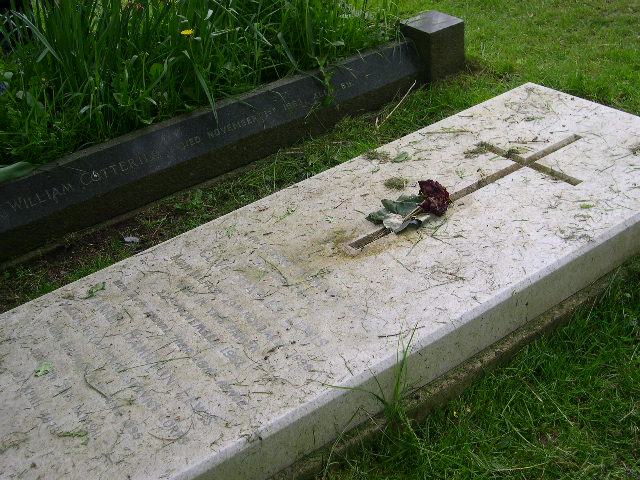
In the liturgical calendar of the Episcopal Church (of which--yes--I am still a member by virtue of being a presbyter of the Diocese of San Joaquin), today is the optional observance of the lesser feast of "Clive Staples Lewis, Apologist and Spiritual Writer (1963)." In Christian tradition, the obervance of a saint customarily takes place on the anniversary of that person's death, and this is the date in 1963 when Professor Lewis passed into the life to come at (what now seems to me) the tender age of 65. This photo is one I personally took of his gravestone (he and his brother are buried one on top of the other) in the churchyard at Holy Trinity, Headington Quarry Parish, Oxford.
Lewis is undoubtedly the Anglican who is best known in the non-Anglican world. (And possibly better respected by non-Anglicans than by his co-religionists.) Without a close second (though Martin Thornton is gaining ground), he is the single greatest human influence on my own theological and spiritual formation, and the energy behind the sort of pastoral care I so feebly attempt to deliver. So I'm exercising the "option" of keeping the feast today.
Blessed Clive, ora pro nobis.
Oh...yes...I'm still drowning.
Tuesday, November 21, 2006
I'm drowning...
...in command performances and diocesan drama--and command performances related to diocesan drama--at the moment, so I barely have time to wipe my nose, let along blog. Plus, most of what is consuming my attention I still don't want to air publicly. But, as our governator here in California says, "I'll be back!"
Monday, November 13, 2006
On Religious Epistemology
During my day off channel surfing, I ran across the film Happy Accidents (2000) on the Independent Film Channel. (Lest you think I just blew off two hours of my life with my posterior planted on a couch, think again: I did a full workout on my Bowflex Motivator, sorted mail, and prepared and ate my lunch while I took in the movie.) Yeah, it's a chick flick (can something billed as a "romantic comedy" be anything else?), but since it had a science fiction angle to it, and being amp ly secure in my sexual identity, I stayed with it.
The main characters are Sam (Vincent D'Onofrio, of whom I am a fan from his work on Law & Order: Criminal Intent) and Ruby (Marisa Tomei). They meet, there's an instant attraction, and things develop pretty much the way they always do in romantic comedies. Early on in the relationship, though, Sam announces to Ruby that he's actually a time traveller, visiting from the year 2470. Most of the plot development has to do with her vacillation in whether or not she should believe him. But since I am neither Siskel nor Ebert (a good thing, since one of them is dead, though I can ever remember which), I'm not going to go there. Given my larger interests, I want to take my cue from the incidental but significant role that religion plays in the script.
In one of her moments of exasperation with Sam, Ruby lifts her eyes in a direction that might be taken for "heavenward" and pleads sotto voce, "Help me! Help me!" But that can be accounted for as reflexive piety. The more interesting moment occurs when Ruby's therapist, trying to assist her in negotiating the relationship, casually inquires, "Is he at all religious?" The reply? "No, religion went out of fashion in 2033 when they discovered the gene that causes it." We'll see. There's a plausible chance I might still be alive in 2033. Fortunately, I'll be retired, so if religion goes out of favor, I won't suffer materially!
This may have been a throwaway line by the scriptwriter, but here's why I think it's telling: Ruby's not the only one wondering whether Sam is telling the truth about being a time traveller; the viewer shares that curiosity with her, but is probably a good bit less skeptical. This is the way it is with any science fiction story. It is much easier for us to suspend disbelief when we're watching events unfold in a world we don't actually live in. As viewers, we are conditioned to want what we "know" cannot be true to actually turn out to be true. We root for the weirdo as he does battle with the skeptics, even though we would be one of those skeptics if we encountered the same sort of weirdo. So, is Sam diagnosable? A charlatan? Or is he, in fact, a time traveller?
Now, speaking from within the universe of the story, if he's nuts, or an itentional liar, his comment about religion disappearing after 2033 is of no relevance. But if it turns out that Sam is telling the truth about time travel, then what he says about religion is automatically equally true. A "religion gene," huh? Maybe Richard Dawkins is on to something in his latest diatribe against belief in God. What if, in 2033, some research scientist indeed does isolate and identify a gene that predisposes one to believe in God? Would that drive a stake into the heart of the notion of revealed religion, and the whole concept of faith? (Actually, it sounds like a Calvinist dream-come-true, but that's a ball for somebody else to run with.)
This raises the theological/philosphical issue knowns as "the god of the gaps." A study of human history could easily lead one to theorize that we and our ancestors have employed God as a sort of algebraic 'x' factor. When there's a "gap" between what we observe (the volcano on our island erupts from time to time) and what we can explain (we have no idea why the volcano actually erupts), we plug a god or gods into that gap (time to sacrifice a virgin so the gods will make the volcano stop erupting). This technique worked splendidly as long as human experience was full of "gaps." But since the practical empiricism of Copernicus, Newton et al and the later philosophical empiricism of Locke, Hume et al, the number of "gaps" is shrinking, and such ones as remain are getting smaller by the day. I can remember being scandalized in the early 1970s when psychologist B.F. Skinner lectured on my college campus after having just published Beyond Freedom and Dignity, in which he contented that all human behavior can be accounted for as the effect of a huge sum of electro-chemical reactions in our brains and other tissues.
So, what if the last "gap" is finally closed...say, in 2033? Will the jig be up? Will all religion be exposed as an archaic hypothesis?
I have what I believe are plausible answers to these questions, but I'm in an interactive mood as I write. So I'm going to make that portion of the blogsphere that happens upon this corner of cyberspace weigh in first. I'll share my thoughts, but it will take a little prompting. Not much, but some. And I'm especially curious how others might respond to this problem.
 ly secure in my sexual identity, I stayed with it.
The main characters are Sam (Vincent D'Onofrio, of whom I am a fan from his work on Law & Order: Criminal Intent) and Ruby (Marisa Tomei). They meet, there's an instant attraction, and things develop pretty much the way they always do in romantic comedies. Early on in the relationship, though, Sam announces to Ruby that he's actually a time traveller, visiting from the year 2470. Most of the plot development has to do with her vacillation in whether or not she should believe him. But since I am neither Siskel nor Ebert (a good thing, since one of them is dead, though I can ever remember which), I'm not going to go there. Given my larger interests, I want to take my cue from the incidental but significant role that religion plays in the script.
In one of her moments of exasperation with Sam, Ruby lifts her eyes in a direction that might be taken for "heavenward" and pleads sotto voce, "Help me! Help me!" But that can be accounted for as reflexive piety. The more interesting moment occurs when Ruby's therapist, trying to assist her in negotiating the relationship, casually inquires, "Is he at all religious?" The reply? "No, religion went out of fashion in 2033 when they discovered the gene that causes it." We'll see. There's a plausible chance I might still be alive in 2033. Fortunately, I'll be retired, so if religion goes out of favor, I won't suffer materially!
This may have been a throwaway line by the scriptwriter, but here's why I think it's telling: Ruby's not the only one wondering whether Sam is telling the truth about being a time traveller; the viewer shares that curiosity with her, but is probably a good bit less skeptical. This is the way it is with any science fiction story. It is much easier for us to suspend disbelief when we're watching events unfold in a world we don't actually live in. As viewers, we are conditioned to want what we "know" cannot be true to actually turn out to be true. We root for the weirdo as he does battle with the skeptics, even though we would be one of those skeptics if we encountered the same sort of weirdo. So, is Sam diagnosable? A charlatan? Or is he, in fact, a time traveller?
Now, speaking from within the universe of the story, if he's nuts, or an itentional liar, his comment about religion disappearing after 2033 is of no relevance. But if it turns out that Sam is telling the truth about time travel, then what he says about religion is automatically equally true. A "religion gene," huh? Maybe Richard Dawkins is on to something in his latest diatribe against belief in God. What if, in 2033, some research scientist indeed does isolate and identify a gene that predisposes one to believe in God? Would that drive a stake into the heart of the notion of revealed religion, and the whole concept of faith? (Actually, it sounds like a Calvinist dream-come-true, but that's a ball for somebody else to run with.)
This raises the theological/philosphical issue knowns as "the god of the gaps." A study of human history could easily lead one to theorize that we and our ancestors have employed God as a sort of algebraic 'x' factor. When there's a "gap" between what we observe (the volcano on our island erupts from time to time) and what we can explain (we have no idea why the volcano actually erupts), we plug a god or gods into that gap (time to sacrifice a virgin so the gods will make the volcano stop erupting). This technique worked splendidly as long as human experience was full of "gaps." But since the practical empiricism of Copernicus, Newton et al and the later philosophical empiricism of Locke, Hume et al, the number of "gaps" is shrinking, and such ones as remain are getting smaller by the day. I can remember being scandalized in the early 1970s when psychologist B.F. Skinner lectured on my college campus after having just published Beyond Freedom and Dignity, in which he contented that all human behavior can be accounted for as the effect of a huge sum of electro-chemical reactions in our brains and other tissues.
So, what if the last "gap" is finally closed...say, in 2033? Will the jig be up? Will all religion be exposed as an archaic hypothesis?
I have what I believe are plausible answers to these questions, but I'm in an interactive mood as I write. So I'm going to make that portion of the blogsphere that happens upon this corner of cyberspace weigh in first. I'll share my thoughts, but it will take a little prompting. Not much, but some. And I'm especially curious how others might respond to this problem.
On the Due Observance of Sunday
I need to remind myself more frequently what a privilege it is to celebrate Sunday--the Lord's Day--as a parish priest. It's exhausting, particularly when there are add-ons, like a deanery pre-convention meeting in the afternoon. I'm worn out at the end of the day; my introversion is taxed to the max. All I really want to do in the evening is veg out in front of the television. There is invariably someone who says something that causes me to doubt myself, or the effectiveness of my ministry. And at the principal Mass, where nearly half the congregation is, for whatever reason, accustomed to walking in at any point after the Entrance Hymn and before the end of the sermon, I'm always anxious and depressed as that gradual process of pew infill takes place. Nowadays, of course, there is the tension emanating from how the larger Episcopal and Anglican world impacts our life together at St John's. My diocese (San Joaquin) faces a monumental decision in three weeks time--arguably the most important decision in our 95-year history. And we're in the holy season of Stewardshiptide, so there's a certain amount of anxiety over how the Anglican angst might affect our finances locally.
But, my God (and I mean that literally in this case), what a joy it is! What an unspeakable privilege. From Evening Prayer on Saturday night through the last coffee hour on Sunday in the early afternoon, I can't imagine anything else I'd rather be doing. I feel connected with who I am and what I'm called to be like at no other time. How did I get to be so lucky? We have evolved a liturgical ethos at St John's that consistently speaks to my soul and makes my heart sing. I know it does the same for others as well. Do I wish more were sharing in the fun? Absolutely! But I can't remember the last time we had a "dud" Sunday. Every week, my heart is overflowing with gratitude at the conclusion of the final liturgy. I feel surrounded by the beauty of holiness.

And it isn't just the beautiful surroundings of St John's. It's the beauty of the people. Yeah, we come in all shapes, sizes, colors, and personalities. But when they're stretching out their hands at the communion rail (into the courts of Heaven, as I am wont to teach them), they're all beautiful to me. I am privileged to have been let into their lives in varying degrees, and as I press the Body of Christ into their hands, it is a precious moment of insight into the mystery of how the brokenness of our lives, when made available to God in Christ, can become the very tools by which God reweaves the fabric of His fallen creation. In giving out the Bread of Heaven, I am watching redemption happen before my eyes. Can it get any better than that?
But, my God (and I mean that literally in this case), what a joy it is! What an unspeakable privilege. From Evening Prayer on Saturday night through the last coffee hour on Sunday in the early afternoon, I can't imagine anything else I'd rather be doing. I feel connected with who I am and what I'm called to be like at no other time. How did I get to be so lucky? We have evolved a liturgical ethos at St John's that consistently speaks to my soul and makes my heart sing. I know it does the same for others as well. Do I wish more were sharing in the fun? Absolutely! But I can't remember the last time we had a "dud" Sunday. Every week, my heart is overflowing with gratitude at the conclusion of the final liturgy. I feel surrounded by the beauty of holiness.

And it isn't just the beautiful surroundings of St John's. It's the beauty of the people. Yeah, we come in all shapes, sizes, colors, and personalities. But when they're stretching out their hands at the communion rail (into the courts of Heaven, as I am wont to teach them), they're all beautiful to me. I am privileged to have been let into their lives in varying degrees, and as I press the Body of Christ into their hands, it is a precious moment of insight into the mystery of how the brokenness of our lives, when made available to God in Christ, can become the very tools by which God reweaves the fabric of His fallen creation. In giving out the Bread of Heaven, I am watching redemption happen before my eyes. Can it get any better than that?
Thursday, November 09, 2006
I'm Feeling Special
Whatever.
Actually I'm feeling "different":
Actually I'm feeling "different":
- Most of the candidates I voted for in this week's election lost. Most of the ballot measures I voted for lost, and most of the ones I voted against won. No news here, though; it almost always comes out that way.
- A particular variety of nutrition bars I've gotten very attached to is no longer being stocked by the only store I know that carries the brand. "They weren't selling well enough," I was told. They're willing to special order them for me. But that's a pain.
- Every time I want to use CD-burning software for one of my apparently esoteric purposes, I wrestle with the assumption that whatever I'm working with must be a "song." I don't work with downloaded music to begin with, but even if I did, the sort of music that I listen to doesn't present itself as "songs."
- Along the same lines ... while the bazillion music channels I can get on my satellite TV dish are categorized into different sub-genres of Country, Rock, Hip-Hop, etc., my CD collection is broken down into Organ, Piano, Choral (the biggest section, with an entire sub-genre for Evensong), Concertos, other Orchestral, other Vocal (my scant collection of Opera is here), Christmas, and--the smallest category--Non-Classical (mostly Jazz).
- I'm left-handed.
- While my gastronomical repertoire has expanded considerably from what it was in my youth, I could probably still be considered a "picky eater." (No fruits, no cream sauces, no salads, very few vegetables.) When we accept a dinner invitation, my wife either has to have a discreet conversation with the host(ess) in advance, or worry that she hasn't.
- I'm foreign-born. Technically, I guess, that makes me an immigrant, even though I was born a U.S. citizen, since my mother is American.
- I'm a Cubs fan for life, though I haven't lived in the Chicago area since the early '70s. When I reveal this bit of personal information to my neighbors in the four other states I have lived in since then, I get lots of sympathetic smiles--verbal pats on the head--but very few know what it feels like. I fantasize about moving back to Chicago and just fitting in, wearing my Cubs hat without getting a second look.
Sunday, November 05, 2006
peaceandjustice
For nearly the last five years, I have been a fairly frequent poster on the House of Bishops/Deputies listserv (HoBD--sometimes pronounced "hobdee"). I suspect that my involvement there is pretty much behind me now; times have changed. But I continue on my quest for what some have termed the "alpha issue"--that is, the single criterion that can reliably sort those who are (at least) generally happy about the direction the Episcopal Church has been moving ("liberals") from those who are (at least) generally unhappy about it ("conservatives"). For instance, a little over a year ago, there was a long thread about the various sorts of disabilities people can be born with or later acquire, and whether they should be considered tragic, or unfortunate, or in any way signs of the presence of evil in the world. To my fascination, that question, which would not seem to be tied in any way to the controversey over sexuality, was a dead-on accurate reflection of the liberal-conservative divide. Liberals saw disabilities, whether congenital or the result of illness or accident, as God-given, and therefore considered it poor form to assume that a blind person would rather be sighted or a deaf person would rather hear. On the other hand, conservatives saw disabilities as signs of the Fall, conditions that can be presumed to be within the heart of God to heal.
All the attention recently being paid to the investiture of the 26th Presiding Bishop of the Episcopal Church, and the interviews she has given and the statements she has made, have reminded me of my quest for the alpha issue. I don't think I've found it yet, but I have another candidate, a clash of paradigms that enfleshes the chasm that first world Anglicans stare at each other across.
An autobiographical tidbit would be in order here. I am not a cradle Episcopalian. I was raised in an affirmatively Christian home, but it was of an evangelical Protestant variety. While I am hugely grateful for my early Christian formation, it did tend to inculcate a hyper-individualistic perception. We were concerned with how "I" get saved and you "you" can get saved, but there was very little "we" in the mix. Moreover, salvation had an exclusively other-wordly connotation. This present world was pretty much something to be endured on the way to Heaven. By the time I was in high school (mid-to-late 1960s), the evil of racism began to appear on our church radar screen, as did the moral imperative of benevolent engagement with the victims of urban poverty. For the most part, though, passion for social issues (whether liberal or conservative--remember, my evangelical days pre-date the "Christian right") is not in my genes. I have to work at it.
Consequently, my life as an Episcopalian--working on three-and-half decades--has alway been marked by constant chagrin over the public policy resolutions passed by General Convention. It's not only that I disagree with the vast majority of them on the basis of their actual content, which I do. It's that I am opposed to any public policy resolutions as a matter of principle.
There are two reasons they bother me. First, it seems to me that there are precious few concrete political issues about which Christians of good will and an informed conscience cannot legitimately disagree. For church conventions to pass resolutions about such issues creates winners and losers. It fosters resentment, embarrassment, and cynicism on the part of those whose consicentiously held and not inherently unchristian political views are officially trashed by the church they are attempting to joyfully serve.
Second, and more profoundly, such resolutions bespeak a fundamental attitude that I believe is flawed at the core, and this is where the new Presiding Bishop's public comments both make my blood run cold and clarify things for all of us. She speaks of trying to create "God's realm" and helping bring about "God's dream," and then proceeds to describe "God's realm" (formerly known as God's Kingdom) as a world where everybody has adequate food, clothing, education, and freedom from violence. One is tempted to add, "with liberty and justice for all." It's the old nineteenth century Social Gospel dusted off and propped up--you know, the gleaming vision that died a slow death in the trenches of World War I, the one where it's up to us to "usher in the kingdom," to "build Jerusalem" amid the "dark satanic mills" (per William Blake) of industrial and now post-industrial society.
This is, in my ever so humble opinion, a dangerous attitude, at least if one is purporting to speak for any branch or brand-name of Christianity. The scriptures make it clear that the vocation of the Church is to announce the kingdom ("Aslan is on the move") and to model the kingdom ("look at us for a sneak preview of coming attractions"), but that making the kingdom happen is God's work, subject to God's timing and God's methods. There are parables all over the gospels about how the kingdom of God is like something that just happens, with little or no human initiative or involvement.
In this dangerous way of thinking, there is little attention paid to the paschal mystery, the kerygma, because there's no need for it. This is why the classic notions of redemption and discipleship were so lacking from the Presiding Bishop's investiture sermon. The onus is on us, the Church, to "produce" the "realm of God," and to the extent that we fail to do so, our worship, teaching, evangelistic efforts, and the like, are of no avail. They are means to an end, and the end has not been produced.
Ultimately--and this may be my evangelical roots showing--the vision articulated by Bishop Katharine is not only misleading, but terminally boring. There is nothing in it that raises my pulse or makes me want to sing. A yawn is about all I can muster.
All the attention recently being paid to the investiture of the 26th Presiding Bishop of the Episcopal Church, and the interviews she has given and the statements she has made, have reminded me of my quest for the alpha issue. I don't think I've found it yet, but I have another candidate, a clash of paradigms that enfleshes the chasm that first world Anglicans stare at each other across.
An autobiographical tidbit would be in order here. I am not a cradle Episcopalian. I was raised in an affirmatively Christian home, but it was of an evangelical Protestant variety. While I am hugely grateful for my early Christian formation, it did tend to inculcate a hyper-individualistic perception. We were concerned with how "I" get saved and you "you" can get saved, but there was very little "we" in the mix. Moreover, salvation had an exclusively other-wordly connotation. This present world was pretty much something to be endured on the way to Heaven. By the time I was in high school (mid-to-late 1960s), the evil of racism began to appear on our church radar screen, as did the moral imperative of benevolent engagement with the victims of urban poverty. For the most part, though, passion for social issues (whether liberal or conservative--remember, my evangelical days pre-date the "Christian right") is not in my genes. I have to work at it.
Consequently, my life as an Episcopalian--working on three-and-half decades--has alway been marked by constant chagrin over the public policy resolutions passed by General Convention. It's not only that I disagree with the vast majority of them on the basis of their actual content, which I do. It's that I am opposed to any public policy resolutions as a matter of principle.
There are two reasons they bother me. First, it seems to me that there are precious few concrete political issues about which Christians of good will and an informed conscience cannot legitimately disagree. For church conventions to pass resolutions about such issues creates winners and losers. It fosters resentment, embarrassment, and cynicism on the part of those whose consicentiously held and not inherently unchristian political views are officially trashed by the church they are attempting to joyfully serve.
Second, and more profoundly, such resolutions bespeak a fundamental attitude that I believe is flawed at the core, and this is where the new Presiding Bishop's public comments both make my blood run cold and clarify things for all of us. She speaks of trying to create "God's realm" and helping bring about "God's dream," and then proceeds to describe "God's realm" (formerly known as God's Kingdom) as a world where everybody has adequate food, clothing, education, and freedom from violence. One is tempted to add, "with liberty and justice for all." It's the old nineteenth century Social Gospel dusted off and propped up--you know, the gleaming vision that died a slow death in the trenches of World War I, the one where it's up to us to "usher in the kingdom," to "build Jerusalem" amid the "dark satanic mills" (per William Blake) of industrial and now post-industrial society.
This is, in my ever so humble opinion, a dangerous attitude, at least if one is purporting to speak for any branch or brand-name of Christianity. The scriptures make it clear that the vocation of the Church is to announce the kingdom ("Aslan is on the move") and to model the kingdom ("look at us for a sneak preview of coming attractions"), but that making the kingdom happen is God's work, subject to God's timing and God's methods. There are parables all over the gospels about how the kingdom of God is like something that just happens, with little or no human initiative or involvement.
In this dangerous way of thinking, there is little attention paid to the paschal mystery, the kerygma, because there's no need for it. This is why the classic notions of redemption and discipleship were so lacking from the Presiding Bishop's investiture sermon. The onus is on us, the Church, to "produce" the "realm of God," and to the extent that we fail to do so, our worship, teaching, evangelistic efforts, and the like, are of no avail. They are means to an end, and the end has not been produced.
Ultimately--and this may be my evangelical roots showing--the vision articulated by Bishop Katharine is not only misleading, but terminally boring. There is nothing in it that raises my pulse or makes me want to sing. A yawn is about all I can muster.
Wednesday, November 01, 2006
Primatial Inadequacy
Today Katharine Jefferts Schori begins her nine year term as Presiding Bishop and Primate of the Episcopal Church. In the corner of the church that I inhabit, this is not greeted as a happy event. The discontent transcends the current presenting problem of how the church should incorporate the faith and the gifts of gay and lesbian Christians into its life. It's bigger than that. Some among my acquaintance go so far as to assert that she ought not to even be considered a Christian.
In the days following her election in June, I defended Bishop Katharine (as I understand she enjoys being addressed) with respect to her use of "mother Jesus" language in her General Convention sermon. (She was drawing from a well that lies clearly within the tradition of Anglican spirituality, though it was a pastoral and strategic faux pas on her part to use it then.) So I've tried hard to believe the best about her, to give her the benefit of the doubt. Yeah, she's a liberal who's all about the agenda of (so-called) "full inclusion." But "not a Christian"? Surely my friends are being a little intemperate.
Well, my friends have also been a little worked up about some comments she made to Time magazine later in the summer, in which, responding to a question about the putative exclusivist claims of Christianity, she said something like, "For those who follow the Christian tradition, we know Jesus to be our vehicle to the divine." But, presumably, God makes other arrangements for those who do not follow the Christian tradition. Troubling. But maybe the interviewer and the interviewer's editor didn't give her ample opportunity to explain and elucidate.
So I was excited when, yesterday, on the eve of assuming office, the Presiding Bishop's interview with public radio journalist Robin Young was made public in both audio and transcript versions. I tuned in to the audio, and then read the transcript. Lucky for me, Ms Young honed right in on the same question that the Time reporter had posed: Is Jesus the only way to God?
Now, for myself, I think I have somewhat generous views on the subject. I do not agree with those Christians who insist that any human being anywhere who lives and dies without ever having said something like "the sinner's prayer," or been validly baptized (depending on what brand of fundamentalism one embraces), is condemned to eternal separation from God and all that it means to be human. Without compromising the truth that all salvation is through Christ, I don't think I'm straying too far off the reservation in thinking that God is capable of saving someone "through Christ" who may not be aware that he or she is being saved "through Christ." It's relatively easy for me to be a Christian. I had the good fortune to be born into a culture that, while no longer overtly Christian, is at least thoroughly marinated in Christianity. Why should that accident of birth give me an advantage over someone born in Mongolia or Uzbekistan or Borneo or the Amazon basin? Perhaps, I thought, Bishop Katharine's views are not all that different from my own. So I was all ears.
Here's what she said:
Christians understand that Jesus is the route to God. Umm– that is not to say that Muslims, or Sikhs, or Jains, come to God in a radically different way. They come to God through human experience.. through human experience of the divine. Christians talk about that in terms of Jesus.
Uh, what? Kind of opaque. Kind of evasive. Definitely not clear. Maybe she wasn't far enough into her cup of coffee. Appaently, Robin Young thought the same thing, because she just asked the question again:
RY: So you're saying there are other ways to God.
KJS: Uhh... human communities have always searched for relationship that which is beyond them.. with the ultimate.. with the divine. For Christians, we say that our route to God is through Jesus. Uhh.. uh..that doesn't mean that a Hindu.. uh.. doesn't experience God except through Jesus. It-it-it says that Hindus and people of other faith traditions approach God through their.. own cultural contexts; they relate to God, they experience God in human relationships, as well as ones that transcend human relationships; and Christians would say those are our experiences of Jesus; of God through the experience of Jesus.
RY: It sounds like you're saying it's a parallel reality, but in another culture and language.
KJS: I think that's accurate.. I think that's accurate.
Well, there we have it. Parallel reality. That goes way beyond the sort of speculative generosity that I indulge in. It goes against, among other things, the very liturgy of the church over which Bishop Katharine now presides. Look at the fourth of the five Solemn Collects in the Liturgy of Good Friday (BCP, p.279). Here are the opening biddings:
Let us pray for all who have not received the Gospel of Christ;
For those who have never heard the word of salvation
For those who have lost their faith
For those hardened by sin or indifference
For the contemptuous and the scornful
For those who are enemies of the cross of Christ and
persecutors of his disciples
For those who in the name of Christ have persecuted others
That God will open their hearts to the truth, and lead them to
faith and obedience.
Merciful God, creator of all the peoples of the earth and lover of souls: Have compassion on all who do not know you as you are revealed in your Son Jesus Christ; let your Gospel be preached with grace and power to those who have not heard it; turn the hearts of those who resist it; and bring home to your fold those who have gone astray; that there may be one flock under one shepherd, Jesus Christ our Lord. Amen.
I can't imagine that there could be a more arresting contrast between the Presiding Bishop's response to Robin Young's softball questions and the clear teaching of the Episcopal Church as enshrined in the Book of Common Prayer. And I haven't even opened a Bible yet. Don't even need to. I am particularly troubled by the Bishop's assent to the interviewer's characterization of her position that other religions are "parallel" routes to God for those of "another culture and language." This is not only a theological train wreck (the Church being "catholic"--i.e. universal--and all), it's elitist and racist. What language or cultural vocabulary does one have to be fluent in in order to qualify to be a Christian?
I'm enough of a Catholic in my theology to affirm the baptismal identity of Katharine Jefferts Schori. So I don't go along with those who say she's not a Christian. But it's a distinction with nary a difference. She is manifestly not qualified to be a teacher of the Christian faith. She is not qualified to be the Primate of a Christian church. This is sad.
In the days following her election in June, I defended Bishop Katharine (as I understand she enjoys being addressed) with respect to her use of "mother Jesus" language in her General Convention sermon. (She was drawing from a well that lies clearly within the tradition of Anglican spirituality, though it was a pastoral and strategic faux pas on her part to use it then.) So I've tried hard to believe the best about her, to give her the benefit of the doubt. Yeah, she's a liberal who's all about the agenda of (so-called) "full inclusion." But "not a Christian"? Surely my friends are being a little intemperate.
Well, my friends have also been a little worked up about some comments she made to Time magazine later in the summer, in which, responding to a question about the putative exclusivist claims of Christianity, she said something like, "For those who follow the Christian tradition, we know Jesus to be our vehicle to the divine." But, presumably, God makes other arrangements for those who do not follow the Christian tradition. Troubling. But maybe the interviewer and the interviewer's editor didn't give her ample opportunity to explain and elucidate.
So I was excited when, yesterday, on the eve of assuming office, the Presiding Bishop's interview with public radio journalist Robin Young was made public in both audio and transcript versions. I tuned in to the audio, and then read the transcript. Lucky for me, Ms Young honed right in on the same question that the Time reporter had posed: Is Jesus the only way to God?
Now, for myself, I think I have somewhat generous views on the subject. I do not agree with those Christians who insist that any human being anywhere who lives and dies without ever having said something like "the sinner's prayer," or been validly baptized (depending on what brand of fundamentalism one embraces), is condemned to eternal separation from God and all that it means to be human. Without compromising the truth that all salvation is through Christ, I don't think I'm straying too far off the reservation in thinking that God is capable of saving someone "through Christ" who may not be aware that he or she is being saved "through Christ." It's relatively easy for me to be a Christian. I had the good fortune to be born into a culture that, while no longer overtly Christian, is at least thoroughly marinated in Christianity. Why should that accident of birth give me an advantage over someone born in Mongolia or Uzbekistan or Borneo or the Amazon basin? Perhaps, I thought, Bishop Katharine's views are not all that different from my own. So I was all ears.
Here's what she said:
Christians understand that Jesus is the route to God. Umm– that is not to say that Muslims, or Sikhs, or Jains, come to God in a radically different way. They come to God through human experience.. through human experience of the divine. Christians talk about that in terms of Jesus.
Uh, what? Kind of opaque. Kind of evasive. Definitely not clear. Maybe she wasn't far enough into her cup of coffee. Appaently, Robin Young thought the same thing, because she just asked the question again:
RY: So you're saying there are other ways to God.
KJS: Uhh... human communities have always searched for relationship that which is beyond them.. with the ultimate.. with the divine. For Christians, we say that our route to God is through Jesus. Uhh.. uh..that doesn't mean that a Hindu.. uh.. doesn't experience God except through Jesus. It-it-it says that Hindus and people of other faith traditions approach God through their.. own cultural contexts; they relate to God, they experience God in human relationships, as well as ones that transcend human relationships; and Christians would say those are our experiences of Jesus; of God through the experience of Jesus.
RY: It sounds like you're saying it's a parallel reality, but in another culture and language.
KJS: I think that's accurate.. I think that's accurate.
Well, there we have it. Parallel reality. That goes way beyond the sort of speculative generosity that I indulge in. It goes against, among other things, the very liturgy of the church over which Bishop Katharine now presides. Look at the fourth of the five Solemn Collects in the Liturgy of Good Friday (BCP, p.279). Here are the opening biddings:
Let us pray for all who have not received the Gospel of Christ;
For those who have never heard the word of salvation
For those who have lost their faith
For those hardened by sin or indifference
For the contemptuous and the scornful
For those who are enemies of the cross of Christ and
persecutors of his disciples
For those who in the name of Christ have persecuted others
That God will open their hearts to the truth, and lead them to
faith and obedience.
Merciful God, creator of all the peoples of the earth and lover of souls: Have compassion on all who do not know you as you are revealed in your Son Jesus Christ; let your Gospel be preached with grace and power to those who have not heard it; turn the hearts of those who resist it; and bring home to your fold those who have gone astray; that there may be one flock under one shepherd, Jesus Christ our Lord. Amen.
I can't imagine that there could be a more arresting contrast between the Presiding Bishop's response to Robin Young's softball questions and the clear teaching of the Episcopal Church as enshrined in the Book of Common Prayer. And I haven't even opened a Bible yet. Don't even need to. I am particularly troubled by the Bishop's assent to the interviewer's characterization of her position that other religions are "parallel" routes to God for those of "another culture and language." This is not only a theological train wreck (the Church being "catholic"--i.e. universal--and all), it's elitist and racist. What language or cultural vocabulary does one have to be fluent in in order to qualify to be a Christian?
I'm enough of a Catholic in my theology to affirm the baptismal identity of Katharine Jefferts Schori. So I don't go along with those who say she's not a Christian. But it's a distinction with nary a difference. She is manifestly not qualified to be a teacher of the Christian faith. She is not qualified to be the Primate of a Christian church. This is sad.
Subscribe to:
Posts (Atom)