We're at that point that is inevitably reached in every General Convention when there's an increasing sense of urgency in the air. Resolutions that pass in one House and then get amended in the other, have to first go back to committee, where the amended version must be concurred with, and then sent back to the House that initially approved it. Adjournment is a time certain event late Friday afternoon. Resolutions run the risk of getting lost in the cracks. This produces anxiety.
Committee 11 this morning put the final stamp on getting Prayer Book revision going, so the measure will soon show up in the House of Bishops. I do hope we might eventually consider the route taken by the Church of England, where the 1662 version remains the standard book, but it's mostly used only by cathedrals for choral evensong. Most parishes use a volume called Common Worship. I would be very pleased if we could allow the 1979 BCP be for us what the 1662 BCP is for the Church of England, and put the new rites in another collection.
To my dismay (I'm dismayed a lot these days), we also considered and moved along a resolution that calls for the formation of a task force to consider the question of Holy Communion for the unbaptized. The House of Bishops rejected this resoundingly only three years ago. I hope we do so again.
The afternoon legislative was brutally long and ... well, just brutal. Once again, an executive session consumed more tomato than it should have (IMO), dealing with the same issue that was before us yesterday. This time, I really do think we've got it sorted out.
Once again, we had to postpone, and then return to, the "make churches greener" resolution because of non-substantive snafus. But it was eventually approved. I vote No simply because I believe this is the sort of thing that can be handled locally, and what can be handled locally should be handled locally.
The bulk of our time and energy, however, was consumed by two marriage-related resolutions. A054 authorizes new liturgical rites that can be used for the celebration of any marriage that is legal in the United States. It includes what I consider to be adequate protections for bishops and dioceses that hold a traditional understanding of marriage. I can and will prohibit their use in the Diocese of Springfield, though I will be obligated, upon request, to facilitate their availability. Referral of such requests to an appropriate neighboring diocese will be considered a good-faith response. I can live with that.
Resolution A036 is another matter. It alters the canon governing marriage to make the language gender-neutral. My handful of allies and I felt this is where we needed to make our stand. We immediately moved a minority report that emerged from the Special Committee on Marriage as a substitute for the resolution. This report was simply a document affirming the traditional understanding of marriage, and was not an alternate canonical change. We had cleared it in advance with the parliamentarian, who deemed it in order. But one of the bishops fairly quickly challenged the Presiding Bishop's ruling that the substitute was in order, and called for a vote on the matter, which is allowed in Roberts Rules. A majority of the bishops voted to overturn the Presiding Bishop's ruling, so our substitute was taken out of play. The parliamentarian was, of course, correct, so this was simply the names exercise of raw power. The mood of this convention is "spike the ball."
Debate proceeded, and there were a couple of amendments and amendments to amendments moved, but none carried. My allies and I did successfully request a roll-call vote, however, which tends to annoy people. Nonetheless, we felt it important for us to be on the record for the benefit of worldwide consumption, particularly among our Global South friends, who are always under pressure to cast us aside in favor of an exclusive relationship with the ACNA. There was some 150 or so bishops still around (down quite a bit from Saturday's PB election). There were 26 No votes and five abstentions. We got our heads handed to us.
One could argue that there are some details still in play before it's possible to conclusively say, "Done deal." And the House of Deputies still has to act, though the conclusion there is more foregone than with the Bishops. Nonetheless, the Episcopal Church has, today, effectively redefined marriage--a universal and timeless human social institution that Christians have believed is, in fact, not merely a human social institution, but a gift from God that is literally prehistoric, participating in the order of creation. We have done so, moreover, without even a pretense of consultation with the other provinces of the Anglican Communion, to say nothing of the rest of the Christian world. It is an act of breathtaking hubris, an abuse of common sense truly worthy of the descriptor Orwellian.
Is it heresy? This is the question I will continue to ponder. I don't use that term loosely. It has a high bar. Mere false teaching (which this manifestly is) is not necessarily, or even often, heresy. Heresy must ultimately be traceable to the denial of one of the articles of the creeds. The creeds don't talk about marriage. The creeds do, however, talk about creation. They name God as the creator of heaven and earth. If marriage was indeed established by God in creation, we are denying the character of that creation when we trivialize the sheer given-ness of "make and female created He them." These are some preliminary thoughts, at least.
This requires a great deal of further thought, prayer, consultation, and discernment. One of my ecclesiological taproots is that one is obligated to remain in communion with a church that engages in false teaching as long as it continues to be a church. When such a church progresses from mere false teaching into formal heresy--not just de facto heresy, but heresy enshrined in its liturgies and canons--and then persists in that heresy over more than one generation--and I would suggest forty years as a benchmark for "more than one generation"--then it ceases to be a church, and a faithful Christian is obligated to not be in communion with it. We've certainly been winding the forty-year clock. Is it now ticking?
Tuesday, June 30, 2015


Monday, June 29, 2015
The Fourth Legislative Day
This being Sunday, the big event of the day was the celebration of the Eucharist, at which the Presiding Bishop presided and preached, and at which the United Thank Offering ingathering from each diocese was presented and announced. One of the occupational hazards of my trade is a tendency to want to critically evaluate the planning and execution of liturgy when I am not myself the one doing the planning and executing. This is not an altogether spiritually healthy habit, and I'm trying to condition myself to put boundaries around it. So, without going into any of the details, I'll simply say this: One would think that if there were ever a time when it is appropriate to be squeaky clean with regard to compliance with Prayer Book texts and rubrics, it would be at the principal liturgy of General Convention.
The Presiding Bishop's homily merits some commentary. As always, it was well-crafted, with insights from the scripture text (from Mark: the raising of Jairus' daughter and the healing of the woman with the chronic hemorrhage) imaginatively applied to the sitz im leben of her listeners. She's a better than average preacher. And in that context, I was dismayed by the level of political and ideological triumphalism that she expressed. She congratulated the Episcopal Church for the very behavior that has effectively sundered the Anglican Communion and contributed to massive losses of communicant numbers. I can understand that, if one considers the agenda that has been pushed consistently for the better part of four decades to be a gospel-driven justice issue, then these losses come under the rubric of fidelity and "counting the cost." Nonetheless, her rhetorical tone left me breathless.
The long afternoon legislative session began with an executive session to discuss the details of what we expect of one another as bishops in certain sensitive areas. I believe we got it sorted out. We opened the doors and then got into a fairly protracted debate on a resolution that calls for disinvestment by TEC and related entities from any companies related to the fossil fuel industry--this to make a statement about the need to reduce the world's aggregate "carbon footprint." An amendment to exempt the Church Pension Fund from this requirement eventually passed, and then, at long last, the entire resolution passed. (I voted No, as I'm very leery of disinvestment as a strategy.) There was a lesser amount of debate on a resolution to create task forces in each province that would help dioceses and parishes be "greener." This one got deferred to a later time to allow for certain "technical" issues to be worked out--namely, to bring the project under the umbrella of the DFMS.
The "big one" was next--the first report from the Special Committee on Marriage. They had two resolutions for us--one that tweaks and refines the rite for the blessing of same-sex relationships that convention approved for use in 2012, and another that would amend the marriage canon to make it gender-neutral, and to make "these canons" rather than "the laws of the Church" (which would include the constitution and the Prayer Book) the rule to which clergy are accountable when it comes to marriage. But before we could get very far down the pike, the committee chair and vice-chair and the Presiding Bishop and the technology gods seemed to all go off the rails in their ability to articulate exactly what it was we were doing. Then, as a sort of deus ex machina, the powers-that-be realized that we had a time certain to gather with our Deputy colleagues for provincial caucuses, at which our sole duty was to elect--and this will sound a little strange--members of the Joint Nominating Committee for the Election of a Presiding Bishop. Yes, the JNCPB has, by canon, a perpetual existence, "just in case." So we will take up sex and marriage again tomorrow.
The Presiding Bishop's homily merits some commentary. As always, it was well-crafted, with insights from the scripture text (from Mark: the raising of Jairus' daughter and the healing of the woman with the chronic hemorrhage) imaginatively applied to the sitz im leben of her listeners. She's a better than average preacher. And in that context, I was dismayed by the level of political and ideological triumphalism that she expressed. She congratulated the Episcopal Church for the very behavior that has effectively sundered the Anglican Communion and contributed to massive losses of communicant numbers. I can understand that, if one considers the agenda that has been pushed consistently for the better part of four decades to be a gospel-driven justice issue, then these losses come under the rubric of fidelity and "counting the cost." Nonetheless, her rhetorical tone left me breathless.
The long afternoon legislative session began with an executive session to discuss the details of what we expect of one another as bishops in certain sensitive areas. I believe we got it sorted out. We opened the doors and then got into a fairly protracted debate on a resolution that calls for disinvestment by TEC and related entities from any companies related to the fossil fuel industry--this to make a statement about the need to reduce the world's aggregate "carbon footprint." An amendment to exempt the Church Pension Fund from this requirement eventually passed, and then, at long last, the entire resolution passed. (I voted No, as I'm very leery of disinvestment as a strategy.) There was a lesser amount of debate on a resolution to create task forces in each province that would help dioceses and parishes be "greener." This one got deferred to a later time to allow for certain "technical" issues to be worked out--namely, to bring the project under the umbrella of the DFMS.
The "big one" was next--the first report from the Special Committee on Marriage. They had two resolutions for us--one that tweaks and refines the rite for the blessing of same-sex relationships that convention approved for use in 2012, and another that would amend the marriage canon to make it gender-neutral, and to make "these canons" rather than "the laws of the Church" (which would include the constitution and the Prayer Book) the rule to which clergy are accountable when it comes to marriage. But before we could get very far down the pike, the committee chair and vice-chair and the Presiding Bishop and the technology gods seemed to all go off the rails in their ability to articulate exactly what it was we were doing. Then, as a sort of deus ex machina, the powers-that-be realized that we had a time certain to gather with our Deputy colleagues for provincial caucuses, at which our sole duty was to elect--and this will sound a little strange--members of the Joint Nominating Committee for the Election of a Presiding Bishop. Yes, the JNCPB has, by canon, a perpetual existence, "just in case." So we will take up sex and marriage again tomorrow.
Sunday, June 28, 2015
The Third Legislative Day
Usual committee meeting from 7:30-9:00. That time slot this morning was devoted solely to hearings on three categories of resolution. The first was the one that originated within the committee itself: start the process of Prayer Book revision. There was a handful of strong, articulate advocates. No one testified in opposition, so I have no doubt that we will in due course report this resolution out to the House of Bishops. Proponents did not offer compelling arguments so much as forceful rhetoric. ("Let's bring our Prayer Book into our own century.") I've already been pretty clear on what I think about this, so I won't repeat myself.
Then there was the resolution about appointing a task force to study the question of offering Holy Communion to the unbaptized. Didn't we send this one packing in 2012, you might ask? Why, yes, we did. By a near-unanimous margin in the House of Bishops, I might add. Yet, the issue is like the Terminator--it keeps coming back. No arguments on either side of which everyone is not already familiar. It is, of course, ludicrous on its face, and betrays a culpable lack of understanding of what either the Eucharist or Baptism actually are. Jeepers.
And then there was a request for the SCLM, as it works on the next revision of the Book of Occasional Services, to include a rite for celebrating the taking of a new name, for any of a number of reasons, one of which is becoming transgendered. Several individuals who so identify were there to testify.
Because a friend of mine was presiding, and because the bishops were to be bussed straight from there to elect the next Presiding Bishop, I attended the daily Eucharist for the first time this convention. It was Rite 2, Eucharistic Prayer C ... more or less. There was some strange material at the Fraction, and the post-communion prayer was not from the Prayer Book. Sadly, the cantor apparently took it upon herself to emend the very language of Holy Scripture itself as she sang the verse for the Gospel Acclamation, substituting "my God" for "the Father." Twice. We continue our slide into liturgical antinomianism.
I was not surprised that we elected Michael Curry as our next Presiding Bishop. But I was surprised that it happened in one ballot, and by such a lopsided margin. Bishop Curry is a devoted disciple of Jesus (whose name he is not bashful about mentioning), a creedal believer, a compelling preacher, and charismatic leader. That will all be refreshing, and I look forward to working with him. I hope he is also a reconciler and healer, because the Episcopal Church is a bleeding church that is largely in denial about its own woundedness.
The afternoon legislative session consisted of mostly pretty minor items, most of which included on the consent calendar. But we did manage to get ourselves pretty gloriously bogged down in the resolution that we passed in Committee 11 yesterday dealing with providing Holy Communion for people in remote places for whom obtaining the services of priest is not very easy on a frequent or routine basis. After a whole bunch of parlaimentary maneuvering, we ended up passing it as presented--that is, the substitute for the original motion that we passed in committee yesterday.
Then there was the resolution about appointing a task force to study the question of offering Holy Communion to the unbaptized. Didn't we send this one packing in 2012, you might ask? Why, yes, we did. By a near-unanimous margin in the House of Bishops, I might add. Yet, the issue is like the Terminator--it keeps coming back. No arguments on either side of which everyone is not already familiar. It is, of course, ludicrous on its face, and betrays a culpable lack of understanding of what either the Eucharist or Baptism actually are. Jeepers.
And then there was a request for the SCLM, as it works on the next revision of the Book of Occasional Services, to include a rite for celebrating the taking of a new name, for any of a number of reasons, one of which is becoming transgendered. Several individuals who so identify were there to testify.
Because a friend of mine was presiding, and because the bishops were to be bussed straight from there to elect the next Presiding Bishop, I attended the daily Eucharist for the first time this convention. It was Rite 2, Eucharistic Prayer C ... more or less. There was some strange material at the Fraction, and the post-communion prayer was not from the Prayer Book. Sadly, the cantor apparently took it upon herself to emend the very language of Holy Scripture itself as she sang the verse for the Gospel Acclamation, substituting "my God" for "the Father." Twice. We continue our slide into liturgical antinomianism.
I was not surprised that we elected Michael Curry as our next Presiding Bishop. But I was surprised that it happened in one ballot, and by such a lopsided margin. Bishop Curry is a devoted disciple of Jesus (whose name he is not bashful about mentioning), a creedal believer, a compelling preacher, and charismatic leader. That will all be refreshing, and I look forward to working with him. I hope he is also a reconciler and healer, because the Episcopal Church is a bleeding church that is largely in denial about its own woundedness.
The afternoon legislative session consisted of mostly pretty minor items, most of which included on the consent calendar. But we did manage to get ourselves pretty gloriously bogged down in the resolution that we passed in Committee 11 yesterday dealing with providing Holy Communion for people in remote places for whom obtaining the services of priest is not very easy on a frequent or routine basis. After a whole bunch of parlaimentary maneuvering, we ended up passing it as presented--that is, the substitute for the original motion that we passed in committee yesterday.
Friday, June 26, 2015
The Second Legislative Day
Today consisted of early morning (7:30-9:00) and mid-afternoon (2:15-4:00) committee meetings, together with a joint session of the two Houses for purposes of having a "conversation" about church structure, plus a late afternoon (4:30-6:30) legislative session.
In Committee 11, we spent most of the morning session, and a large part of the afternoon one, dealing with A044, Maintain the Primacy of the Eucharist. The impetus behind this resolution comes from the reality that there are smaller and/or remote parishes that, for one reason or another, do not have access to a priest every Sunday. The fallback is to have a licensed Worship Leader officiate at Morning Prayer. The resolution as originally offered asked for permission for bishops to license laypersons to preside at a Liturgy of the Word followed by the administration of Holy Communion from the reserved sacrament.
While I am not unmoved by the plight of such congregations, I found this resolution highly problematic from the moment I laid eyes on it, beginning with its title. The 1979 Book of Common Prayer is unprecedentedly clear in affirming the celebration of the Holy Eucharist as "the principal act of Christian worship on the Lord's Day." Over the generation that the book has been in use, this aspiration has become a reality. Episcopalians did not used to feel deprived if they could not receive Holy Communion on a weekly basis. Now they do, and this has created the kind of problem that gives rise to A044.
The problem is, the reception of Holy Communion is not tantamount to the celebration of the Eucharist. It's only the tail end. It is the Eucharist, not Holy Communion, that is the principal act of Christian worship on the Lord's Day. So the resolution is misnamed, and a great deal of its language was just plain theologically incorrect. Plus, it could never accomplish what its proposers wanted, since the restriction on laypersons administering from the reserved sacrament in in the Prayer Book itself, and cannot be worked around except through Prayer Book revision.
I would have preferred to refer the whole matter to the House of Bishops Theology Committee for further study, but such a motion would not have carried. Instead, one of the Deputies proposed a substitute that was much shorter than the original, and eloquently expressed the pastoral need at the heart of the resolution, leaving the matter in the hands of diocesan bishops, where it actually belongs.
In other news ... the committee also, to my rather great horror, passed a resolution calling for a process that would lead to the next thorough revision of the Book of Common Prayer. I argued that we simply do not have the institutional bandwidth for such a project at this time, given the other conflicted issues we are dealing with (structure, decline, sexuality and marriage). But the motion carried. Proponents voiced the concern that the present Prayer Book is heavily laden with masculine pronouns for God, along with terms like "Father" and "Lord" that are in the present moment ideologically offensive. The resolution calls for the SCLM to develop a process that would be presented to the 2018 convention. We still have to hold a hearing on it, and then it has to make its way through both Houses. Perhaps it can yet be derailed. Yet, realistically speaking, the soonest we could see a draft of a new BCP would be 2021, but it would more likely be 2024 or later. Still, the prospect is chilling. The kind of Prayer Book TEC would write in this era would not be one I would want to use.
The joint session consisted of table discussions, with eight or nine people representing two different dioceses talking about a set of questions proposed by the Committee on Structure, beginning with the churchwide programs and structures, then taking it down to provincial and diocesan levels. We were asked to respond to what we would like to keep and what we would like to change at each of these levels. To share our responses, we were to post to the Twitter hashtag #gcgas (the latter part standing for "governance and structure," yet a possible alternate interpretation was not lost on people). As I was the only one in my group with a Twitter account, I was the scribe. (If you are on Twitter, you can, of course, see the 600+ responses by filtering for that hashtag.)
The HOB legislative session continued to work through the now growing number of resolutions that are being reported out by committees. Among these was the resolution Committee 11 passed yesterday regarding the liturgical calendar. I gave voice once again to my conviction that we are settling for half a loaf, and that we deserve a full-bodied sanctoral theology and calendar. But there was only a handful of other dissenting votes in addition to mine.
In Committee 11, we spent most of the morning session, and a large part of the afternoon one, dealing with A044, Maintain the Primacy of the Eucharist. The impetus behind this resolution comes from the reality that there are smaller and/or remote parishes that, for one reason or another, do not have access to a priest every Sunday. The fallback is to have a licensed Worship Leader officiate at Morning Prayer. The resolution as originally offered asked for permission for bishops to license laypersons to preside at a Liturgy of the Word followed by the administration of Holy Communion from the reserved sacrament.
While I am not unmoved by the plight of such congregations, I found this resolution highly problematic from the moment I laid eyes on it, beginning with its title. The 1979 Book of Common Prayer is unprecedentedly clear in affirming the celebration of the Holy Eucharist as "the principal act of Christian worship on the Lord's Day." Over the generation that the book has been in use, this aspiration has become a reality. Episcopalians did not used to feel deprived if they could not receive Holy Communion on a weekly basis. Now they do, and this has created the kind of problem that gives rise to A044.
The problem is, the reception of Holy Communion is not tantamount to the celebration of the Eucharist. It's only the tail end. It is the Eucharist, not Holy Communion, that is the principal act of Christian worship on the Lord's Day. So the resolution is misnamed, and a great deal of its language was just plain theologically incorrect. Plus, it could never accomplish what its proposers wanted, since the restriction on laypersons administering from the reserved sacrament in in the Prayer Book itself, and cannot be worked around except through Prayer Book revision.
I would have preferred to refer the whole matter to the House of Bishops Theology Committee for further study, but such a motion would not have carried. Instead, one of the Deputies proposed a substitute that was much shorter than the original, and eloquently expressed the pastoral need at the heart of the resolution, leaving the matter in the hands of diocesan bishops, where it actually belongs.
In other news ... the committee also, to my rather great horror, passed a resolution calling for a process that would lead to the next thorough revision of the Book of Common Prayer. I argued that we simply do not have the institutional bandwidth for such a project at this time, given the other conflicted issues we are dealing with (structure, decline, sexuality and marriage). But the motion carried. Proponents voiced the concern that the present Prayer Book is heavily laden with masculine pronouns for God, along with terms like "Father" and "Lord" that are in the present moment ideologically offensive. The resolution calls for the SCLM to develop a process that would be presented to the 2018 convention. We still have to hold a hearing on it, and then it has to make its way through both Houses. Perhaps it can yet be derailed. Yet, realistically speaking, the soonest we could see a draft of a new BCP would be 2021, but it would more likely be 2024 or later. Still, the prospect is chilling. The kind of Prayer Book TEC would write in this era would not be one I would want to use.
The joint session consisted of table discussions, with eight or nine people representing two different dioceses talking about a set of questions proposed by the Committee on Structure, beginning with the churchwide programs and structures, then taking it down to provincial and diocesan levels. We were asked to respond to what we would like to keep and what we would like to change at each of these levels. To share our responses, we were to post to the Twitter hashtag #gcgas (the latter part standing for "governance and structure," yet a possible alternate interpretation was not lost on people). As I was the only one in my group with a Twitter account, I was the scribe. (If you are on Twitter, you can, of course, see the 600+ responses by filtering for that hashtag.)
The HOB legislative session continued to work through the now growing number of resolutions that are being reported out by committees. Among these was the resolution Committee 11 passed yesterday regarding the liturgical calendar. I gave voice once again to my conviction that we are settling for half a loaf, and that we deserve a full-bodied sanctoral theology and calendar. But there was only a handful of other dissenting votes in addition to mine.
The First Legislative Day
Our one-hour morning legislative session didn't do any actual legislating, but was devoted to organizational formalities.
Back to Committee 11 after lunch. The liturgical calendar of the church was front and center the entire time, in one way or another. Dealing with the substance of what comes before General Convention is challenging enough, but when precious time and energy get sucked into procedural matters, it's doubly frustrating, and that is exactly what we got caught up in, trying to piece together the components of a smooth transition from the (trial use) Holy Women, Holy Men to ... whatever comes next, presumably A Great Cloud of Witnesses, all in an environment of deep emotional investment in the "cause" of particular nominees to the calendar. Before the end of the meeting, we passed a set of resolutions that move GCW into the next step in the legislative pipeline, but with the proposed deletions undeleted, and about thirty new names to be studied for future inclusion. One of these came at my personal initiative--Charles Stuart, King & Martyr (January 30). He wasn't on the SCLM's list, but now he's among those who will be held up against the new (and looser) criteria that we approved. Of course, he has long had an established cult in TEC, with a long-standing devotional society dedicated to him. There was only one dissenting vote.
That said, even after expressing "tepid support" for GCW, I ended up being the sole vote against it. Why did I change my mind? As we slogged through the new criteria, we clearly opened a fairly wide door for future inclusion of individuals who are not only not "saints" in any traditional Catholic sense, but who were not even Christian. Gandhi, for instance could quite plausibly meet the standard for inclusion, as could, arguably, Plato, Aristotle, and Socrates. Suddenly I felt convicted that we are too easily abandoning the effort to have a robust theology of sainthood and a carefully thought-through process for judiciously naming individuals as such. People want a calendar of saints, and no matter how much we try to teach that GCW is not that, there will still always be a tendency to understand it in those terms. We need to beat a strategic retreat, let this matter lie fallow for two or three triennia while we deal with church structure and marriage and other really pressing concerns, and then, with a fresh vision and fresh eyes doing the visioning, put together a proper calendar. We need to kick the can far enough down the road that anyone presently chasing it will not be the one to pick it up. In the meantime, we still have Lesser Feasts & Fasts.
The late afternoon session of the House of Bishops finally got down to some legislating. There is an exotic quasi-liturgical form for this. The Committee on Dispatch informs a committee chair that a resolution coming out of that committee has been placed on the daily calendar. When called on, the chair goes to the podium and says something like "Committee #99 on Coffee Hour Resources presents its Report #17 on Resolution B123, "Add Starbucks to the List of Approved Coffee Vendors," with a recommendation to Adopt." The Presiding Bishop then opens the floor to debate, and the regular parliamentary process ensues. We barely got our feet wet with this today, dealing with some 25 resolutions, 22 of which were to refer to a different committee (one of the available alternatives to Adopt or Reject). Three others were adopted with no debate, one of which was the one approved by Committee 11 yesterday to authorize continued development of a revised Book of Occasional Services. I was the lone No vote.
Because we accomplished so much in our afternoon meeting, Committee 11 did not meet this evening.
Back to Committee 11 after lunch. The liturgical calendar of the church was front and center the entire time, in one way or another. Dealing with the substance of what comes before General Convention is challenging enough, but when precious time and energy get sucked into procedural matters, it's doubly frustrating, and that is exactly what we got caught up in, trying to piece together the components of a smooth transition from the (trial use) Holy Women, Holy Men to ... whatever comes next, presumably A Great Cloud of Witnesses, all in an environment of deep emotional investment in the "cause" of particular nominees to the calendar. Before the end of the meeting, we passed a set of resolutions that move GCW into the next step in the legislative pipeline, but with the proposed deletions undeleted, and about thirty new names to be studied for future inclusion. One of these came at my personal initiative--Charles Stuart, King & Martyr (January 30). He wasn't on the SCLM's list, but now he's among those who will be held up against the new (and looser) criteria that we approved. Of course, he has long had an established cult in TEC, with a long-standing devotional society dedicated to him. There was only one dissenting vote.
That said, even after expressing "tepid support" for GCW, I ended up being the sole vote against it. Why did I change my mind? As we slogged through the new criteria, we clearly opened a fairly wide door for future inclusion of individuals who are not only not "saints" in any traditional Catholic sense, but who were not even Christian. Gandhi, for instance could quite plausibly meet the standard for inclusion, as could, arguably, Plato, Aristotle, and Socrates. Suddenly I felt convicted that we are too easily abandoning the effort to have a robust theology of sainthood and a carefully thought-through process for judiciously naming individuals as such. People want a calendar of saints, and no matter how much we try to teach that GCW is not that, there will still always be a tendency to understand it in those terms. We need to beat a strategic retreat, let this matter lie fallow for two or three triennia while we deal with church structure and marriage and other really pressing concerns, and then, with a fresh vision and fresh eyes doing the visioning, put together a proper calendar. We need to kick the can far enough down the road that anyone presently chasing it will not be the one to pick it up. In the meantime, we still have Lesser Feasts & Fasts.
The late afternoon session of the House of Bishops finally got down to some legislating. There is an exotic quasi-liturgical form for this. The Committee on Dispatch informs a committee chair that a resolution coming out of that committee has been placed on the daily calendar. When called on, the chair goes to the podium and says something like "Committee #99 on Coffee Hour Resources presents its Report #17 on Resolution B123, "Add Starbucks to the List of Approved Coffee Vendors," with a recommendation to Adopt." The Presiding Bishop then opens the floor to debate, and the regular parliamentary process ensues. We barely got our feet wet with this today, dealing with some 25 resolutions, 22 of which were to refer to a different committee (one of the available alternatives to Adopt or Reject). Three others were adopted with no debate, one of which was the one approved by Committee 11 yesterday to authorize continued development of a revised Book of Occasional Services. I was the lone No vote.
Because we accomplished so much in our afternoon meeting, Committee 11 did not meet this evening.
Thursday, June 25, 2015
Day "0" (no legislative sessions)
There were no actual full-house legislative sessions today, but the process sputtered toward the official starting line. My committee--Committee 11 on Prayer Book, Liturgy, and Church Music--began the day at 7am with hearings on a number of relatively second-tier resolutions, dealing with such things as translations of liturgical texts into other languages, recommending support for programs that help musicians in small churches, and continuing the work of the Congregational Song Task Force. These were sent to the House of Bishops (where all liturgy resolutions go first) with 'Adopt' recommendations, though one was amended slightly. A resolution asking the Standing Commission on Liturgy and Music (SCLM) to compile essays and other resources on the subject of Christian Initiation earned a 'Reject' recommendation, with which I concurred. Among other things, I picked up a vibe of it being a stalking horse for reopening official consideration of authorizing offering Holy Communion to unbaptized persons, which the last General Convention resoundingly rejected. We also discussed authorizing a comprehensive revision of the Book of Occasional Services. While I voted No on this, both because I sense that we're blurring the distinction between public liturgies and occasions of personal pastoral care, and because I suspect ulterior motives regarding further revision of liturgical language to remove ideologically offensive but orthodox traditional terms like "Lord" and "Father," mine was the lone dissenting voice, and it was reported out with an 'Adopt' recommendation.
The evening committee meeting heard more testimony, this time on resolutions relating to the liturgical calendar. This has turned out to be a bit of a quagmire. The current official calendar and compendium of materials for the keeping of lesser commemorations is the 2006 Lesser Feasts and Fasts. In 2009, a volume called Holy Women, Holy Men was approved for trial use, and that trial use was extended in 2012. The proposal from the SCLM now is to supplant it with a new book called A Great Cloud of Witnesses. The problem is that GCW is not just an apple to HWHM's orange; it's a zebra. The assumption underlying HWHM (and LF&F before it) was that this is as close as TEC gets to "canonizing saints," that those who are assigned calendar dates are presumed to be exemplary Christian disciples worthy of emulation by all the faithful. GCW explicitly claims to not be a sanctoral calendar, but, rather, a sort of almanac or "family history"--people, most of them them practicing Christians, though not all, who contributed to society and/or the life of the church in significant ways, and who merit being learned about, though not necessarily emulation or veneration. Hence, there are different entrance criteria for GCW than there were for HWHM. The problem is, this distinction is not yet very widely known, so people are behaving like was are still going to have a calendar of saints, and the discussion surrounding who gets so designated and who doesn't is very political and highly contentious. Add to that the fact that there are some unintended conflicts in the related resolutions, which affects the logic of the order in which they are considered, and you have a fine mess. It remains a mess, but the mess will soon become hash, and something will get done. I will probably vote in favor of adopting GCW, though with tepid enthusiasm. It's actually an admission of our failure to coalesce around a broadly understood and agreed theology of sainthood. It's a punt. But at least it's honest, and it's better than HWHM. What I really wish, though, is that we would simply not deal with such things at this convention. None of it is an emergency. And there are demanding items on our plate that are emergencies.
The evening committee meeting heard more testimony, this time on resolutions relating to the liturgical calendar. This has turned out to be a bit of a quagmire. The current official calendar and compendium of materials for the keeping of lesser commemorations is the 2006 Lesser Feasts and Fasts. In 2009, a volume called Holy Women, Holy Men was approved for trial use, and that trial use was extended in 2012. The proposal from the SCLM now is to supplant it with a new book called A Great Cloud of Witnesses. The problem is that GCW is not just an apple to HWHM's orange; it's a zebra. The assumption underlying HWHM (and LF&F before it) was that this is as close as TEC gets to "canonizing saints," that those who are assigned calendar dates are presumed to be exemplary Christian disciples worthy of emulation by all the faithful. GCW explicitly claims to not be a sanctoral calendar, but, rather, a sort of almanac or "family history"--people, most of them them practicing Christians, though not all, who contributed to society and/or the life of the church in significant ways, and who merit being learned about, though not necessarily emulation or veneration. Hence, there are different entrance criteria for GCW than there were for HWHM. The problem is, this distinction is not yet very widely known, so people are behaving like was are still going to have a calendar of saints, and the discussion surrounding who gets so designated and who doesn't is very political and highly contentious. Add to that the fact that there are some unintended conflicts in the related resolutions, which affects the logic of the order in which they are considered, and you have a fine mess. It remains a mess, but the mess will soon become hash, and something will get done. I will probably vote in favor of adopting GCW, though with tepid enthusiasm. It's actually an admission of our failure to coalesce around a broadly understood and agreed theology of sainthood. It's a punt. But at least it's honest, and it's better than HWHM. What I really wish, though, is that we would simply not deal with such things at this convention. None of it is an emergency. And there are demanding items on our plate that are emergencies.
Monday, June 01, 2015
What Confirmation sort of might be

So, as briefly as I can, here's my take.
CAVEAT: Although the topic has been and is rightfully the subject of historical and liturgical scholarship, I am not an academician. I know enough about history and liturgy to be very annoying to actual scholars, but I am not completely "read up" in the fields, and the pros will be able to tell. Also, I'm lazy about attribution, and I'm a synthetic thinker, which is a dangerous combination. There's no desire or intent to purloin anybody else's work, but I absorb what I absorb, over a period of years, mash it up in my brain, and then what comes out is what comes out. I'll do my best about this.
In the beginning there was baptism, and it was pretty simple. You confessed your faith in Jesus, made some promises, and got dunked--or water was poured over you (not sprinkled, poured, so whether you were actually dunked or not, you got uncomfortably wet). In time (I'm going to say somewhere in the second century, but the scholars can check me out), the Bishop became the normative presider at this event, and the normative occasion was the Great Vigil of Easter.
Then there was some add-ons. Accretions or enrichments, depending on your perspective. After the bit with the water, there was the laying-on of hands, which became associated (simultaneously? sequentially?) with a prayer that invoked the presence and power of the Holy Spirit in the new Christian's life. And somewhere in this mix, anointing with oil (chrismation) got thrown in, and also got associated with the Holy Spirit.
So, by the fourth century sometime, we see a single rite of Christian initiation that is unified but segmented, presided over by the Bishop, and generally reserved to the Easter Vigil. (There are always exceptions and localizations and statistical outliers with pretty much everything, and, as I make my generalizations, I stipulate to that.) It included water, hand-laying, chrismation, and prayer invoking the Holy Spirit. One sacrament, several parts.
As the Church expanded beyond urban centers after Christianity became legal in the Roman Empire, the diocesan system evolved, and bishops delegated many of their functions to the presbyters whom they assigned to provide pastoral care and leadership in those smaller communities. Among these functions was that of baptizing. (Notice that, even today, in the 1979 Prayer Book rite for the Celebration of a New Ministry, the Bishop presents the newly-inducted rector with a pitcher of water and says, "Help me baptize ... ". It's a delegated responsibility, not an entitlement of the local pastor.) However, the West and the East took different directions here. In the East, the bishops tended to delegate all the segments of the one initiation rite--water, hands, Holy Spirit invocation, and chrismation. In the West, the bishops were stingier. They allowed presbyters to take the water element of the rite, but reserved to themselves the others. So you would be baptized in your village church on Easter eve, but then, sometime before Pentecost, travel to the urban center where the Bishop was to receive laying-on of hands, invocation of the Holy Spirit, and chrismation.
Understandably, with the passage of time, and human laxity being what it is, the interval between the "water rite" and the other elements tended to get longer and longer. Understandably, the perception evolved that this was not one initiatory sacrament in two segments, but two actual sacraments, the one involving the Bishop being styled Confirmation. And instead of making you come down to the county seat to get confirmed, the Bishop just took care of that sort of thing when he showed up at your parish. But bishops were not always that responsible about showing up at your parish, since your vestry was perpetually behind in its diocesan assessment, so the answer to the question, "When's the Bishop coming so my kid can get confirmed?" was "God only knows."
Yes, speaking of kids, with Christendom now established and everybody getting baptized in their local parish church as infants, the "Sacrament of Confirmation" (eventually elevated to the Big Seven conference) became understood as an adolescent rite of passage, a time when those who had baptismal vows taken on their behalf by their godparents, could step up and say, "Yeah. What they said back when I was baptized." Especially after the Reformation, the "rite of passage" understanding of Confirmation pretty much fully eclipsed the "completion of baptism" aspect, and among, say, Lutherans, as well as many others, to this day, that's what it's about.
In the Church of England, Confirmation--not understood by anyone to be a sacrament before the Oxford Movement--was administered haphazardly in most places, and among Anglicans in the American colonies, not at all between the 1607 Jamestown settlement and the consecration of Samuel Seabury as the first American bishop in 1783.
The Catholic revival of Anglicanism in the mid-nineteenth century rekindled an awareness of a connection between Confirmation and the sequence of Christian initiation. It became understood as the completion of Baptism, and, consistent with such a notion, became a prerequisite for admission to the sacrament of Holy Communion. In the Episcopal Church, this remained the case until 1970.
In the early years of the twentieth century, there began to be a flowering of historical scholarship about the liturgical practices of the early Church. Much that had been lost to the historical record became known once again. The desire to apply these new historical discoveries to contemporary Christian practice took shape in what became known as the Liturgical Movement. The Liturgical Movement gathered steam within both Roman Catholicism and Anglicanism. (Indeed, one of its most seminal works, The Shape of the Liturgy, was the work of the Anglican Benedictine monk Dom Gregory Dix.) It was the driving force behind the liturgical reforms emanating from the Second Vatican Council in the early-to-mid 1960s, and behind the development of what eventually became the 1979 Book of Common Prayer.
As the drafters and compilers of the 1979 BCP considered what to do with the liturgies for Christian initiation, it is clear from the documentary record that their aspiration was to restore what they understood as the primitive initiatory sequence: water, hands, Holy Spirit, and chrismation in a segmented but unified rite. In effect, what they wanted to do was adopt the practice of the Eastern churches, in which the local parish priest presides over the entire sequence, on one occasion, and eliminate altogether anything called "Confirmation." But it was evident to them that, while this was historically and liturgically defensible, it was not politically feasible or pastorally sensitive. Bishops who caught wind of it complained that Confirmation was their only point of ordinary pastoral contact with lay people in a liturgical context, and they would be loathe to part with it.
So, instead of pressing the battle, the Standing Liturgical Commission (as it was then known), deftly enticed the bishops into a little semantic shell game. They went ahead and did what they wanted to do with Baptism. The BCP 1979 liturgy for Holy Baptism has all the ancient elements in place, with the local priest as the presumed presider. There is immersion in (or pouring of) water, followed by chrismation and laying-on of hands with both a formula that mentions the Holy Spirit and a prayer (either preceding or following) that explicitly invokes the Holy Spirit. At the same time, they created, pretty much out of whole cloth, a new rite and gave it the name Confirmation, and reserved it to the Bishop. So, phenomenologically--culturally and pastorally--the familiar "normal" (though not normative) sequence of infant baptism and adolescent (or thereabouts) "Confirmation" could be retained, while the baptismal liturgy itself was restored to its patristic era integrity. Win-Win.
This, at any rate, is one narrative. I've done a lot of research in this area, and I believe my narrative fits the historical (by that I mean recent TEC historical) facts most coherently. The problem is, that's not how most Episcopalians--laity, priests, or bishops--tend to look at the matter of Confirmation. Even as a generation or more of parish clergy tried to overlay their 1928-formed liturgical paradigm for the Eucharist on the texts of the 1979 Prayer Book (pretty much ignoring rubrics and other explanatory materials), thus creating a really impressive liturgical mishmash that has become accepted as normal in mosts parts of TEC, most Episcopalians, lay and ordained, have tended to overlay their pre-1979 perceptions of Baptism and Confirmation over the texts of the 1979 Prayer Book, resulting in a morass of confusion, especially as regards Confirmation.
So ... is Confirmation a sacrament, or not? I'm going to go out on a limb and say straight out: No. I know that messes with the perfection of the mystical number seven, but that's something we probably need to get over anyway. My 'No', however, is predicated on the validity of the narrative I have here set forth. Think of it this way: the sacrament of 'Confirmation' consists of the elements that were once married to the water part of Baptism. They got divorced in the early Middle Ages, and the hands/oil/Spirit elements took the name 'Confirmation.' Eventually, 'Confirmation' got hitched to 'Adult Rite of Passage,' and the happy couple kept the name 'Confirmation.' In the turmoil of the Liturgical Movement, the original (sacramental) 'Confirmation' got forcibly divorced from 'Adult Rite of Passage' and remarried its former spouse, 'Completion of Baptism.' But, in the divorce settlement, (non-sacramental) 'Adult Rite of Passage' kept the name 'Confirmation,' and has proceeded to enjoy the single life without really broadcasting the reality of the divorce. Must keep up appearances, you know. Not everybody around town has gotten the message about the divorce, and some still think the "sacrament" of Confirmation is hiding out in the back yard, when, in fact, it's now shacking up back with Baptism. In one unified but segmented rite. That one is a sacrament.
Maybe I've made things clearer with this. Maybe I've muddied the waters. Of course, it only applies in the micro-universe of the Episcopal Church. The whole question is still wildly in flux across the Anglican world, and while Roman Catholics think they understand their own theology and practice on this, my guess is they probably don't, but don't want to let on about their confusion. The Orthodox are the ones who seem never to have been confused.
Of course, there's also the issue of how too many Episcopalians (including priests and bishops) too casually treat Confirmation as if it were the "sacrament of becoming an Episcopalian." But that's another blog post.
Sunday, May 31, 2015
Heresy Hunting on Trinity Sunday

Until today.
I placed this text in the pulpit of Trinity Church in Mattoon when I arrived there this morning about 20 minutes before the start of the liturgy. Then, just before the Gospel, the congregation was asked to sing a hymn with the following lines:
Most loving Parent, Child of joys and pains
creative Spirit, life force that sustains,
in bone and flesh, we touch your gentle hand,
your face we see in water, air, and land.
In ev’ry making, each creative dream
and in the flow of life’s great healing stream,
when love is born or people reconciled,
we share your life, O Parent, Spirit, Child.
These are the third and fourth stanzas of #743 from the collection Wonder, Love, and Praise, an officially authorized supplement to the Episcopal Church's Hymnal 1982. The text is by W. L. Wallace (b. 1933).
I was distracted during the first two verses by the process of loading the thurible with incense for the gospel procession. Then I rose to join the singing and encountered these words.
First, let me say that I absolve both the priest-in-charge and the organist (who chooses the hymns) from any culpability. They can be forgiven for assuming that a hymn text in an authorized collection is "good to go." But I knew immediately that I couldn't just let it slide, and that I would need to avail myself of the impending opportunity to set the record straight. I needed to exercise my proper role as a teacher of the faith. Homiletics and catechesis are two distinct enterprises, and I normally endeavor to maintain that distinction. Today, however, I let the line get blurry, and I told the congregation exactly why I was doing so. What follows is a more carefully organized digest of what I said. It is intended to be more pastoral than academic, so it is neither comprehensive nor precise.
No language about God is adequate to denote the actual reality of God. There is only more and less inadequate language. Theological orthodoxy is about adhering to the least inadequate language available. The doctrine of the Trinity evolved over a nearly 500 year period, with an abundance of tears, sweat, and--who knows?--maybe even some blood along the way. The "least inadequate" language to emerge from that process was "Father, Son, and Holy Spirit." Words matter, and those words are the foundational, non-negotiable standard of trinitarian orthodoxy. The reality of the Holy Trinity is vastly more expansive than those words. But the path to that vast expanse lies through "Father, Son, and Holy Spirit." There is no shortcut. There is no bypass. There is no alternate route.
Many who are motivated by ideological concerns rooted in feminism have expended a good bit of energy in recent decades trying to find that elusive alternate route. They have argued that words like "Father" and "Son" are metaphors, and that the Church should be free to find other metaphors that point to the same underlying truth. One widely-used alternative to the traditional trinitarian formula is Creator, Redeemer, and Sanctifier. Another is that which we encounter in the hymn that roused my ire: Parent, Child, and Spirit.
The central problem with this argument, as I (and many others) see it, is that it fails to recognize the distinction between the categories of metaphor and analogy. A metaphor is a poetic device. Its function is to be evocative, to stimulate imagination further in the direction toward which it points. A metaphor is, for that reason, open-ended and inductive. An analogy is a linguistic and pedagogical device. Its function is to serve as a sort of model, a mechanism that provides access to a reality that is not inherently accessible (such as the reality of God). An analogy is, for that reason, constrained and deductive.
To call God "Father" is not merely to employ a metaphor. God is not merely like a Father. An an analogical predicate, "Father" is God's proper name. "Parent" is a clinical abstraction; we conveniently group mothers and fathers together and label them "parents" for social and legal and other purposes, but in actual fact, there are no (presumably interchangable) "parents," but only mothers and fathers. So we can say that God is mother-like, or evinces maternal qualities, and to do so would be to speak metaphorically in an entirely appropriate manner. We may or may not experience God as father-like, but God is, nonetheless, properly denoted as Father. And however mother-like our experience of God may be, God is never Mother. We cannot name God as Mother.
Similarly, "child" is a genre abstracted from the concrete reality of daughters and sons. Jesus was born as a male human being--a boy who became a man--the son of Mary and, for purposes of public consumption at the time, Joseph. That much is fairly non-controversial (save among those who question the historicity of Jesus to begin with). But I will, in the boldness of the moment, push further, and suggest that, even before becoming incarnate in the womb of his human mother, the Eternal Word, the logos who was present and instrumental at the moment the universe was created (spoken into existence), was and has ever been the Son of the Father, and not the Child of the Parent. To employ an analogy is to acknowledge a layer of separation from the reality that the analogy predicates. But it is not to create an abstraction that can be divorced from that reality.
So ... I got a little more technically wonky here than I did in my actual sermon. And if there are any professional academic theologians reading this, there are probably some faces in palms. The safest thing to do on Trinity Sunday is not to say anything about the Trinity. That was my intention. Do read my originally-planned sermon! I regret the necessity of the detour. But I don't regret doing it. I would have been derelict otherwise.
Thursday, April 30, 2015
Cuba Libre

The expression Cuba libre ("free Cuba") began life, according to most accounts, as a political expletive at the time of what Americans call the Spanish-American War (1898) and Cubans remember as the occasion of their independence from Spain. Of course, it is best known now as the name of a cocktail featuring rum, cola, and lime juice. My recent five nights and part or all of six days in Cuba, however, afford me a perspective in which "Cuba" and "free" dance with one another in some interesting ways. What I share below is mostly straight travelogue, interspersed, I hope, with some of my personal observations and reflections, with some summaries thereof at the end.
First, the background: Bishops in the Episcopal Church are grouped into "classes," defined by the year of their election and identified by the year following. Hence, I am in the Class of 2011, which consists of twelve bishops who were all elected in 2010. We all attended three five-day annual residencies sponsored by the College for Bishops, known as Living Our Vows. Several bishops from other Anglican provinces often attend this program as well--most often Canada--and, in our case, we were joined by the Bishop of Cuba, Griselda Delgado. The Diocese of Cuba was, for most of its history (well over a century) part of TEC. When the revolution came in 1959, with the ensuing restrictions on travel and fund transfers, it became impractical to continue the relationship, and the diocese entered extra-provincial status within the Anglican Communion, with primatial oversight provided by a panel of archbishops.) When we completed the three-year Living Our Vows program, the Class of 2011 bishops decided to try and continue getting together annually for continuing education purposes. Last year, we met in Albuquerque, home of one of our number. In the meantime, Bishop Griselda invited us to visit Cuba, and we decided to take her up on her offer. A parish in the Diocese of Wyoming (whose bishop is one of us) has had en established partnership with a parish in Cuba, so there were resources who knew what levers had to be pulled to get us religious visitor visas (this was underway well before the recent thaw in relations between our two countries). So, on Easter Monday, April 6, we all made our way to Miami in anticipation of our departure for Havana the following day.
Tuesday, April 7


Flights arriving from the U.S. and a handful of other places are directed to a separate terminal at Jose Marti International Airport. Passport control and customs went smoothly, with another representative of the tour company on hand to present us with our actual visas. It was evident immediately that we were in a third world country. The wait at the baggage carousel was inordinately long. Once outside, we were met by our guide and companion for our entire visit, an ebullient and outgoing gentleman named Manuel (aka Manny). He works for a company called Havanatur, which is a government-sponsored entity, though Manny preferred to downplay that detail. He collected us and escorted us to the place where we could exchange the Canadian cash we had brought with us for Cuban Units of Convertibility--or CUCs (pronounced to rhyme either with "cook" or "kook," depending on one's disposition), which are worth 24 pesos (aka "Cuban regulars"). CUCs are in the process of being phased out, but they are convenient for Americans because they convert 1:1 to and from USD.

We then boarded our comfortable (and comfortably air-conditioned) 40-passenger bus (which left plenty of room for eleven bishops, four wives of bishops, the communications officer of the Diocese of Utah, whose goal was to make a video record of our visit, plus Manny, to spread out in). And those stories you hear about pre-revolution American cars in Cuba? They're all true. I would guess that around 30% of the vehicles on the road date from 1959 or earlier. Many of them appear to be in remarkably good condition, though we were warned not to assume that any of them had a functioning brake system. About half an hour later, the bus deposited us at the Hotel Presidente, about three blocks from the ocean, in the heart of the "modern" (that is, post-1863) section of the city. It was build in the 1920s for a visit by Calvin Coolidge; hence, the name. I assume it's been renovated a couple of times since then, but not particularly recently. It's run by a hotel corporation called ROC--yes, another government entity. The lobby, bar, and breakfast area are quite pleasant in an old-fashioned classy sort of way, but the rooms have not kept pace with the expectations of travelers from the developed world. The place is a dowager, and, in many ways, is emblematic of the country as a whole.
After some time to unpack, we were met by a representative of the Diocese of Cuba, who led us on foot over what had to be the better part of a mile to the restaurant where we had reservations. It's one of the new private enterprises that have arisen since the strictures of hard-line socialism have been loosened over the last couple of decades (necessitated by the evaporation of support from the now-defunct Soviet Union). The ambience was lovely, but the actual room set aside for our large party was windowless (and therefore airless) and cramped. Nonetheless, we had a wonderful time with Bishop Griselda and a handful of her staff members. The food was not horrible, but it was not great. On the whole, it was an auspicious start to our remarkable journey.
Wednesday, April 8

On the bus after breakfast, with our bags packed and checked out of our rooms, for a ride of a few short blocks to the Cathedral Church of the Holy Trinity, located in a tree-lined residential neighborhood that, in its day, was quite upscale--lots of grand homes that are now multi-family dwellings. As it happened, the cathedral was hosting the annual meeting of the Cuban Council of Churches, so we were brought in to be introduced to them, and each of us brought a brief word of greeting. Bishop Griselda showed us around her offices and introduced us to her staff. At one point, I was set upon by two very enthusiastic ladies, with whom I conversed for a bit entirely in Spanish. My ears catch only about a third (I would estimate) of what native Spanish-speakers say, and while I am "fluent" in as much Spanish vocabulary as I know (and, hopefully, in the present indicative tense), my vocabulary is quite limited, so I can't talk very deeply about any particular topic. So, while I can get along fairly well in Spanish talking with hotel staff, bartenders, restaurant servers, store clerks, and taxi drivers, anything more complex is pretty challenging. Nonetheless, I was pleased that I was mostly able to hold my own with these ladies.

Before long, it was back on the bus, skirting around the harbor and the old section of Havana, and then east about 100 miles to the city (and province) of Matanzas. There we visited the only non-Roman Catholic "mainline" seminary on the island. It was established in the 1940s as an ecumenical venture between Methodists and Presbyterians, and, soon afterward, Episcopalians. The Episcopal Diocese of Cuba continues to maintain a strong relationship with the school. After an extensive tour, we enjoyed lunch in the refectory (a "late" lunch, by American standards--it was around 3pm by the time we sat down) before boarding our bus once again. As we were leaving the area of the seminary, on some narrow streets, we enjoyed seeing a horse and her foal just wandering around freely, the foal constantly trying to find a way to nurse. A couple of my colleague bishops who had spent time living in Italy told me I can now cross Sicily off my bucket list, since, by their lights, I have now "been" there, having been to Matanzas.

A little further east, and on to a peninsula that veers off into the sea, we were deposited at our lodging for the night in Varadero, which, to our delight turned out to be a beachside hotel. Most of us enjoyed some time walking along the shore and/or in the delightfully warm water on a very warm and breezy late afternoon. A not-too-bad buffet dinner was served by the hotel restaurant.
Thursday, April 9
On our bus after breakfast a checking out, whereupon we backtracked west for a bit to get of the peninsula that Varadero is on, then turning southeast into the interior of Cuba. In due course, we stopped at the hamlet of Favorito, home of the Church of St Mary Magdalene. If I surmised

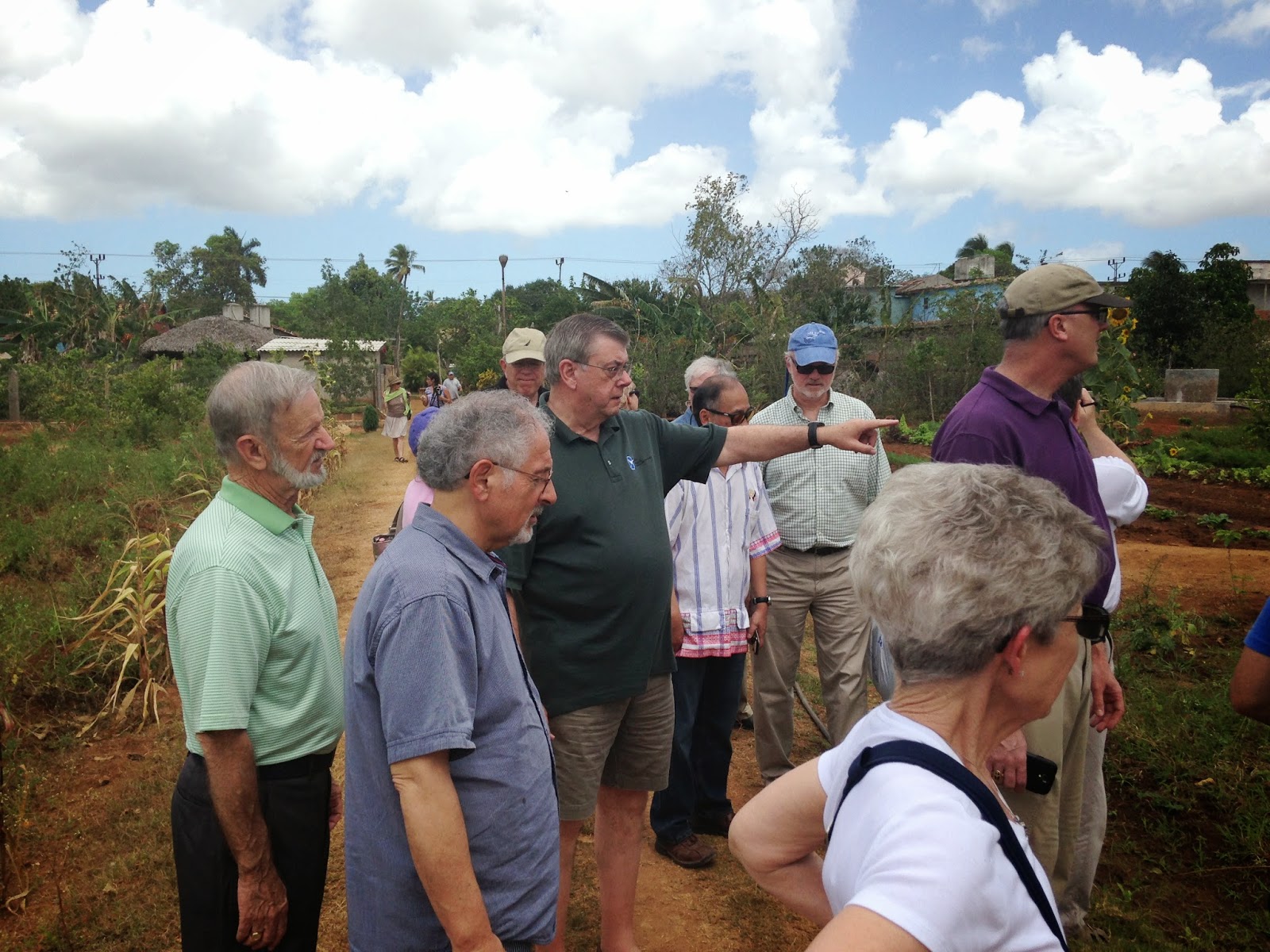
We then headed on down the road in the same direction to the nearby village of Itabo, and the Church of St Mary the Virgin. St Mary's is, by Cuban Episcopalian standards, an older structure, dating back to well before the revolution. They have acquired several acres of land adjacent to the church and are operating a sort of mini-farm (including a collection of pigs), where the emphasis is on sustainable practices, and, again, with hope of benefiting the entire community. After touring the area, we gathered in the church for a (probably too long) presentation on the ministry and strategy of, not just the parish, but the entire diocese. By the time they served us a lunch of freshly-caught and wonderfully prepared red snapper in a lovely covered patio, it was already mid-afternoon.

Back on the bus once again, we continued in a roughly southerly and easterly direction, arriving eventually at the port city (on the Caribbean side of the island) of Cienfuegos, situated on a large and beautiful bay. Our hotel, constructed just before the 1959 revolution, was a caricature of its own genre, giving off a 1950s bon vivant vibe, with a Latin beat. And so it was emblematic of the sort of juxtaposition that most Americans feel when they visit Cuba in this present moment. The artifacts of the pre-revolutionary American-dominated culture survive and are maintained (again, witness the automobiles!). Yet, the countryside is speckled with hortatory billboards (since commercial billboards are not allowed) extolling the virtues of socialism and trying to sustain revolutionary fervor among the people.
After checking in and taking some time to get settled, Manny led us on foot, walking along the bay on a gorgeous evening, to the restaurant where we had our dinner reservations. Like most eateries in a mostly tropical climate, the lines between indoors and outdoors were delightfully blurry, and while the food may not have been stellar, the ambience and the company made up for anything it lacked.

Friday, April 10


 By late afternoon, we were entering the Havana area, and were eventually deposited back at the Hotel Presidente, grateful that we were there for two nights this time, and could enjoy a respite from living day to day out of a suitcase. After an opportunity to settle in, we reported back to the bus for the short ride to Bishop Griselda's Havana residence (she and her husband also maintain their original home in Matanzas), next door to the cathedral. It's an elegant structure, with 14' ceilings, built in the 1940s by Hugo Blankingship, the last American bishop of Cuba. Dinner was prepared for us there (a very nice roast pork), and we were joined by a distinguished guest--the the government's Minister of Religious Affairs, along with one of her staff members. We enjoyed some serious conversation (via Manny wearing his interpreter's hat) before dinner around various ways the government and churches can cooperate for the greater good of Cuban society. Interestingly, the strengthening of marriages was at the top of her list. So, what was once proclaimed to be an "atheist" state is now merely "secular," but with a very benign attitude toward Christians (and the small Jewish community in Cuba; there is no significant Muslim population).
Saturday, April 11
This was a pure tourism day. Manny had the bus take us to the oldest section of Havana, dating back to the early 1500s, on the harbor ("Remember the Maine!--this is where it happened) Our first stop was a cigar store, which also sold rum. I'm not a cigar guy (yes, I know I have friends and relatives who are, but I guess I just must not love them enough), but I did pick up a nice bottle of 11-year old sipping rum. We were told we didn't have to shop around for these things, because prices for the same item are the same everywhere, strictly controlled by the government. The old city is a warren of narrow streets, historic buildings (some restored, some still waiting their turn), elegant but shopworn old hotels, restaurants and bars, museums, churches, and a few shops, though not many, as there is not yet a thriving retail sector in Cuba. We lunched in a privately-owned and very popular restaurant (highly recommended by TripAdvisor), that provided, by my lights, the best meal we had while in the country, without a close second. (My choice was grilled shrimp, served with a variety of grilled hot peppers.)

We then stopped by an open-air market, with rows and rows of private vendors selling crafts, art, clothing, and accessories. I did a little bit of gift shopping, but the highlight of the time there was a conversation (again, all in Spanish) with a vendor from who I didn't buy anything, but who, when she found out I was from the U.S., peppered me with questions relating to how difficult (or not) it was for me to get into the country, and lamenting that she would like to visit the U.S. but the only Cubans who can get entry visas are those with family already here, and she has none. Then, when she found out I am a bishop, enthusiastically assured me that she is a Christian, and asked me to give her a blessing, which I did. What a joy, on so many levels.

In the evening, we had dinner at another private restaurant on the other side of the harbor entrance, near the historic Spanish fort that guards the city, and near the grounds of the Cuban army's artillery academy. At 9pm every evening, on the grounds of the fort, there is a reenactment, with actors dressed as 18th century Spanish soldiers, that culminates in the firing of a canon pointed out over the water that forms the harbor. It was quite impressive, and there was a large crowd.
Sunday, April 12


We checked out of the Hotel Presidente and boarded our bus for the short ride to the cathedral. They were graciously hospitable; while the liturgy was entirely in Spanish, the page numbers in the (Spanish) Prayer Book were called out in English in order to facilitate our participation. Bishop Griselda presided, with assistance from two priests (one of whom was the cathedral dean). Our own Bishop Mike Milliken (Western Kansas) preached, through an interpreter. At the conclusion of the service, all eleven of us were brought forward and asked to introduce ourselves and bring a brief word of greeting. I took a deep breath, crossed my fingers, and gave mine in Spanish. Nobody laughed, so it must have been intelligible. The signing was led by what we would call in this country a Praise Band, the members of which were all quite competent musicians. I was fascinatedly distracted the whole time by a bird that flitted back and forth between the top of the canopy above the grand pulpit, and a clerestory-type window that allowed her access to the outside. I can only surmise that she had a nest inside the church, which brought to mind the familiar words from Psalm 84: "The sparrow has found her a house, and the swallow a nest where she may lay her young, by the side of your altars, O Lord of hosts."

When we were finished with our greetings, it was time to get right to the airport. En route, Manny had the driver take us through some quite interesting residential neighborhoods, reflecting the great wealth that was accumulated in Cuba during the sugar boom of the 1920s. Once at the airport, all went relatively smoothly, though we were amused by the observation that the immigration and customs officials who were female all wore some version of black lace or fishnet stockings with their uniforms, and that the drug-sniffing dog was not a menacing German shepherd but an adorable spaniel, whose handler willingly instructed it to pose for pictures. Once aboard our aircraft, our final Cuban adventure was a half-hour delay on the tarmac while we waited for President Raul Castro's plane, direct from the historic summit in Panama, to land and have him deplane and exit the airport. The delay was about as long as the actual flight back to Miami.

Final Thoughts
Cuban society is amazingly hardy and resilient. It survived and adapted during centuries of colonial subjugation by Spain until 1898, then effective colonial subjugation by the United States until 1959, and now 57 years of Communist rule that has simultaneously increased literacy to an enviable rate and produced such a surplus of well-trained physicians that they are rented out to other countries for cash, and also inflicted the usual consequences of a centralized economy--shortages of consumer goods and a redistribution, not of wealth, but of poverty. Embracing the dual challenge of socialist strictures and an economic boycott by the U.S. is what has called forth the ingenuity leading to the continued operation of so many antique automobiles. Indeed, images of these cars have been absorbed into the Cuban "brand," and appear on all sorts of souvenir items marketed to tourists. Even the image of Che Guevara, a symbol of the most brutal and doctrinaire phase of the revolution, has been thoroughly commercialized, appearing on hats ubiquitously for sale in a variety of places.


Now Cuba is on the cusp of major change. First, the Soviet Union collapsed 25 years ago, ending the first gravy train that kept the island nation afloat after Castro's revolution. Then Venezuela, under the leadership of the leftist Hugo Chavez, stepped into the breach for a few years. But, between Chavez's death and the plunge in world oil prices, that font of largesse dried up as well. So it's in the interests of the regime to make nice with the U.S. When the details of the relational thaw are worked out, I expect there will be massive private investment in Cuba. This will inure to the benefit of the Cuban population and lift the whole nation economically. Hotels (and, let's face it, casinos) will be built, and all manner of infrastructure will be improved exponentially. And, in the process, some virgin beaches will be over-developed and blighted by high-rise hotels, and the $2.50 cocktails I enjoyed at the bar of the Hotel Presidente will be a thing of the past. It's all so very double-edged.

Personally, here's my biggest takeaway from the trip: I feel like I got to look fifty years into the future of the relationship between Christianity and American culture, and it was encouraging. In the wake of the revolution, Cuba had its own, slightly premature, moment of "post-Christianity." The constitution proclaimed it an officially "atheistic" state. Religious practice was stigmatized and marginalized. Now, five decades later, this is the trend in American society, though it's rolling out at a rather more deliberate pace. But also, now, the Episcopal cathedral in Havana holds theology classes on Saturdays. They are intended primarily to form their own people in ministry, but the classes are open to all comers. There is a steady stream of university students who attend faithfully. There is an intense curiosity about Christianity (and other faith practices) on the part of a generation of young people who are virtual blank slates, who did not grow up with it, for whom it is a fresh novelty rather than an artifact of cultural baggage. When we met with the government minister for religious affairs--the one who will personally have to approve any visit by the Pope--she referred to "our Lord" and openly prayed with us. She articulated a hope for partnerships between the government and churches to attack Cuba's social ills. Top on her list of these challenges was the need to strengthen marriages and families. Such a thing would be virtually unthinkable in U.S. society at present. But there it is, right in the heart of Communist Cuba. So, as American Christianity continues to enter a bit of a winter season, my visit to Cuba gives me hope that spring will indeed come. Not in my lifetime, most likely, but it will come.

Tuesday, March 17, 2015
House of Bishops 2015 Spring Meeting, Day Five
The last day. Everyone pretty much wants to be out of here. We had a little extra time after breakfast before gathering at 10am for Morning Prayer (again, with a selectively emended version of Psalm 97), followed by the only on-the-record-with-Roberts'-Rules business session of this meeting. You can go here for the official press release, which I certify as the truth and nothing but the truth. You may be curious about the item proposed by the Pastoral Development Committee regarding "core values" in the run-up to General Convention. I don't mean to trivialize it, but it's basically "We promise to play nicely." Nothing nefarious; no hidden agendas that I could detect. I do, of course, as you might suspect, generally have a hermeneutic of suspicion. But sometimes things are indeed as they appear.
I did raise a concern--a couple of times, in fact--about the House being asked to vote on things with very little or no notice. Again, it can be a way of sneaking substantive things by under the guise of something routine or innocuous. For instance, the report of the Ecclesiology Committee. To my suspicious eyes, this document had all the earmarks of an attempt to provide cover for TEC's legal arguments in property disputes, with its (erroneous, IMO) assertions about the hierarchical polity of TEC from General Convention downward. So I was relieved when the resolution was merely that the House receive it, rather than commend it. But it did have language about disseminating it throughout the church for further study, which I found problematic, because, whatever the resolution actually says, it would have the appearance and the weight of an action of the House of Bishops when, in fact, only a minority of the bishops have even read it yet. So, after some parliamentary haggling, we appended the word 'Draft' to the title, and removed any reference to dissemination. I felt good about this result, even though I would rather it have gone away completely. After the meeting, I had a good talk with the bishop who is the primary mover and shaker behind this, and I think we understand one another much better as a result. There may even be some cooperation in the offing.
The resolution asking the Presiding Bishop to appoint "an independent commission" is an outgrowth of the recent tragic events in the Diocese of Maryland. I think it might be compared to an NTSB investigation of an airline accident.
We adjourned the business session early enough for some more down time before lunch. After lunch, I had time for another circumambulation of the lake, on what turned out to be another gorgeous day.
The afternoon was devoted to preparation and orientation for General Convention, which happens in late June/early July. We're going virtually paperless this time, with rented iPads being handed out to all bishops and deputies. These will contain an intranet link to whatever business is before the house, with amendments to resolutions made in real time, along with supporting documents. Should be interesting.
Dinner on the last night of an HOB meeting is modestly upscale, and many of the bishops dress up a bit. Lots of bow ties. Not me, though. I just came as I am. What you see is what you get. Looking forward to heading out tomorrow morning on the 11:30am shuttle to the airport in Asheville. Ready to be home.
I did raise a concern--a couple of times, in fact--about the House being asked to vote on things with very little or no notice. Again, it can be a way of sneaking substantive things by under the guise of something routine or innocuous. For instance, the report of the Ecclesiology Committee. To my suspicious eyes, this document had all the earmarks of an attempt to provide cover for TEC's legal arguments in property disputes, with its (erroneous, IMO) assertions about the hierarchical polity of TEC from General Convention downward. So I was relieved when the resolution was merely that the House receive it, rather than commend it. But it did have language about disseminating it throughout the church for further study, which I found problematic, because, whatever the resolution actually says, it would have the appearance and the weight of an action of the House of Bishops when, in fact, only a minority of the bishops have even read it yet. So, after some parliamentary haggling, we appended the word 'Draft' to the title, and removed any reference to dissemination. I felt good about this result, even though I would rather it have gone away completely. After the meeting, I had a good talk with the bishop who is the primary mover and shaker behind this, and I think we understand one another much better as a result. There may even be some cooperation in the offing.
The resolution asking the Presiding Bishop to appoint "an independent commission" is an outgrowth of the recent tragic events in the Diocese of Maryland. I think it might be compared to an NTSB investigation of an airline accident.
We adjourned the business session early enough for some more down time before lunch. After lunch, I had time for another circumambulation of the lake, on what turned out to be another gorgeous day.
The afternoon was devoted to preparation and orientation for General Convention, which happens in late June/early July. We're going virtually paperless this time, with rented iPads being handed out to all bishops and deputies. These will contain an intranet link to whatever business is before the house, with amendments to resolutions made in real time, along with supporting documents. Should be interesting.
Dinner on the last night of an HOB meeting is modestly upscale, and many of the bishops dress up a bit. Lots of bow ties. Not me, though. I just came as I am. What you see is what you get. Looking forward to heading out tomorrow morning on the 11:30am shuttle to the airport in Asheville. Ready to be home.
Monday, March 16, 2015
House of Bishops 2015 Spring Meeting, Day 4
After breakfast, I absented myself from the Eucharist (see yesterday's entry) but sneaked back into the back of the chapel in time for the day's retreat meditation from Mark Beckwith, Bishop of Newark. His assigned theme was "Interfaith." That sounded a little odd; "interfaith" is usually an adjective that modifies a noun like "worship," or "relationships," or "cooperation," or some such. He recounted his experience of living as a child in a very Jewish suburb, a very WASP suburb, and then in Japan, where he dabbled in Buddhism. If I understood him correctly, he invited us to be open to finding Christ on the margins of our experience, on the margins of the environments in which we live and work. As per the established pattern, we walked back to our plenary room for table discussions. I have to confess that, while interfaith dialogue and cooperation in certain areas is probably a good thing, as I triage the demands on my time and attention, it's safe to say I will likely never find it to be the best thing or the necessary thing. There's too much else that is more urgent. Or so it seems to me, at any rate.
Following lunch, I had time for a vigorous half-hour walk around the lake, which felt good on another very nice day (after the morning gloom burned off).
The afternoon was devoted to consideration of the report from the Task Force for Reimagining the Episcopal Church (TREC). This was done in plenary presentation, plenary discussion, and table discussion, and we spend three and a half hours on it. I have already written a longish evaluative analysis of this document upstream on this blog, which you can find here. I haven't really changed any of my opinions, so I'll simply mention that I got up during the plenary session and reiterated by point from the blog post that the Standing Commission on Liturgy and Music (SCLM) should not be given an exemption from the plan to sunset all committees, commissions, agencies, and boards (CCABs).
At 5:00 we heard from Sam McDonald, Deputy Chief Operating Officer at the Church Center in New York ('815'). He took us through a slide presentation on the current state of churchwide ministry and mission.
The time slot after dinner was dedicated to various interest groups, so I hung out, naturally, with my Communion Partner colleagues. CP is dedicated to fostering the highest degree of fellowship possible between TEC and the other Anglican Communion provinces, especially those in the Global South, and advocating continuously on behalf of the Anglican Covenant. We had some strategizing to do as we look toward General Convention.
Following lunch, I had time for a vigorous half-hour walk around the lake, which felt good on another very nice day (after the morning gloom burned off).
The afternoon was devoted to consideration of the report from the Task Force for Reimagining the Episcopal Church (TREC). This was done in plenary presentation, plenary discussion, and table discussion, and we spend three and a half hours on it. I have already written a longish evaluative analysis of this document upstream on this blog, which you can find here. I haven't really changed any of my opinions, so I'll simply mention that I got up during the plenary session and reiterated by point from the blog post that the Standing Commission on Liturgy and Music (SCLM) should not be given an exemption from the plan to sunset all committees, commissions, agencies, and boards (CCABs).
At 5:00 we heard from Sam McDonald, Deputy Chief Operating Officer at the Church Center in New York ('815'). He took us through a slide presentation on the current state of churchwide ministry and mission.
The time slot after dinner was dedicated to various interest groups, so I hung out, naturally, with my Communion Partner colleagues. CP is dedicated to fostering the highest degree of fellowship possible between TEC and the other Anglican Communion provinces, especially those in the Global South, and advocating continuously on behalf of the Anglican Covenant. We had some strategizing to do as we look toward General Convention.
Subscribe to:
Posts (Atom)