Friday, March 06, 2009

This Language I Love

I am a professed amateur philologist, in the literal sense of both words. Who else would delight in owning the 20-volume Oxford English Dictionary?

So I pass on this item which I found while perusing the "Humor" category of my saved emails in Outlook. I know not who the author is.

This is worth a few minutes of your time.  It will help you understand why English is difficult to learn. Is it?   Or is it not? This little treatise on the lovely language we share is only for the brave. It was passed on by a linguist, original author unknown. Peruse at your leisure, English lovers, but be sure to read aloud. 

Reasons why the English language is so hard to learn:

         1)    The bandage was wound around the wound.

         2)    The farm was used to produce produce.

         3)    The dump was so full that it had to refuse more refuse.

         4)    We must polish the Polish furniture.

         5)    He'd be able to lead if he would get the lead out.

         6)    The soldier decided to desert his dessert in the desert. [Triple whammy!]

         7)    Since there is no time like the present,he thought it was time to present the present.

         8)    A bass was painted on the head of the bass drum.

         9)    When shot at, the dove dove into the bushes.

         10)    I did not object to the object.

         11)    The insurance was invalid for the invalid.

         12)    There was a row among the oarsmen about how to row.

         13)    They were too close to the door to close it.

         14)    The buck does funny things when the does are present.

         15)    A seamstress and a sewer fell down into a sewer line.

         16)    To help with planting, the farmer taught his sow to sow.

         17)    The wind was too strong to wind the sail.

         18)    After a number of injections my jaw got number.

         19)    Upon seeing the tear in the painting I shed a tear.

         20)    I had to subject the subject to a series of tests.

         21)    How can I intimate this to my most intimate friend?

Let's face it, English is a crazy language. There is no egg in eggplant nor ham in hamburger; neither apple nor pine in pineapple. English muffins weren't invented in England nor French fries in France. Sweetmeats are candies while sweetbreads, which aren't sweet, are meat. 

We take English for granted. But if we explore its paradoxes, we find that quicksand can work slowly, boxing rings are square and a guinea pig is neither from Guinea nor is it a pig. And why is it that writers write but fingers don't fing, grocers don't groce and hammers don't ham? If the plural of tooth is teeth, why isn't the plural of booth beeth? One goose, 2 geese . So one moose, 2 meese or one mouse, 2 mices? one index 2 indices?

Doesn't it seem crazy that you can make amends but not one amend. If you have a bunch of odds and ends and get rid of all but one of them, what do you call it? If a vegetarian eats vegetables, what does a humanitarian eat? If teachers taught, why didn't preachers praught? 

Sometimes I think all the English speakers should be committed to an asylum for the verbally insane. In what other language do people recite at a play and play at a recital? Ship by truck and send cargo by ship? Have noses that run and feet that smell? How can a slim chance and a fat chance be the same, while a wise man and a wise guy are opposites? You have to marvel at the unique lunacy of a language in which your house can burn up as it burns down, in which you fill in a form by filling it out and in which an alarm goes off by going on. English was invented by people, not computers, and it reflects the creativity of the human race, which, of course, is not a race at all. That is  why, when the stars are out, they are visible.

PS. - Why doesn't "Buick" rhyme with "quick".....huh, WHY ?


Tuesday, March 03, 2009

An Aftershock in the Making

I have long taken to heart C.S. Lewis' observation in his classic Mere Christianity that affirming the Christian faith does not mean automatically dis-affirming everything that all other religions teach. Other religions, in fact, may contain significant elements of truth, and may even have insights into truth that Christians would do well to pay attention to. I have also long admired the witness of Thomas Merton, who died visiting Asia in order to further explore connections between the spiritual practices of Buddhist monasticism and those of his own Cistercian Benedictine tradition. Indeed, I have visited Trappist monks who rise in the middle of the night to sing the office of Vigils and then spend an hour in Zen meditation, seeing this as neither threat to nor compromise with their robust practice of Christianity.

So, as the news has emerged over the past few weeks that the (Episcopal) Diocese of Northern Michigan has discerned Kevin Thew Forrester as its next bishop, I have attempted to avoid rushing to judgment. You see, Father Thew Forrester, in addition to being an Episcopal priest and rector of St Paul's Church in Marquette, Michigan, is also a practicing Buddhist, and has received "lay ordination" in Buddhism, which includes taking a Buddhist name. There are those who contend, after all, that Buddhism is more a philosophy and a set of spiritual practices than it is a religion in the sense that Christianity is a religion. Hence, there is no inherent contradiction between the two; one can practice Christianity in a Buddhist "style."

Although I have seen some credible refutations of this position, I would, all things being equal, be willing to give Fr Thew Forrester the benefit of the doubt, and assume that he is up to nothing more sinister than were those Zen-meditating Trappist monks I visited in Oregon back in the 1980s. Unfortunately, all things are not equal. A credible source reports, confirming what was already anecdotally known, that, as rector of his current parish, he has engaged in numerous violations of TEC's constitution and canons in the exercise of liturgical leadership, casting aside not only the letter of the law--the texts and rubrics of the Prayer Book--but its spirit as well--the underlying theology of the gospel itself. He is clearly preaching "another gospel," one that bears little resemblance to classical Christianity in any form, let alone an Anglican one.

If this were happening a few weeks later, the confirmation of Fr Thew Forrester's election would come before General Convention, as did Gene Robinson's in 2003. As it is, it will be the Bishops unconvened and the Standing Committees who will bear that responsibility. Even so, however, I believe this situation has the potential to amount to a serious aftershock to the 2003 Robinson earthquake. If the election is confirmed and the consecration proceeds, it will be another signal to the rest of the Anglican Communion that, as far as the Episcopal Church is concerned, the privileges of autonomy trump the responsibilities of communion every time. It will be yet more grist for the mills of those who squander no opportunity to portray TEC as deranged substantially and not merely accidentally. It will make it that much more difficult for General Convention to respond in any affirming way to whatever version of the Anglican Covenant is revealed in Jamaica in May.

On the other hand, if Bishops and Standing Committees summon the fortitude to nip this one in the bud, the effect could be salutary indeed. Dare one hope?

Monday, March 02, 2009

Beware of the Grinding Wheels

The wheels of Anglican political machinations grind exceedingly slowly. They haven’t caught up with the internet age, and clearly don’t seem to care. The risk, of course, is that events will pass them by, and they will be rendered irrelevant, the effect of their grinding moot. The “progressive” end of the spectrum found the theological baseline enunciated by Lambeth I.10 in 1998, and the attendant listening process therein called for, too slow-moving for their liking, and forced the issue with the actions of General Convention 2003. Their opposite numbers on the “orthodox” end found the organic response of the Communion to the events of 2003 way too glacial, and have been about creating “facts on the ground” in myriad ways ever since.

But here’s the thing about those Anglican wheels: To the same extent that they grind slowly, they grind surely. They grind inexorably.

Practically before the lights were turned off on the General Convention of 2006, with its, at best, ambiguous response to the entreaties of the rest of the Communion, the Archbishop of Canterbury weighed in with a pastoral letter to the bishops, clergy, and faithful of the Anglican Communion entitled, The Challenge and Hope of Being an Anglican Today. In that letter, Dr Williams made it clear that he had no intention of either initiating or abetting any effort to impose external “discipline” on the Episcopal Church (or the Anglican Church of Canada). One may fault him for not doing so if one is thusly inclined, but he is not culpable of inconsistency.

This is not to say, however, that the Archbishop is heedless of the misconduct of the North American holders of the Anglican franchise; indeed, quite the contrary. But his approach has ever been one of fostering the creation of the conditions under which the Americans would be the ones to “discipline themselves out” of full membership in the worldwide Anglican Communion. Challenge & Hope actually laid out an endgame scenario under which this would take place, with its two-tiered structure of “full membership” and “associate membership” in the WWAC, with the latter unmistakably envisioned as a state akin to “Anglican emeritus,” without seat, voice, or vote in the councils of the Communion.

Nothing that has transpired since Challenge & Hope—particularly and especially the words and deeds of Dr Williams—can be understood properly apart from its relationship to that document. This includes the communiqué from the Primates’ Meeting in Tanzania in February 2007, the statement from the House of Bishops in New Orleans in September of that year, Rowan’s presidential addresses at the 2008 Lambeth Conference, the report of the Windsor Continuation Group, and the communiqué from last month’s Primates’ Meeting in Alexandria, Egypt.

The latest piece of the puzzle to fall into place was announced by Lambeth Palace today. In fulfillment of one of the key recommendations in the report from the Windsor Continuation Group, the Archbishop has named the members of an initial team of “pastoral visitors” whose job it is to safeguard the interests of besieged “orthodox” minorities in dioceses and provinces dominated by “progressives.” Provinces like the Episcopal Church and the Anglican Church of Canada. In May, the Anglican Consultative Council will convene and presumably be invited to lend its imprimatur to the arrangement and up the ante by establishing a Pastoral Forum along the lines envisioned by the Windsor Continuation Group to the Lambeth Conference last summer, which recommendations seem to be widely endorsed in the final published compilation of reports from the conference’s indaba groups.

Reaction to today’s news has been utterly predictable, with indignant consternation from the left (“See what’s ahead of us if we don’t nip it in the bud right now?”), and derisive yawns from the right (“Uh…Rowan…the horses left the barn a long time ago. Don’t worry about the door now”). Sometimes when you’re taking fire from both sides it means you’re occupying an completely untenable position. Is Rowan short a few credit hours in Rabbi Friedman Triangulation Prevention Training? Or, making both ends of a conflicted relationship angry can mean that you’re doing something exactly right, and that you shouldn’t be discouraged by the shrapnel flying all around your head.

My bet is on the latter scenario.

The next click of the gears will be heard in May, when the Anglican Consultative Council next convenes, in Jamaica. In addition to creating the Pastoral Forum, they will have a look at the next (and final?) draft of the evolving Anglican Covenant, which will not be perfect, but will, I wager, move us unambiguously in the direction of formally recognizing that communion is, in fact, the natural limit of autonomy for the 38 Anglican provinces. After the ACC meeting, all eyes will then turn to Anaheim, where both houses of General Convention will be gaveled to order on July 6th.  It’s impossible to tell from this far out exactly what action or inaction General Convention will take that will move TEC in the direction of “second tier” membership in the WWAC. It may not even be all that clear when the convention is over.

But it will not remain a mystery for long. Because while the wheels do grind slowly, they also grind surely. Rowan Williams may go down in history as a lot of things. But a fool isn’t one of them.

Position Wanted

Part-time, of course. I have a day job I like.

This is from my junk mail folder this morning:

- My name is miss Blessing, I am single and 5.5ft.How are you,i hope your are find and in sound health.I went through your profile today and i took interest on it. I am interested in your profile, Kindly contact me. I will tell you more about myself and picture.Awaits your reply soonest.Blessing.


OK, I'm officially making myself available to all the internet scam artists out there. Y'all need an editor! You're losing a huge amount of potential business BECAUSE YOU DON'T KNOW HOW TO WRITE!! So people know right away that you're idiots, rather than finding out later that they are idiots, which is the way you want it, right?

I can help you over this hump. I can clean up your grammmar and punctuation and make you sound ... well ... credible. We can even negotiate a Platinum Package where you were actually get some rhetorical flair, some style. We can pinpoint your pitch to specific target markets. 

All for a decent cut of the action, of course.

Contact me.

Sunday, February 22, 2009

Rowan in the Dock

The news broke on Episcopal Cafe this past week that the Archbishop of Canterbury will be making a visit to Anaheim during General Convention this coming July. This is not in itself big news; all of Dr Williams' recent predecessors have done the same one or more times during their tenures. 

But the Anglican climate being what it is, the announcement has provoked what is at least a teapot-sized tempest in its venue-of-origin, as well as on the House of Bishops/Deputies listserv (HoBD), though, while I have not done an exhaustive search, apparently not elsewhere in the blogsphere. Those from the port side of the vessel who have ventured to opine are near-universally cynical about the prospect, with suggestions ranging from sending him across the street to Disneyland for a photo session with Goofy to granting him no more than a booth in the Exhibit Hall.

Leaving aside the obvious observation that Rowan really won't have to go to Disneyland to have his picture taken with Goofy--a group shot with either house of General Convention would serve that end--there are some recurring themes among his liberal critics (his conservative critics, who are legion, being largely silent on this one) that would seem to merit at least a small degree of attention.

It has been suggested that Rowan has never actually taken the trouble to listen to the voice of the Episcopal majority, while he has gone out of his way to be hospitable to American dissidents like Bishop Robert Duncan and Southern Cone Primate Gregory Venables. So, if the Archbishop comes to Anaheim, it should be as a listener rather than a talker. He needs to learn who we are as Episcopalians and how we do things in "this church," since, despite his prodigious academic accomplishments (the man can write a book faster than I can read one), he is under-educated in those areas. I find the combination of naivete and hubris in such suggestions mind-blowing. I have no doubt that Dr Williams understands the Constitution and Canons of TEC better than most members of the House of Deputies and that he is eminently up to speed on all the relevant dynamics of how controverted issues are dealt with on this side of the pond. To infer from his behavior that he is somehow not sufficiently "curious" about our church is to manifest myopia trending toward megalomania.

The perception of Rowan's cluelessness is to some degree fueled by an inordinate obsession with whether he has actually ever worshipped in a congregation of the Episcopal Church since taking offce. (He has had multiple opportunities to do so, having recently spent a sabbatical in Washington, D.C.) No one actually spells out precisely why this is important, but the implication seems to be that he is intentionally avoiding contamination by post-Robinson Episcopalian cooties. Could this perhaps be to maintain his street cred among the Nigerians and other assorted Africans and North American Anglicans who are beholden to them? If so, it is an astonishingly unsuccessful strategy on his part. Just scan the comments on any number of Stand Firm posts for a quick read on this Archbishop's standing in that community.

Rowan is also taken to task for having thrown Jeffrey John under the bus way back when. Dr John, currently dean of St Alban's, was named to the (suffragan) See of Reading in 2003. He was known then, and still is, to be in a partnered gay relationship. At the time, he offered assurances that the relationship was no longer sexual in nature--making him, some contend, a virtual "poster boy" for the sort of gay cleric that even a conservative could accept in high ecclesiastical office. Yet, in the midst of loud and constant pressure from the Evangelical party of the C of E, the Archbishop entreated Dr John to step back from the appointment, which he then did. Dr Williams was wise in making the request, and Dr John was wise in acceding to it. In a visible and highly-charged political environment, it is indeed not enough to simply be doing the right thing. One must be seen doing the right thing. In an ideal world, whatever goes on between Dr John and his partner would be nobody's business but their own. Alas, this is not an ideal world, and as their domestic arrangements have the appearance of impropriety, Dr John is not an appropriate candidate for the episcopate. Rowan did not throw him under the bus. Rowan enabled the Anglican Communion to live to see another day. That is a noble end, and that the means to that end were awkward and unpleasant does not make them morally illicit.

I am glad that the Archbishop will be in Anaheim. By virtue of his office, he will personally encapsulate for us the rest of the Anglican Communion. If, as it seems plausible to expect, we continue our slow but steady journey away from the mainstream of Anglicanism and toward sectarian isolation, we will have to do so while we look Rowan--and, through him, the rest of the communion--in the eye. It will be good for our character.

Tuesday, February 10, 2009

Two Tales of a City

It is perhaps not the worst of times, but it is certainly not the best of times.

I first encountered Stockton, California in 1972, when the woman I would later marry brought me home to meet the parents. (“Home” at the time was actually Lodi, which is effectively a Stockton suburb, and she had lived in Stockton until her mid-teens.) For the next 22 years, it was on my personal radar screen as a place we visited (or at least drove through) regularly as we lived first in Santa Barbara, then in the Salem, Oregon area, then in Wisconsin and Louisiana. In 1994, I accepted a call to become Rector of St John the Evangelist, the historic downtown Stockton parish, and the city became my home for the next 13 years. My mother-in-law still lives there, as do other members of my extended family-by-marriage, to say nothing of a host of friends and former parishioners. It’s still very much on my personal map.

Stockton is part of the “unknown California.” In the Midwest, where I live now, people tend to carry the visceral impression of California as one big beach town, where you can catch rays 365 days a year. The vast central valley—larger than all of New England, draining the San Joaquin River from the south and the Sacramento River from the north—tends to fly under the radar, even to many coastal Californians. Only a few days ago I had a conversation with a resident of Orange County who referred to Stockton as the “armpit of California,” assuming, from its name, that it was a center of the cattle business, imbued with fetid slaughterhouse odors. In fact, Stockton, with its environs, is a population center housing more than 350,000 people. In my now home state of Indiana, it would be the second largest city. There is a highly-acclaimed private university there, a fine symphony orchestra, and a bunch of other cultural amenities. Yes, lately, it’s also been Foreclosures R Us, but that’s a passing factoid.

St John’s Church is (was?—that’s kind of what this post is about) the third-oldest Episcopal congregation on the west coast, founded in 1850. In 1911, the San Joaquin Valley was spun off by the Diocese of California (centered in San Francisco, 80 miles to the west) and became the Missionary District of San Joaquin. Some fifty years later, San Joaquin became a full-fledged diocese of the Episcopal Church, and St John’s was long its northern anchor (St John the Baptist, Lodi being the actual northernmost congregation), which stretches 200 miles south to Bakersfield and then over the Sierras to the Nevada border, encompassing such isolated communities as Bishop, Lone Pine, and Mammoth Lakes.

In the arena of secular politics, the San Joaquin Valley has tended to swim against the larger California tide. California may be solidly a “blue” state, but there are a great many “red” counties in the interior (though San Joaquin County, with its seat in Stockton, went narrowly for Obama in the 2008 election). This general agrarian cultural conservatism has been generally reflected in the life of the Episcopal Church there. Bishop Victor Rivera, who served from 1968 until 1988, was in harmony with the critical mass of his diocese, which tended to stay the course theologically as the much larger coastal dioceses moved steadily to the left. Bishop Rivera’s successor, John-David Schofield, continued this direction and gave it a steroid shot. The majority of clergy and laity within the diocese grew steadily more disenchanted with the general direction of the Episcopal Church during the 1990s and into the new century, a rising tide of discontent that was not caused by the bishop’s leadership, but was certainly fueled by it.

Nonetheless, for most of this time, clergy of varying theological and ideological perspectives managed to maintain cordial and cooperative relationships with one another in pursuing local ministry and mission. In my own deanery, the eight (at the time) congregations pooled resources (from each according to its abilities) in 1997 and called a full-time youth minister, an arrangement that had some marked success during the years it lasted. I met regularly for lunch with my colleagues, the Rectors of St Anne’s, Stockton and St John the Baptist, Lodi. We were friends. We respected and liked one another. The youth of our congregations began to form relationships across parish lines. 

Of course, there was always thunder rumbling in the distance. I distinctly remember calling attention to this thunder at one of our lunch meetings eleven or twelve years ago. In one of those makes-the-blood-run-cold moments of prescience, I compared that moment to a shared repast between young U.S. Army officers in, say, the late 1840s, some being from New Jersey and Massachusetts, and some being from Virginia and South Carolina. You can see where I was going with that, although the analogy doesn’t play out with complete accuracy, because, by the time of the actual split in December of 2007, all three of us had moved away from the diocese. Yet, both of their parishes are today connected to the Episcopal Church, while mine stayed with Bishop Schofield and is now a parish in the Anglican Province of the Southern Cone, en route, no doubt, to becoming part of the emerging Anglican Church of North America.

So, today, there are two Anglican congregations in the city of Stockton. One is the mother of the other; St Anne’s on the north side was begun in 1950 as a parochial mission of St John’s downtown. Over the decades, parishioners have moved between the two of them at various times for various reasons—some noble and some petty. Divergent cultures evolved in each parish, but that was seen largely as a good thing, providing a sort of safety valve for those who felt stifled by the predominant conservatism of St John’s or insecure in the predominant liberalism of St Anne’s. Until the most recent unpleasantness, both wore the label “Episcopal” comfortably, even proudly.

But St John’s and St Anne’s are now, using the idiom of this era, walking apart. The differences don’t seem huge at first. Both buildings look the same as they did before the 2007 convention, save for a new sign at St John’s striking “Episcopal” and replacing it with “Anglican.” Both use the 1979 Book of Common Prayer in their worship—as far as I know still, Rite I early on Sundays and Rite II late—and both still sing from the Hymnal 1982, supplemented by more contemporary sources. Both retain a corporate memory of being linked to one another—sometimes joyfully and sometimes uneasily—cooperating in diocesan camping programs, sharing services (and choirs) on Ascension or All Saints, being part of the same extended family.

But no more. Last month, the Executive Council of the Episcopal Church elected to hold its regular winter meeting in Stockton, for the express purpose of demonstrating solidarity with those congregations that chose not to follow the majority to the Southern Cone. Some, at least—and I would suspect most if not all—of its members worshiped at St Anne’s over the Sunday of the meeting. It was a decision rich with irony, since, until the split, one of the members of the Executive Council was a resident of Stockton and a member of St John’s. Yet, before the split, it would never have occurred to the Presiding Bishop or the President of the House of Deputies to schedule a meeting in Stockton, or anywhere else in the Diocese of San Joaquin. That was considered “enemy territory.” Yet now, members of Executive Council have blogged about their discovery of Stockton, what a wonderful place the San Joaquin Valley is, and how excited they are about the continuing ministry of the Episcopal Church in that area. One wonders whether such a visit—say, ten years ago—not with the intent of intimidating but with the intent of listening, might have contributed to an atmosphere of trust that could have forestalled the secession of a diocese. I’m glad the leadership of the Episcopal Church has discovered Stockton. But I’m afraid their visit was an exercise in shutting the barn door long after the horses are nowhere in sight.

Last Saturday, my successor was installed at St John’s. He shares the theologically and morally conservative views of his parishioners, but lest anyone think these are in any way generational issues, it is worth pointing out that he’s 29 years old, and, trust me, there are a lot more young Anglicans where he came from, so to speak. The preacher on the occasion was the Bishop of Fort Worth—not the newly rehabilitated entity that continues in union with General Convention, but the ongoing entity that is also now part of the Southern Cone.

So the “walking” continues, and the “apart” is now a whole lot further.

These two tales of one city are, I believe, microcosmic. They are part of the same narrative that we can find all over the ruins and remains of what was once a united Anglican presence in this country. We seem to be able to interminably parse the meaning of schism—what it is and what it isn’t, exactly, and whether or not it’s worse than heresy. I don’t have any additional wisdom today on those questions. What I do have is a heavy heart about the damage that has already been done in the last several months—damage done for very principled reasons by both sides, I realize, but real damage nonetheless, damage that was accomplished as quickly as “calling the question” at a convention, or signing a deposition notice or a legal complaint.

And I suppose I also have a hope—not a visceral hope, but an intentional hope, in the sense of affirmatively cultivating a virtue—that, as we try to figure out the way ahead for Anglican Christianity, people on both sides of the divide might endeavor to do as little damage as possible to the institutional infrastructure of our common life, that, if we must walk apart, that we try to walk apart a little closer together, not so far apart that we have to shout to be heard, and occasionally, perhaps, close enough on parallel paths that we are still able to join hands as we walk. As the ACNA emerges, may its members foster a culture of generosity toward their Episcopalian neighbors. It now matters more how we walk apart than that we walk apart. And in the light of the latest communique from the Primates, and the report of the Windsor Continuation Group, may a similar generosity of spirit emerge in the Episcopal Church—at 815, and especially at General Convention this summer.  

If we can do that much, it will be a far, far better thing that we do than we have ever done.

Monday, February 09, 2009

Terra Sancta Travelogue, VI

Monday, January 26, our last day in Israel.

Usual breakfast and boarding time. We're grateful that the hotel is not over-crowded, thus making it possible for us to keep possession of our rooms until the late afternoon.

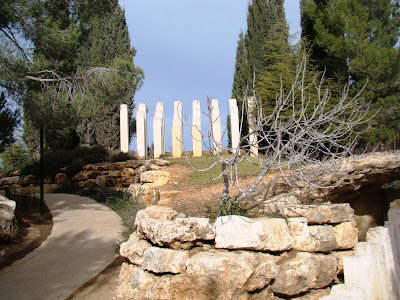
It would be an understatement to describe the first item on our itinerary as "emotionally challenging." It's Yad Vashem, the Holocaust memorial. I'm not going to attempt to give anything resembling a comprehensive account of this experience, for a number of reasons. I had to make myself watch Schindler's List (though I'm glad I did) and Brenda is still trying to get me to see Life is Beautiful. The subject is way beyond depressing. If I had been visiting Jerusalem on my own, and not been effectively forced to visit this place, I might not have chosen to do so. If you are ever there on your own, don't make that mistake.

The place is a coherent work of art in itself, composed of several smaller works of art. The columns in the above installation are manifestly incomplete; they lead nowhere, cut off before maturity, thus representing the children whose lives were snuffed out by the Nazis, nearly erasing an entire generation and ending a centuries-old tradition of Jewish culture in Europe. 

Our next stop takes us back to the area of the old city--just outside the (northern) Damascus Gate. In the 19th century, the British General Charles Gordon came up with an alternative theory, contradicting St Helena, as to the actual location of Golgotha. He noticed a hill that still looked like a hill, with some caves that looked like eye sockets and--voila--the Place of  a Skull. Not only that, but there is a nearby tomb that, in fact, dates from the first century, and has demonstrably fourth century Christian symbolism painted on an interior wall. 

The "Garden Tomb," as it came to be known, is now owned and operated by a private British foundation. Our guide there is a retired British Methodist pastor. It is clear that this place, because it looks and feels plausibly "authentic," resonates with those who have the "historically accurate tourism" mindset (Holy-Land-as-Christian-theme-park) and are put off by shrines that are redolent of liturgical and sacramental spirituality that is foreign to them. Free church evangelicals and even some oldline Protestants find themselves much more naturally affected by the Garden Tomb than by the Church of the Holy Sepulchre. I certainly don't begrudge them that, but I am personally not much impressed.

Time-certain visits militate against efficient urban transit today. When we're back on the bus, we retrace most of our route from earlier in the day, through high-density but often slightly upscale residential neighborhoods in west Jerusalem, past former (and likely future) Prime Minister Benjamin Netanyahu's condo (there seem to be no free-standing houses in this part of town), and past the Knesset building, to a museum complex that houses both a magnificent outdoor scale model of Jerusalem as it was on the eve of its destruction by the Romans (what you see below is a view from the east, only with the Holy of Holies standing where the Dome of the Rock now is), as well as the original scrolls found at Qumran. 

While it would not have been logistically feasible, I actually wish we could have seen and studied this model before going up to the Mount of Olives. The amount of detail is incredible, and it is a great help in mentally consolidating all the territory we had covered the previous day.

All week long it has been a mystery as to whether we would get to go to Bethlehem. From the end of the British Mandate after WWII until the 1967 war, Bethlehem, along with east Jerusalem and all the other territory now referred to as the West Bank, was part of the Hashemite Kingdom of Jordan, and Christian pilgrims had relatively easy access; indeed, the majority of the residents of the town were native Arab Christians. In that war, however, Israel conquered these territories (along with the Golan Heights, the Gaza strip, and the Sinai peninsula). Because the residents of the West Bank were not actually Jordanians, but Palestinians, Jordan, while officially indignant, seems to have been privately just as happy to have it off their hands. In the meantime, the more ardent of Israeli Zionists, seeing the territory as "Judea and Samaria," part of the ancient Jewish patrimony, began to establish settlements. At present, then, there are three categories of real estate in the West Bank: 'A' areas, populated entirely by Palestinians, and under the control of the Palestinian authority; 'B' areas that are populated entirely by Jewish settlers; and 'C' areas, i.e. everythere that is not either A or B. Israeli citizens are forbidden by Israeli law from entering 'A' areas. Palestinians are forbidden from entering 'B' areas. Anyone can live and work in 'C' areas. Got it?

Anyway...I tell you all this because Bethlehem (along with Bethany, Jericho, and other places that would be of interest to pilgrims both Christian and Jewish) is an 'A' area. Most of these arrangements have come about since the Intifada that began early in this decade. Before that, both Israelis and Palestinians were able to move around in the West Bank with what now seems like an remarkable degree of freedom. It was in everyone's best interest. Since the Intifada, however, the Israelis have understandably tightened security, resulting in the A-B-C system, and in the high walls shielding populated areas of Israel from potential threats. 

What this means is that the 'A' areas can be a little touchy from a security standpoint even for harmless tourists. However, since we are harmless tourists with money to spend, every effort is made to work things out. Yossi has been in touch with his on-the-ground sources all week and announced to us on Sunday that Bethlehem is a "Go." Unfortunately, it's no-go for him, since he's an Israeli citizen. This means that there needs to be an arrangement with someone on the inside, and a coordinated handoff at the checkpoint (literally a "hole in the wall"). After what appears to be a potential last minute glitch is resolved by cell phone, we get off the bus, show our passports to the guards, and walk through one of those intimidating vertical turnstiles. On the other side, we are met by an Arab Christian guide and a minibus for our tour of the "little town of Bethlehem", no longer in deep and dreamless sleep.

As it's already after 2 PM and we haven't eaten anything since breakfast, lunch is our first priority. The bus delivers us to a restaurant, which is next to a large gift and souveneir store, all owned by the same family, which is the same family that owns our bus and employs our guide! We're the only patrons in the rather large restaurant, and there's a long table all set up for us. They bring out a generous supply of pita bread and hummus and the veggies that usually accompany such things. After a while, most of us assume that's all there's going to be, and we chow down. Then they bring out some room-temperature falafel, which I personally welcome as at least it bears some resemblance to protein. And just as we're all well stuffed, out comes two kinds of shish kebab--chicken and ground lamb. I'm grateful for this, but now wish I hadn't eaten so much pita.

It's not hard to figure out that the restaurant and the tour are pretty much loss-leaders for this operation. Their bread and butter lie in the gift shop, so we're taken there before anywhere else. We all understand the dynamics and try to be accomodating. I would like to have purchased a fairly large olive wood nativity set (carved on site below the store) for my church, but the price tag is $17,000 (including shipping, and probably negotiable), and I left the church credit card at home (note to St Anne's vestry members: that was a joke). I do, however, manage to part with close to $100 buying gifts for family members. (We each had our own effective "personal shopper" encouraging us in our buying decisions. I was just wanting trinkets but it felt like an auto dealership!)

When we've re-boarded the minibus, it's off to Manger Square and the Church of the Nativity. 


Once again, there are Greek, Armenian, and Roman sections to this building, though no irascible young monks telling us where to go. Above you can see the plaza leading to the entrance. For some reason, the original (Byzantine? Crusader? I'm not sure) grand door has been reduced twice and now an average-size adult has to crouch to get through it. Something about humility, as I recall.

Below is the inner sanctum marking the spot of the actual Nativity. A few feet away is the site of the manger.


Our knowledgeable guide takes us down into the crypt of the Roman Catholic section and I am surpised and delighted to find there the tomb of St Jerome, the fifth century translator of the Scriptures from Hebrew and Greek into Latin--i.e. the inimitable Latin Vulgate, the Bible for the western church until the Reformation.

The photo below is in the main (Greek Orthodox) section. At certain spots there are intentional gaps in the (raised) current floor that allow one to see the original mosaic from the time of Helena, still in excellent condition.

On our way out of town we pull over for a look at the "Shepherd's Field" (see photo below). The hillsides have been terraced and planted since then, and there's a lot of urban construction that now occupies the view, but it's not too hard hard to imagine shepherds keeping watch over their flocks by night in this place.

What you see below is the "inside" view of the wall as we proceed toward the checkpoint, where our familiar bus will meet us. Notice all the taxis. They are awaiting Palestinians who live in Bethlehem but commute to Jerusalem for work. There's no vehicular traffic allowed through the checkpoint. The graffiti tells the real tale: Both Israelis and Palestinians alike know that tourist dollars are their life's blood.


Between having to wait at the checkpoint for our regular bus to arrive, and dealing with very thick rush hour traffic, we arrived back at the hotel with only about 45 minues in which to shower (in ancticipation of not being able to do so for about the next 28 hours), pack, and check out. The bus then drove us to a restaurant on the west side of Jerusalem, in a very cosmopolitan neighborhood, where we were treated to a farewell dinner, consisting pretty much of exactly what we'd been served for our late lunch in Bethlehem! There are no complaints, though, as both the food and the fellowship are quite enjoyable.

Shortly after 7:30, we're back on the bus for the last time. It's only about a 35 minute drive to Ben Gurion Airport. Once again, we have to deal with the intimidating scrutiny of Israeli security officers. Even knowing that all you have to do is tell the truth, it can still be nerve-wracking. I've probably seen one too many movies and TC shows about the Mossad! They ask me the name of my parents--a pretty easy and innocent question!--and I actually have a long moment of hesitation before I can get the answer from my brain to my lips. God help me.

Our flight isn't until 1:00 AM, so we have a lot of time to kill. Fortunately, even after we clear security (why is it that the Israelis, who set the gold standard for air security, have found a way to not require passengers to remove their shoes, and our own TSA can't seem to do so?), there is plenty of room in which to roam and lounge and buy snacks. I'm amused to look at the departure board and see a direct flight to Warsaw listed. Somehow, it probably doesn't go to Indiana. 

On our flight is a group of about a hundred American Jewish teenagers returning from a pilgrimage. They are wired, and I am more grateful than ever for my chemical assistance in sleeping. We land back at JFK at 6 AM local time, which is 1 PM in Israel, and it's still dark. Talk about a long night! Fortunately for us three Hoosiers, our connecting flight (to Detroit, and then another one to South Bend) is not until 9, so there's plenty of time to find our way to where we need to be and get something to eat (pork sasuage!--I'm feely very pork-deprived). We touch down in South Bend on schedule at 1 PM, and I'm home by around 3:30. Believe it or not, I grab a shower and show up to celebrate 5:30 Mass for the Conversion of St Paul (delayed a day because nothing liturgical happens at St Anne's on Mondays--long story). 

I am very grateful for this trip. It refreshed me spiritually, intellectually, and, I think, pastorally. The plan, still quite tentative, is for the Diocese of Northern Indiana to sponsor a tour in about two years' time. It would be quite similar to what I've described in these postings, though possibly a day longer so as not to feel so rushed. It would be tailored to Anglicans, and Bishop Little, God willing, would be the lead "teaching guide" (a capacity in which your humble blogger might find himself assisting) even as we would also have a Jerusalem Tours guide for the local stuff. Stay tuned for the details!

Saturday, February 07, 2009

Terra Sancta Travelogue, V

Sunday, January 25. "Now our feet are standing within your gates, O Jerusalem." (Ps. 122)

Yossi has a sense of the dramatic. For our first day in Jerusalem, he takes us first to the top of the Mount of Olives, looking down on the city from the east. To our left and slightly behind us is the village of Bethany (now a walled Palestinian enclave, one of the no-go zones for Israeli citizens), which we can see because, like Bethlehem (to the south, also behind a wall), it sits on a hilltop; it feels like you can almost reach out and touch these towns, now, after 2000 years of urban sprawl, no longer isolated from Jerusalem (except for that darn wall). It was in Bethany where Jesus' friends, the siblings Mary and Marth and Lazarus, lived, and where he spent the night before what we now call Palm Sunday. 

His route that day took him to where we are now standing. Immediately in front of us, down the hill just a bit, is a Jewish cemetery--quite ancient but still with some vacancies if you know the right people. Beyond it is the Garden of Gethsemane. Beyond that is an ancient Christian cemetery, leading down to a ravine known in biblical times and now as the Kidron Valley. From there the ground rises sharply through a Muslim cemetery until it hits the massive stone wall of the old city. The acutal wall that is there now dates from Byzantime times and later (remember, the Romans did a typically thorough job of destroying Jerusalem in AD 70). In the middle of that eastern wall is the main gate on that side of town, known as the Golden Gate. It was through this gate that Jesus passed atop a donkey in his "triumphal entry." It was sealed shut by the Turks during the Crusades in view of the Jewish tradition that the messiah woul enter through that gate. (Note to the Turks: He already got in. You were too late.)

After posing for a group picture (available to us about 90 minutes later for $10), we proceed on foot down the very route Jesus and his entrourage traversed. Along the way there are legions of peddlars of sourveneir trinkets, some as simple as a sprig from an olive tree. My instinct--a good one, actually--is to keep my hands in my pockets and not make eye contact.

We pass by a small shrine church marking the spot where Jesus is thought to have wept over the city of Jerusalem (the lament about a hen gathering her chicks). The Garden of Gethsemane itself is still partly a garden, though there is a shrine church there, of course, and since it's Sunday morning, there is a Mass about to begin as we arrive, so we can't look around much. It's built (once again, bear in mind Yossi's wise comment that "tradition is stronger than history") around the rock at which Jesus agonized in prayer until he sweated blood. But what is now, in effect, the churchyard, is planted in olive trees that are clearly quite ancient, and there is no reason to disbelieve the tradition that this area has been an olive garden for three millenia, since the time of David. Olive trees are among the most long-lived of plant species, and if these particular trees were not on the scene on the night Jesus was arrested, then their parents or grandparents certainly were. For anyone with the "historically accurate tourism" mentality, this is as good as it gets.

We can't actually enter the old city from the east like Jesus did, so our journey across the Kidron Valley is by bus, which is magically waiting for us in front of the church. It takes us to the Zion Gate, on the south side, toward the southeast corner. When we get out of the bus, which this time we will not see again for several hours, we cannot help but notice a contingent of about 20 or 30 Israeli Defense Force soldiers. Yossi explains that, periodically, Sunday is a mandatory "culture day" for them, in which they have to visit a museum or attend a concert or hear a lecture or some such. So these young men, and two or three young women, are out getting some culture. It's a virtual certainty that most or all of them had only a few days earlier been in Gaza getting something other than culture. I am struck by how young they all look--barely out of their teens, if that. (Military service is universally mandatory in Israel for both sexes.) But more than that, I am struck to see them each carrying a loaded M-16, even though they're off duty. One of our companions, an Iraq veteran, explains to me that, when you're in a "hot zone," you always carry your weapon, because the difference between "off duty" and "on duty" can be a matter seconds. And when you live in that neighborhood of the world, you're always in a hot zone. Sobering.

The area where we are is outside the Byzantine wall, but was inside the city wall in more ancient times. Our first stop is the Tomb of David--the idealized King of Israel, the one who politically unified the nation for the first time since their arrival from Egypt, the proto-messiah. The men among us are required to don headgear. Pious Jews would wear a yarmulke, but my Jerusalem Tours baseball cap is completely adequate, I am assured.  This is hugely counterintuitive to the way I am acculturated; indeed, in Christian holy places, we are exhorted to remove our hats. Hard to keep track of without actually engaging the brain. In any case, this is obviously a very sacred location to Jews, and there are many there engaging in various forms of formal personal devotion. 

Nearby is the supposed site of the Upper Room--where Jesus and his disciples gathered for the Last Supper, when the Risen Christ met them behind closed doors on the evening of his resurrection, and where the Holy Spirit fell on them on the Day of Pentecost. No one claims that this is the actual room in the actual building, both of which have long since been reduced to rubble and build over several times. Nonetheless, in the orthography of Christian pilgrimage-cum-tourism, this is the spot. (Yossi says about David's Tomb: "As an historian, I have my doubts that the David is actually buried here. As a Jew, this is David's Tomb." I guess I would have a similar attitude toward this room.) 

Upon emerging from the warren of narrow streets that make up this part of town, we find ourselves back near where the bus had deposited us, but now we actually go through the Zion Gate, inside the Byzantine south wall. We're in what is known as the Jewish Quarter, and Yossi marches us through a parking lot, which is where the residents have to park because the streets are way to narrow and winding for vehicular traffic. Soon we are in the Muslin Quarter, home--ironically, some would say--of the most sacred spot in Judaism, the Western Wall (aka the Wailing Wall). This is a large section of the actual western wall of the Temple ("Herod's Temple") that the Roman legions neglected to dismantle when they destroyed the city. (The eastern wall of the Temple doubles as the eastern wall of the city itself.) The plaza leading up to the wall is about 15-20 feet higher than it was in the time of Christ, but it's the same wall. The sexes are segregated here (as they were at David's Tomb), and disposable paper yarmulkes are available for men who don't have headgear with them. With those restrictions, we are allowed to approach the wall.


Then, primarily because Jerusalem Tours is so well-connected, and made reservations for a time certain six months in advance, we are treated to a tour through the (still ongoing) excavation along the entire length of the Western Wall, completely beneath the current street level of the city. We are able to walk on the actual pavement that was at street level at the time of the Temple's destruction. A long way, I might add. Although some of us are reaching the point of archeological satiation by this time, it is really quite compelling, moreso than I can find words for.

When we emerge back into the light of day, we are on a narrow street, near the site of the Praetorium (only several feet higher), which is where Pilate finally condemned Jesus to death, and, hence, the first Station of fourteen along the Via Dolorosa, the Way of Sorrows. It was a little surreal here, because even though this is a place of pilgrimage, and Christian pilgrims walk this route in formal procession quite frequently, we are proceeding at a pace that can hardly be described as contemplative. Nor is the ambience conducive to contemplation, with all the shops hawking Christian trinkets and knick-knacks of widely varying degrees of quality and expense. 

Nowhere is this disjuct so apparent as at a spot where the path makes a left turn (from westward to southward) at the place of the Seventh Station (Jesus Falls a Second Time). Yossi points to a section of paving stones that look distinctly different from all the others. Some years ago, when they were excavating for some infrastructure improvement (sewer? electricity? fiber-optic cable?), they encountered the actual pavement from the time of Jesus. They obviously couldn't bring the street back down to that level so they did the next best thing and brought a section of the ancient paving stones up to the present street level. In walking the Via Dolorosa, we can walk on the actual stones that Jesus walked on carrying his cross. 

Awesome.

But right at that spot--I'm talking right beside those new-old paving stones--there's a pizza place ("Best Pizza in Jerusalem") and since Yossi knows the owner (an Arab Muslim), we stop for refreshments. Yes, the pizza was pretty good, and the Diet Coke really hit the spot. But I can't help feeling a little guilty, you know? I mean, Jesus could have really used a pit stop here, right? After all, it's right where he fell the second time. But it was not to be. I'm not sure I'll ever finish my inner processing of this little anomaly. 

Most of the Christian pilgrimage sites in the Holy Land were identified and established as such by St Helena, mother of the Emperor Constantine, in the 4th century. Shortly before our pizza break, we turn and pass through a gate that was, at the time of Christ, part of the western wall of the city (not to be confused with the western wall of the temple). Helena identified a rocky rise in the terrain as Golgotha, the "place of a skull," and built a shrine church there that encompasses not only the site of our Lord's crucifixion, but the site of his burial as well (the gospels do indicate that Joseph of Arimathea's tomb was, in fact, nearby). 

The Church of the Holy Sepulchre, as it is named, is under the joint--though often not amicably joint--control of the Roman Catholics and the Greek Orthodox ... and you have to walk through part of a Coptic Orthodox monastery to get there! The instability of this relationship is signified by the fact that the actual keys to the church are held by a neutral third party-- Muslim family. The same family has performed this service for hundreds of years, and we are able to meet the current warden of the keys in the plaza outside the church. Even so, I heard that an actual physical fight broke out recently between Roman and Greek monks inside the walls of the church!

As we enter the church, I feel some sympathetic pity toward our evangelical companions, because I don't think they have much working familiarity at all with the spiritual geography that governs such places. Without a spiritual "map" by which to negotiate the darkness and candles and icons and pervasive aroma of incense, etc. I can only imagine that they would have been both a little lost and a little annoyed. (Their moment in the sun will arrive, of course, the next day when we visit the so-called Garden Tomb.) The three Episcopalians, happily, all have a piety that swings way in the Catholic direction, so very little, if any, "translation" is required in order for us to find it a soul-enriching experience. 

In the center of the large church, right under the mosaic-covered dome, is a building-within-a-building that marks the site of the tomb. Within that structure, there is a small inner chamber that is the very spot-within-the-spot. Only about four people can fit comportably in that chamber, and there's only one narrow passageway that serves as both an entrance and an exit. A young Orthodox monk--he apparently drew the short straw at Chapter meeting that morning--serves as a traffic cop. He evidently doesn't enjoy his job very much, because he's very curtly--no, actually, rudely is more like it--harrassing everyone to "keep moving, no time for lingering, that's long enough," etc. etc. 

OK, I've waited my whole life and come however many thousand miles, and here I am in the spot where Christ trampled down Death by death and bestowed life to those who dwell in the tomb, and some snot-nose monk is telling me I can't stay long enough to say so much as "Thank-you, Jesus"? 

Whatever.

So I'm in a slightly bristly mood when I emerge from the tomb. (Hopefully, Jesus had a better attitude at that same point in his emergence.) But after desolation, as the spiritual masters say, comes consolation. Only this time, I don't see it coming; it totally ambushes me. Several yards away from the sepulchre shrine, up some steps, is a shrine marking the site where Our Lord's cross was placed, and I head in that direction. But blocking my path is another shrine, about halfway between the cross and the grave. It's a stone slab meant to represent the stone slab on which the body of Jesus was laid and anointed for burial. (Remember, it was a rush job because the sun was setting on the eve of the Sabbath.) Instinctively, I drop to my knees and bend over to kiss that slab. (Others are doing the same.) Now, if you know me, you are aware that I am not exactly renowned for my emotional effusiveness. Mr Spock, the Star Trek character, was my personal hero when I was in high school; I wanted to be just like him. OK, you get the picture, right? So I drop to my knees and kiss the stone and, all of a sudden ... Niagara Falls. My tear ducts just burst open and I'm sobbing like ... like ... I don't know what ... like I've very seldom ever wept. They are tears of awe and tears of gratitude as I imagine the Incarnate Word's crucified body lying on that slab, but not tears of grief. I don't know how long I am there, but when I get up, it's because I think I should, not because I actually want to. There is a sweetness in that moment that is indescribably special, and is the indisputable highlight of my trip.

Then I ascend the steps to the site of the crucifixion. Pilgrims of many different nationalities and ethnicities (per John the Seer's vision of "every tribe, people, language, and nation"?) are reverently filing by, some politely taking turns crouching under the mensa of the stone shrine altar and offering a prayer while kissing the floor. This is nearly as moving as my prior experience, and some more tears flow. I flash on thirty consecutive Good Fridays of kissing a wooden cross during the ceremony of Veneration, and realize I am at the very font of all those memories, even though it is my first visit. 

Soon--too soon--Yossi's deadline arrives (he gives us one in every place) and the 13 of us are marching through the narrow streets of old Jerusalem, past inummerable shops selling an array of items catering to the needs and desires of tourists. In one of these shops is a T-shirt with the familiar logo of the Chicago Cubs, only with "Chicago" and "Cubs" transliterated into Hebrew characters. That I cannot resist, and make everybody wait while I buy one. It may be my only moment of utterly selfish indulgence in the whole trip. 

Eventually, after viewing remnants of late first century Roman reconstruction of the city they had just destroyed, we find our exit--the familiar Zion Gate--and our bus, and, after fighting our way through some very 21st century urban traffic, our hotel. 

What a day.

Friday, February 06, 2009

A Brief Word on the Primates' Statement

Yesterday the Anglican primates concluded a significant meeting in Alexandria, Egypt. I will have more to say in due course. There's already a lot of good commentary out there in cyberspace. (Please do make the Covenant site your primary source.) I will weigh in when some of the dust has settled, but in the meantime I am very encouraged by Archbishop Rowan's thought summarized in the Anglican Communion News Service Report:

The need for a shift of focus in the life of the communion from autonomy of provinces with communion added on, to communion as the primary reality with autonomy and accountability understood within that framework.
Spot on.


Thursday, February 05, 2009

Terra Sancta Travelogue, IV

Saturday, January 24, on the Dead Sea. We have the morning off! Load-em-up-and-move-em-out time isn't until noon. The idea, no doubt, is that we have an opportunity to take advantage of some the amenities of the place, which include floating in the Dead Sea itself--which can apparently be accomplished in nearly any body position because of the high salt content--covering oneself with the local mud (supposed to be therapeutic), or patronizing the full-service spa located in the hotel (with more varieties of massage than there are items at some sushi restaurants). Alas, a bathing suit is the one item I neglected to pack and all the massage openings are booked. So I'm left with a very familiar passtime--walking. I go out to the beach, stand on an artificial peninsula, and just soak in the moment. This is the lowest spot on earth, some 1500 feet below sea level. The rumor is you can't even get a sunburn at that (lack of) altitude, and that it's good treatment for a whole range of ailments, including depression. I get a chuckle out of a sign leading into the beach area: "Nightly bathing is forbidden." So every other night would be OK? I can infer the actual intent, of course, but the non-idiomatic English reminds me of something I first learned traveling in Brazil, which is that, no matter how well you think you know a language not your own, run it by a native speaker before you put it on a sign or a website or in a magazine. Nobody is exempt from this rule.


At noon our bus began to transport us northward along the western shore of the Dead Sea. It's gradually receding because the inflow of fresh water is diminishing due to getting used by the 7 million people who live in Israel. We can see evidence of this slow environmental train wreck in the form of sink holes between the road and the shoreline. 

Our interim destination is Masada. To anyone who knows the story, the very word is evocative of strong emotions associated with the strong actions that human beings are capable of taking under extreme circumstances. The place was built, on a virtually impregnable mountaintop, by Herod the Great just in case he needed to get out of Dodge for a few months, so access these days is via a cable car ride that last about three minutes (a bit of a challenge for me; I don't "do" heights). It turned out Herod never used it, but it was certainly ready for him, complete with immense storerooms, an intricate system for trapping rare and precious rain water, and an amazing room that wasn't called a sauna, since Herod wasn't Swedish, but which, for any practical purpose, functioned like one. Once again, I'm in awe of the engineering prowess of our ancient forebears.
The most sobering archeological find in Masada, of which we are shown a picture, was the ten pottery shards on which were written the names of the last ten men in the community. After it became clear that the Roman seige would imminently succeed (after the patient construction of an immense earthen ramp), each man slew his wife and children. Then these ten killed all the other men. The pottery shards represented a lottery: The man whose name came up killed the other nine, and then took his own life. Masada is a keystone of the "never again" narrative that binds Israeli Jews together, despite their immense differences. As Yossi explains it: "Never again will we die like sheep [referring to the holocaust] and never again will we take our own lives." Any analysis of the recent mess in Gaza that fails to take account of Masada just doesn't "get it."

Not far up the road from Masada is Qumran. At the time of Jesus, there was what amounted to a Jewish monastic community--an ascetically strict and ideologically apocalytic community--that lived there, the Essenes. There is credible speculation the John the Baptist wa greatly formed and influenced by this community prior to his public ministry, and that this influence rubbed off on Jesus himself. Like the Christian monks of the European middle ages, one of the things they got good at was making backup copies of biblical texts, which they were wont to roll up and stick in clay jars, which they squirreled away in caves conveniently located on nearby hillsides. In 1947, a Bedouin mother got fed up with her boys and told them to get their hind ends out of the tent and go play. So they started throwing rocks at caves (rocks are as ubiquitous on the ground in Judea as they are in Galilee), and one of their rocks hit one of the clay pots and that's how we got the Dead Sea Scrolls--for biblical scholars, the Powerball lotto of acheological finds.


Now we learn why the scriptures always talk about "going up" to Jerusalem, no matter what the direction of travel. It's because, from anywhere in Judea, Samaria, or Galilee, going to Jerusalem involves traveling uphill. This is especially true when one's starting poing is the Dead Sea! As we wind our way upward on the highway, Yossi does his best to psych us up for the experience of seeing the Holy City for the first time. Rather that just taking us directly to our hotel, he had Meier drive us to the summit of Mt Scopus, from which we can look down on the old city (and a good bit of the newer city). We get out of the bus and take it all in (and bundle up a bit; it's at least 20 degrees cooler that what we've lately become accustomed to). 

It's nearly sunset, and the Muslim call to prayer begins blaring from the minaret of a nearby mosque. This occasioned one of the few moments of awkwardness arising from the differences between the varieties of Christians that made up this group of 12 pilgrims. In response to the Muslim call to prayer (admittedly, IMHO, too loud and quite irritating), somebody alluded to Jesus' exhortation to not pray with "vain repetition as the Gentiles do." This made me bristle, not because I'm a particular friend of Islam--truth to tell, I think it's a quite dismal religion--but because a good deal of Christian prayer that means a great deal to me is also formulaic and repetitious, and I wondered whether the person who made the remark might similarly condemn forms of prayer that I find life-giving. On my own, however, I probably would have been inclined not to make a big deal of it. It was just an ignorant remark. But then one of our other travel companions muttered, "What an ignorant thing to say!" Whereupon I thought to myself, "Indeed. But some truths are better left unspoken." I can't recall the precise turn of events, but I soon found myself in ... shall we say, a "Socratic" exchange with the source of the "vain repetition" statement, during which he assured me that the Muslims down the hill would be more than happy to welcome me into their fellowship. I was also assured that while Muslim prayers may not be meaningless to Muslims, they certainly are to God.

Hmmm.

Here's my edudite analysis: The noise emanating from the minaret was like a red flag to a fighting bull. It set off an explosion that was already poised to happen. There is a certain brand of American evangelical Christian whose inner mental template of the Holy Land--and we had just arrived at the Big Top of the Holy Land--is that of a Christian theme park staffed by Jewish employees. In this idealization, there is no room for Islam or Muslims. They are interlopers, tresspassers. They spoil the view. So here we are, Christians looking down on the seat of Judaism, and what do we see? The Dome of the Rock, a Muslim shrine, right on the peak of the Temple Mount, right where the Holy of Holies should be, right where the veil was rent at the moment of Jesus' death. And what do we hear? Vain repetitions that we can't understand blaring from a cheap sound system. It's not a suprise we had a Socratic exchange between Christian brethren on Mount Scopus. It's a surprise nobody went truly postal. 

After a drop or two of ceremonial wine, and a special blessing from our Jewish hosts, we head down into the city and our hotel (not far north of the old Damascus gate). Since it's the eve of the Lord's Day, and our itinerary for Sunday looks jam packed, my two Episcopalian colleagues and I score some challah bread and a small bottle of wine and, after dinner, repair to my room, joined by a United Methodist companion, and celebrate Mass for the Third Sunday after the Epiphany. 

Wednesday, February 04, 2009

Terra Sancta Travelogue, III


Friday, January 23. Back to a more reasonable "all aboard" call time of 8:00 AM. Today will be our longest travel day of the trip, as our ultimate destination is a resort town on the Dead Sea, well to the south of the Galilean venue where we have spent two nights. I will miss this storied lake. The night was mild enough that I could keep the balcony door in my hotel room wide open all night, and even being on the ninth floor and a full block from the beach, I was soothed by the rhythmic lapping of the water on the shore. As we leave Tiberias, I am mildly astonished to sea actual crashing surf such as one might observe on Lake Michigan on a breezy day, and more impressive than the Gulf of Mexico ever is along the Mississippi coast. 
Driving south on the highway that parallels the Jordan River (only on a straighter path), we arrive thirty minutes or so later at Beit She'an, which is both a national park an a "live" archeological dig. For anyone with even the slightest interest in archeology, it is an amazing experience. At the height of its develpment as an urban center, in 8th century, an earthquake leveled the city. Excavations over the last several years have gradually uncovered that moment of destruction, frozen in time. The twelve of us were spellbound by Yossi's narrative; he had personally work on the site early in his professional career. We experienced the uncanny acoustics of the ampitheatre, inspected the public toilets, and witnessed multiple layers of pavement as the keys of the city were passed from Romans to Byzantines to Arabs to Crusaders to Turks. I came away from the entire trip with many things, but one was certainly a profound respect for the engineering prowess of ancient civilizations.

In a politically neutral world, we would have proceeded to our Dead Sea rendezvous on the same highway that had brought us from Tiberias to Beit She'an. That's the route Jesus would have walked, taking him through the Decapolis and Samaria en route to Judea. But today we'd be talking about the heart of what is still officially the "occupied West Bank," so it was deemed prudent to make a large letter C.  We backtrack a little bit north and considerably east, through the Jezreel Valley once again, and then head south at 70 mph on what is still a new toll road along what had been, before 1967, the border between Israel and Jordan. It was an unsettling juxtaposition of 21st century technology ("open road tolling" and very attractive rest areas) with ancient feuds, signified by fortified barbed wire all along the way on our left, with the periodic appearance of a 20-foot high concrete wall shielding this Israeli highway and nearby Israeli towns from potential hostile projectiles emanating from the Palestinian communities that we were whizzing by. It's a sad and complicated reality.

Gradually, as we head south, the appearance of the countryside begins to shift as if we were driving from, say, the San Diego County coastal area to the Coachella Valley to Palm Springs, only compressed into a much smaller area. Soon we cross the freeway that could have taken us either back to Tel Aviv to the west or Jerusalem to the east. I see exits for Ashdod and Ashkelon and realize that we're probably only 30 miles or so from Gaza, as those communities had taken Hamas rocket fire only a week or so earlier. I don't for a moment feel unsafe, but it was sobering to be in such temporal and physical proximity to a war zone. Soon we're in Beersheba (spelled several different ways--this is the one I remember from my old King James bible). This is territory associated with the proto-patriarch Abraham, and we're on the edge of the vast Negev desert that takes up nearly half of Israel's territory. 

In Beersheba we turn left (east) and head into some truly desolate territory--dry and hilly. From time to time we see a small settlement consisting of a handful of ramshackle structures made mostly of corrogated metal and black plastic sheeting, with a few children kicking around a 
soccer ball while some goats or sheep wander around, and maybe with a pickup truck or two on sight. Once in a while there might even be some camels. These, it turns out, are Bedouin camps, only they're not so much 
"camps" anymore because the Bedouin have pretty much given up their nomadic ways because, for a number of reasons I do not completely understand, they no longer have to chase pastureland in order to survive. Now, driving past these little communities, one is tempted to infer that they live in abject poverty. Indeed, I've seen some of the infamous favelas in Brazil that look several notches more upscale. But the truth is--so we're told, at any rate--that they've essentially lived this way for millenia, only now they have a few more perks, so they actually think they've struck the Mother Lode. Everything is relative, I guess.

As it turns out, we're headed for a made-for-tourists iteration of a traditional Bedouin camp. Instead of plastic sheeting, the tent material is wool woven in attractive decorative patterns, but the components of the substructure looks like they could have been purchased at Home Depot. So we plop down on some cushions while a guy in a caftan squats by a fire and cooks fresh pita bread in a large pan while we watch. Some among us are a little squeamish about the sanitation conditions, but it's nearly 2 PM and we're all pretty hungry. So when the bread arrives, along with the ubiquitous hummus and vegetables and kebab (it's turkey today, we're told, though I look around later and never see any turkeys on the premises, while there is a herd of goats off in the distance, to say nothing of a burro or two), we wolf it down.

Then it's time for a camel ride. These are truly exotic beasts, and I have to say, they didn't seem entirely happy with their lot in life. I wonder whether they let out a collective moan whenever they see a tour bus pull in. "Crap! Not again!" We're told not to let our fingers get anywhere near their  mouths--that is, if we care about our fingers. To allow a rider to mount, these poor creatures have to kneel, first on the front end, then on the back. It's a slow and apparently tortuous process, and herein lies, I think, my perception of their endemic angst. And for the rider, it's akin to being on a sl0w-miving roller coaster. And for the record, camels are wider than horses. I would have been much more prepared for the experience were I a 15-year old female cheerleader at the peak of training ... if you catch my drift. 
But wait ... there's more. Back onto the tent cushions for some sweet hot tea chased by some uber-strong Arab coffee, followed by a sort of lecture-recital from a Bedouin with a degree in musicology (ah, my old field!) singing and playing a plucked/strummed five double-string instrument and talking to us about Bedouin culture.


Once we were safely back on the bus, with the camels in our driver's rearview mirrow (much to the camels' satisfaction, I'm sure), we headed a few miles back in the direction from which we had come, headed for a junction in the town of Arad, a relatively new town populated largely by sephardic Jews from Ethiopia and reflecting Israel's determination to settle and subdue the desert. The community has a quite pleasant feel to it, reminding me, once again, of any number of towns in arid parts of California. 


By sunset we are pulling in to the resort town of Ein Bokek (and the Hotel Daniel, I am pleased to discover), on the western shore of the Dead Sea. By this time, it is officially the Sabbath in Israel, so one of the elevators automatically stops at every floor, sparing its observant passengers the labor of pushing a button. It's such a beautiful evening that our dinner tables are set outdoors on a patio overlooking the pool, which is fed by the 
saline waters of the Dead Sea itself. Yossi and his wife (who drove from Jerusalem to meet us there) and Sara and Meier (our bus driver) lead us in the traditional Jewish prayers and the ceremonial blessing of wine and bread on the evening of the Sabbath.  After dinner, as has been my custom every night, I pay for some internet time on a public computer--about $8USD for an hour--and check email and update my Facebook status. Not enought time, however, for blogging.