Same morning pattern as that to which we have become accustomed. The retreat meditation was delivered by John Howard, Bishop of Florida. (The Diocese of Florida is one of five dioceses with territory in that state, and is based in Jacksonville.) Bishop Howard, a former lawyer and prosecutor, spoke movingly of singing the Lord's song in the particular alien land known as the criminal justice system, encouraging us to pray and work for a system that is more humane and flexible, more able to temper justice with mercy. Compared to the rest of the world, the U.S. has a disproportionately high percentage of its citizens living behind bars.
With careful attention to the use of available time, I was able to walk down the main road through Camp Allen all the way to the two-mile marker today, further than I've gone before. This means my walk was four miles, which is my old customary standard. I've been grateful for the amount of exercise I've been able to get while here.
The best and most valuable part of House of Bishops meetings is without any doubt the informal interaction that takes place at meals, evening "hospitality" time, and assorted other moments. We have no peer colleagues in the normal course of our work, so we all treasure the opportunity to be with one another, to build relationships that transcend the variations in theology, ideology, churchmanship, and regional peculiarity that otherwise distinguish and divide us.
The afternoon session began with a set piece called a Town Meeting. Anybody who wants to get on the agenda for a brief announcement (3-5 minutes) can do so. So we heard about the process for electing the next Presiding Bishop, a coming conference sponsored by Bishops Against Gun Violence, a work-in-progress by the Ecclesiology Committee, and sundry other items. None will probably soon forget the remarks of John Tarrant, Bishop of South Dakota, who continually and compellingly challenges the House over issues of economic disparity between dioceses, clergy, and bishops.
After a break, we reconvened in formal session, with the officers of the House on the dais and the Presiding Bishop in the chair, for a business meeting. There were no items of actual substance. We passed a resolution marking the 25th anniversary of the consecration of Barbara Harris, the first female member of the House. We passed resolutions authored by the Bishops of Venezuela and the Dominican Republic regarding issues in their respective countries that we explicated at our Fireside Chat last Friday evening. Then we adjourned and made our way upstairs to All Saints Chapel for our closing Eucharist, at which Jeff Fisher, one of the bishops suffragan of the Diocese of Texas (our host diocese, one of six with territory in the state), presided, and Canon Stephanie Spellers, one of our chaplains, preached. We celebrated the feast of the Annunciation. Personally, I could have used some more liturgical comfort food on such a significant occasion as this, but what would make me feel like I've been to "real church" is simply not the way of these gatherings.
Dinner was in the usual place, but with white table cloths, wine, and an upscale menu, banquet-style. I didn't get the memo about wearing a navy blue blazer, but I did anyway, and was therefore in good company. After dinner, most of us headed back into the chapel for a musical presentation (guitar and vocal) of original songs by John Smylie, Bishop of Wyoming. It was a nice conclusion to our time together.
So we're almost out of here. Those who have early flights out of Houston left tonight for a hotel near the airport. My ride is at 8am and my flight at 11:20. The usual poker games are in full swing a few feet away from me as I sit with my MacBook Pro in the entry area lounge furniture. On the positive side, I really needed the enforced down time from the usual tasks I deal with (although I certainly did continue to engage many of them via email), and, as I've said, have benefited from the extra exercise. The time with colleagues was invaluable, and all the retreat meditations were very much worth hearing. What we did during the plenary sessions was, I have to say, disappointing. Some have called it a waste of time, and while I am not inordinately annoyed by what we've experienced, I don't know that I could muster a case to challenge that assessment. The outside world thinks we talk deeply about important things, but the fact is, we don't talk deeply about anything. We hear reports and talk superficially and briefly about lots of things, but, even then, not about the most important things we should be talking about. Over my three years in the House, we have sometimes skirted the edges of engaging the wrenching divisions this church has suffered over the last decade, but always in a technical and juridical context, and always with much more "reporting" than free-flowing discussion. We talk around and past the really important things, and distract ourselves with a host of secondary and tertiary concerns. We desperately need to find a new model for difficult conversations. There is a reluctance (perhaps a vestige of very difficult experiences of twenty or so years ago) to spend a lot of time in plenary debate, but short and tightly-managed table discussions are not doing the job. There has got to be an intermediate modality that will enable us to safely say very challenging and honest things to one another. We haven't found it yet. I don't know whether enough of us even want to.
Tuesday, March 25, 2014


Monday, March 24, 2014
2014 Spring House of Bishops, Day 4
Usual morning "retreat" routine. Following Morning Prayer, today's meditation was delivered by my good friend Bill Love, Bishop of Albany. His account of missionary activity in the diocese was invigorating--singing the Lord's song in the alien land of urban Albany/Troy.
Between the meditation and lunch, I got in another hard walk--about three miles this time, I would say. One of the blessings of this time away has been that I've been able to get significant exercise every day. Good for my health.
The afternoon session was devoted to ecumenical and religious engagement. The national church officer for such things, the Rev. Margaret Rose, called on a succession of bishops in turn to report on the bilateral ecumenical dialogues that they superintend: Presbyterians, Lutherans, Methodists, Moravians, Swedish Lutherans, Old Catholics, Roman Catholics, and probably one or two that I'm forgetting. (Though I don't think I'm forgetting the Orthodox; I think they weren't mentioned.) This was all report; no discussion. We then turned our attention to "inter-religious" activities. A seminary middler from General Theological Seminary in New York offered a reflection on the critical importance of inter-religious discourse. I have to say, I was not persuaded. But maybe that's just me. This time we did have about 20 minutes for table discussions, wherein we were to share what's going in our own dioceses with respect to this topic. I didn't have much to report, save that I had recently met three self-proclaimed Druids at a New Years Eve party, but since it was a party, didn't press them very hard to share with me what drew them (all raised Irish-American Catholics) to Druidism. While I am passionate about ecumenism, interfaith engagement is, in my mind, one of those "nice" things that will always lose any triage assessment of where to put energy and resources. And speaking of energy and resources, there were certainly more pertinent things we could have done with our plenary time this afternoon. This was a disappointment.
The session ended at 3:30, so I went back to my room to read, but first needed to grab a nap. By the time I emerged from my grogginess, I was just missing the beginning of the Eucharist, so I finally did get around to doing some reading.
After dinner, the item on the plenary agenda was a briefing on the next meeting of the House, which will take place this September ... in Taiwan. Why Taiwan, you ask? Because the Episcopal Church, in fact, has a diocese there, whose bishop faithfully attends every meeting of the House. However, I had already made the decision that I will let them have this meeting without me. I'm certain the Diocese of Springfield would come up with the funds to send me, pretty much without blinking. But I just don't think it's good stewardship of the not-unlimited money we are blessed with. Moreover, I do not wish to be complicit in furthering the narrative that "the Episcopal Church is an international church; we're in 16 countries on four continents." While technically true, that is an incidental and circumstantial reality, not the virtuous fruit of a grand missionary strategy. If anything, it is a vestige of colonialism, and we ought to find it an embarrassment and be taking more aggressive steps to spin off our overseas dioceses into self-sustaining Anglican provinces. As it happens, though, it is politically useful for TEC to have recourse to the "international church" meme. In any case, I don't need to be an accomplice. So ... I didn't go to the meeting, and spent the time in the conference center lobby (alas, no usable wifi in my room) cleaning out about a page and a half of emails. A huge weight is lifted.
I'm ready to go home, but there's one more day.
Between the meditation and lunch, I got in another hard walk--about three miles this time, I would say. One of the blessings of this time away has been that I've been able to get significant exercise every day. Good for my health.
The afternoon session was devoted to ecumenical and religious engagement. The national church officer for such things, the Rev. Margaret Rose, called on a succession of bishops in turn to report on the bilateral ecumenical dialogues that they superintend: Presbyterians, Lutherans, Methodists, Moravians, Swedish Lutherans, Old Catholics, Roman Catholics, and probably one or two that I'm forgetting. (Though I don't think I'm forgetting the Orthodox; I think they weren't mentioned.) This was all report; no discussion. We then turned our attention to "inter-religious" activities. A seminary middler from General Theological Seminary in New York offered a reflection on the critical importance of inter-religious discourse. I have to say, I was not persuaded. But maybe that's just me. This time we did have about 20 minutes for table discussions, wherein we were to share what's going in our own dioceses with respect to this topic. I didn't have much to report, save that I had recently met three self-proclaimed Druids at a New Years Eve party, but since it was a party, didn't press them very hard to share with me what drew them (all raised Irish-American Catholics) to Druidism. While I am passionate about ecumenism, interfaith engagement is, in my mind, one of those "nice" things that will always lose any triage assessment of where to put energy and resources. And speaking of energy and resources, there were certainly more pertinent things we could have done with our plenary time this afternoon. This was a disappointment.
The session ended at 3:30, so I went back to my room to read, but first needed to grab a nap. By the time I emerged from my grogginess, I was just missing the beginning of the Eucharist, so I finally did get around to doing some reading.
After dinner, the item on the plenary agenda was a briefing on the next meeting of the House, which will take place this September ... in Taiwan. Why Taiwan, you ask? Because the Episcopal Church, in fact, has a diocese there, whose bishop faithfully attends every meeting of the House. However, I had already made the decision that I will let them have this meeting without me. I'm certain the Diocese of Springfield would come up with the funds to send me, pretty much without blinking. But I just don't think it's good stewardship of the not-unlimited money we are blessed with. Moreover, I do not wish to be complicit in furthering the narrative that "the Episcopal Church is an international church; we're in 16 countries on four continents." While technically true, that is an incidental and circumstantial reality, not the virtuous fruit of a grand missionary strategy. If anything, it is a vestige of colonialism, and we ought to find it an embarrassment and be taking more aggressive steps to spin off our overseas dioceses into self-sustaining Anglican provinces. As it happens, though, it is politically useful for TEC to have recourse to the "international church" meme. In any case, I don't need to be an accomplice. So ... I didn't go to the meeting, and spent the time in the conference center lobby (alas, no usable wifi in my room) cleaning out about a page and a half of emails. A huge weight is lifted.
I'm ready to go home, but there's one more day.
Sunday, March 23, 2014
2014 Spring House of Bishops, Day 3
Not a lot to report today. We observed the principle of sabbath rest, so the only plenary gathering scheduled was the 10am Eucharist. I got a hard walk in between breakfast and then. The weather is noticeably cooler today, but for most of us, it's still warmer than home. After the liturgy, we sat for a retreat meditation from the Bishop of Nebraska, Scott Barker. The theme for all the meditations is from Psalm 137, "singing the Lord's song in an alien land." I could identify with much of what Bishop Barker had to say, as Nebraska, like central and southern Illinois, suffers from a slowly-unfolding demographic crisis, with the demise of the family farm and the depopulation of small towns. But in order to "make room," I suppose, for the retreat meditation, there was no homily at the Eucharist. I felt a little deprived by this. The gospel readings for Lent in Year A are of such uncommon power and compelling clarity. It was by means of these narratives that the ancient church took the hands of catechumens and walked them through the mysteries of baptism and eucharist. My heart wanted to hear the story of Jesus and the Samaritan woman at Jacob's well be broken open once again.
I took part in two voluntary but substantial meetings during the afternoon. One was among those bishops present who are also trustees of Nashotah House. While the campus community seems healthy and well-behaved, there have lately been some atmospherics among some off-campus stakeholders, so it was good for those of us who are here to take counsel together. The other was with the Communion Partner bishops who are present. We discussed possibilities for a meeting with our Canadian counterparts, and the potential for sponsoring a major conference on mission in a post-Christian environment.
After dinner, I floated between two other impromptu (more or less) meetings: one to further discuss the work of the Task Force on Marriage, and the other comprised of bishops who are seminary trustees. Tomorrow we're back to a rather fuller schedule.
I took part in two voluntary but substantial meetings during the afternoon. One was among those bishops present who are also trustees of Nashotah House. While the campus community seems healthy and well-behaved, there have lately been some atmospherics among some off-campus stakeholders, so it was good for those of us who are here to take counsel together. The other was with the Communion Partner bishops who are present. We discussed possibilities for a meeting with our Canadian counterparts, and the potential for sponsoring a major conference on mission in a post-Christian environment.
After dinner, I floated between two other impromptu (more or less) meetings: one to further discuss the work of the Task Force on Marriage, and the other comprised of bishops who are seminary trustees. Tomorrow we're back to a rather fuller schedule.
Saturday, March 22, 2014
2014 Spring House of Bishops, Day 2
Three years ago, at my first meeting of the House of Bishops, the schedule was relentless, most of the activity consisting of lectures and seminars under the rubric of continuing education. The one following, in Quito, was nearly as grueling. But the powers-that-be must have heard a chorus of complaints, because, beginning with the spring meeting two years ago, with the necessary exception of General Convention the following summer, the pace has been much more humane. Today we gathered for Morning Prayer as we did yesterday, with the retreat meditation this time being delivered by Mary Glasspool, one of the suffragans of Los Angeles. I got a good hard hike in between the conclusion of her talk and regathering at 11:30 for Eucharist (of a sort--the Liturgy of the Word somehow went missing; we began with a hymn and continued with the gospel and Prayers of the People). I had lunch with my Province V compatriots, but we had nothing particularly substantive to discuss. The afternoon was free. I visited for a while with a free-lance journalist who lives in the area and whom I have known heretofore only cybernetically. Then I was able to grab a nap, catch up on some email, and enjoy a nice impromptu conversation with a recently retired colleague before getting changed and heading out to dinner with my Class of 2011 friends. We drove to College Station and had a tasty and economical meal at Chuy's, a regional Tex-Mex chain. On the whole, the day was recreative, which I rather desperately needed.
Friday, March 21, 2014
2014 Spring House of Bishops, Day 1
- Breakfast at 8:00.
- Morning Prayer at 9:00, with a retreat meditation delivered by Bishop Lloyd Allen (Honduras).
- Free time in silence (with a designation talking area for extroverts). I took the opportunity to take a long walk through the piney woods and sandy soil beauty of Camp Allen.
- Lunch at 11:30.
- 1:00--"check in" at our assigned tables. (We have the same table mates for three years, re-shuffling after each General Convention).
- Presentation from the Task Force for the Study of Marriage, a group mandated by General Convention 2012 and populated by the presiding officers of each house. I cannot see how anyone can deny that it is heavily stacked. It includes prominent LGBT activists, and not one member who approaches marriage from a traditionalist perspective. Not one. Despite discussions and feedback such as we participated in today, I don't think there's any doubt that the eventual outcome will be proposed legislation that will redefine marriage in the Episcopal Church to remove the "one man / one woman" norm. How precisely they will get to that objective remains to be seen. There was some mention from the task force of changing language in the Prayer Book. In my table group, I tried to make the point that this is a slippery slope on many levels. Since the Episcopal Church was founded in 1789, we have had four versions of the Book of Common Prayer, including the present 1979 edition. Each one has been a thorough revision, markedly different from its predecessor. We have never simply tweaked and tinkered with the Prayer Book in a piecemeal fashion. This tradition was slightly altered a dozen years ago when we (temporarily, supposedly) suspended language in the Ordinal in order to proceed with our full communion agreement with the Lutherans. Then, over the last two General Conventions, we actually did follow the process of Prayer Book revision in order to bring the lectionary for Holy Week in line with the Revised Common Lectionary. Yet, I've heard no one begin to speak of the new "2012 Prayer Book." But the camel's nose is under the tent, and I suspect (fear?) that, if we amend the language of the marriage rite to accommodate same-sex weddings, we will continue down that same path for other purposes, and the de facto liturgical anarchy we currently enjoy across the church will only be compounded. Of course, this is to say nothing of the inherent enormity of changing the marriage liturgy for the intended purpose, which would be a theological, sacramental, ecumenical, and pastoral train wreck.
- After a break, we heard from TREC, the Task Force for Reimagining the Episcopal Church. This, too, is a creation of the last General Convention. They are only 24 people, the scope of their task is impossible to comprehend, and their work is seriously underfunded. Yet, they are striving valiantly. The two most salient items on the discussion agenda today were, What does the national church have to do that cannot be done at a more local level? and How should the office of Presiding Bishop relate to the governance structure of the church? Re the latter, my personal opinion, for a number of reasons, is that the Presiding Bishop should retain his or her diocese upon election to the primacy, with responsibility for day to day operations at any centralized church office falling to a General Secretary. My sense is that opinion on this was very divided, with some table groups favoring it in the plenary reports, and others opposing it. As the to larger question about subsidiarity, I have some hope for a future that would be less juridical and more informal, less centralized and more networked. But there a lot of oxen lined up to be gored in such a move, and the inertia of the status quo should not be underestimated. The trick will be how to reduce the ability of various stakeholders to propose resolutions to General Convention. My own idea is that standing committees, commissions, agencies, and boards should be forbidden from creating their own work--that is, proposing resolutions that ask General Convention to ask them to do something. We'll see how that one flies.
- At 4:30 we gathered upstairs in All Saints Chapel for Eucharist, commemorating the lesser feast of Thomas Cranmer. (This is according to the trial use Holy Women, Holy Men calendar; in the still official calendar of the church, today commemorates Thomas Ken). The Presiding Bishop celebrated and preached.
- After dinner we gathered back in our plenary meeting room for the customary event styled "Fireside Chat." We heard from the Bishop of Venezuela about the recently tense and dangerous political and social situation in his country, from the Bishop of the Dominican Republic on the emerging issue of multi-generation Dominicans of Haitian descent being deprived of their citizenship, from the Bishop of Indianapolis on the disintegration of the social fabric in South Sudan, and handful of other items.
Thursday, February 13, 2014
On the Making and Unmaking of Saints
For several years, the Episcopal Church--through the Standing Commission on Liturgy and Music at the behest of the General Convention at the behest of the Standing Commission on Liturgy and Music (yes, you read that right)--has been working on revising its calendar of "saints" (with no coherent articulation of just who a "saint" is). The standard sanctoral calendar is found in the volume Lesser Feasts and Fasts (last revised in 2006), but the current trial use volume is styled Holy Women, Holy Men, and has been the subject of a great deal of heated debate.
The SCLM has produced a draft proposal, now called A Great Cloud of Witnesses, and has solicited comments from the whole church. You can see my comment below, but I suggest you look here to get a sense of the context; otherwise what I say will seem a little opaque.
I don't know whether I will be reappointed to the General Convention committee that will take on this work, but, in any case, I am probably not finished engaging this subject.
The SCLM has produced a draft proposal, now called A Great Cloud of Witnesses, and has solicited comments from the whole church. You can see my comment below, but I suggest you look here to get a sense of the context; otherwise what I say will seem a little opaque.
This proposal is certainly a step in a good direction when set alongside HWHM. I would echo much of what has been said upstream: 1) do not include non-Christians or Christians whose ecclesial tradition rejects or knows nothing of the idea of a sanctoral calendar; 2) hold fast to the local observance criterion; 3) reinstate and strictly observe the 50-year post-mortem criterion; 4) simply call the volume what it is--"Propers for Optional Observances" is fine, though I personally prefer just keeping LF&F; 5) eliminate "category satisfying" nominations for inclusion--this is not a "Who's Who."
All this said, I find myself disappointed that the process has become so politicized, and that there is not sufficient consensus around a sane and tradition-rooted approach to the recognition of heroic and exemplary discipleship and holiness. If I were more confident that the list that will be finally approved would be consistent with the enunciated criteria, I would join my voice with those calling for the retention of proper collects. But that not being the case, the "commons" approach is probably best. But this is a settlement, a compromise, and represents, in my view, a systemic failure.
I really liked Derek's original proposal. What "Cloud..." does is retain its basic two-tiered concept, but move the bar between Tier 1 and Tier 2 such that only the category of "major holy days" is included in Tier 1. If the question were not so fraught with other agendas, we could expand Tier 1 to include bona fide heroes and exemplars, each with proper lessons and collect, and adopt Tier 2 ("people we should all be aware of"), and appoint common readings and collects.
Anyway, as I said, a step in the right direction, and probably the best we can do.
I don't know whether I will be reappointed to the General Convention committee that will take on this work, but, in any case, I am probably not finished engaging this subject.
Monday, February 10, 2014
On Bishops Being Bishops (Presiding & Otherwise)
As the Episcopal Church lumbers on toward the next General Convention in the summer of 2015, the atmosphere is thick with confusion and questioning about structure and governance. Just last week, the Executive Council met and considered a controversial revised oversight structure for what is arguably one of the most successful ministries in the history of TEC--the United Thank Offering (UTO). Questions have been raised in various parts of the blogsphere about just who the staff at '815' and its various satellites is accountable to. Is it the Presiding Bishop through her appointed Chief Operating Officer (Bishop Stacy Sauls)? Or it is the Executive Council, which is a steward of the authority of General Convention when the whole body is not in session?
Meanwhile, in the background--but not too far in the background--the Task Force for Reimagining the Episcopal Church (TREC) is revved up in anticipation of its 2015 General Convention deadline. This is the group created by GC in 2012 and charged with the impossible task (and meager resources with which to accomplish it) of coming up with an outside-the-box proposal for reconfiguring the governance structures of the church in view of several ominous indicators of (terminal?) institutional decline.
To add interest to the mix, we'll also be electing a Presiding Bishop. Speculation abounds about whether the current occupant of that office will be among those nominated for the next nine-year term, and whether she will be elected if nominated, but ... we won't know until we know.
So it seems a propitious moment to suggest that a sensible way forward invites us to take a step "back to the future." Until the 1940s, the Presiding Bishop was simply the senior active member of the House of Bishops. Upon assuming the office, he held onto his day job as the actual bishop of an actual diocese. He wasn't in any substantial way a figurehead and CEO. That is no longer permissible under the canons as they are presently written. But we can change that. At the last convention, the House of Deputies bravely tried to do so, but the proposal was defeated in the House of Bishops (over the dissenting vote of the Bishop of Springfield, as is sadly so often the case).
It's time to revive the idea. I'm not suggesting we go back to making the senior active bishop the PB. But it would be healthy on many levels if we could elect a Presiding Bishop without requiring that person to resign his or her see in order to take up the new position. Of course, we would need to re-write the canonical job description to make this practically feasible. Removing the requirement that the PB visit every diocese during a nine-year term would be the major component of this revision. Removing the expectation that the Presiding Bishop serve as chief consecrator every time we ordain a new bishop would be another big piece. It would probably also be necessary to come up with a way of aiding the diocese whose bishop is elected in calling a suffragan or assisting bishop to take up some of the load. And we may want to think about creating a new position called something like General Secretary, someone to mind the store and take care of the daily operations of ... whatever we end up having that still has daily operations. Lots of other Anglican provinces have an arrangement like this.
The advantage would be that we have a Presiding Bishop and Primate who is actually the bishop of something. A bishop is by nature and definition a pastor, not an executive or a figurehead. Our Primate is not an Archbishop (we've had that "discussion" more than once and rejected the idea), and has no metropolitical authority. So the person occupying the office is effectively churchless. And a bishop without a church is like a ... well, you get the idea.
Lest you think this is a bizarre suggestion: Out of the 38 Anglican provinces, only two--the Episcopal Church and the Anglican Church of Canada--have "dedicated" Primates, that is, unattached to a diocese. Even the Primate of All England and visible face of the worldwide Anglican Communion is the bishop of a diocese, and makes regular parish visitations in the Diocese of Canterbury. For that matter, a man who lives in Rome and goes by the name of Francis claims the title Supreme Pontiff of the Universal Church only because he first holds the title Bishop of Rome, elected to that position by the senior clergy ("cardinal rectors," as they might be called in TEC) of the diocese. Our practice is an anomaly, and theologically incoherent.
This proposal is also consonant with what TREC seems to be aiming at: a structure that is more networked than hierarchical, more nimble and less bureaucratic, more driven by theology (formed by scripture and tradition) than by the models of post-WWII American corporations. We can do this.
Meanwhile, in the background--but not too far in the background--the Task Force for Reimagining the Episcopal Church (TREC) is revved up in anticipation of its 2015 General Convention deadline. This is the group created by GC in 2012 and charged with the impossible task (and meager resources with which to accomplish it) of coming up with an outside-the-box proposal for reconfiguring the governance structures of the church in view of several ominous indicators of (terminal?) institutional decline.
To add interest to the mix, we'll also be electing a Presiding Bishop. Speculation abounds about whether the current occupant of that office will be among those nominated for the next nine-year term, and whether she will be elected if nominated, but ... we won't know until we know.
So it seems a propitious moment to suggest that a sensible way forward invites us to take a step "back to the future." Until the 1940s, the Presiding Bishop was simply the senior active member of the House of Bishops. Upon assuming the office, he held onto his day job as the actual bishop of an actual diocese. He wasn't in any substantial way a figurehead and CEO. That is no longer permissible under the canons as they are presently written. But we can change that. At the last convention, the House of Deputies bravely tried to do so, but the proposal was defeated in the House of Bishops (over the dissenting vote of the Bishop of Springfield, as is sadly so often the case).
It's time to revive the idea. I'm not suggesting we go back to making the senior active bishop the PB. But it would be healthy on many levels if we could elect a Presiding Bishop without requiring that person to resign his or her see in order to take up the new position. Of course, we would need to re-write the canonical job description to make this practically feasible. Removing the requirement that the PB visit every diocese during a nine-year term would be the major component of this revision. Removing the expectation that the Presiding Bishop serve as chief consecrator every time we ordain a new bishop would be another big piece. It would probably also be necessary to come up with a way of aiding the diocese whose bishop is elected in calling a suffragan or assisting bishop to take up some of the load. And we may want to think about creating a new position called something like General Secretary, someone to mind the store and take care of the daily operations of ... whatever we end up having that still has daily operations. Lots of other Anglican provinces have an arrangement like this.
The advantage would be that we have a Presiding Bishop and Primate who is actually the bishop of something. A bishop is by nature and definition a pastor, not an executive or a figurehead. Our Primate is not an Archbishop (we've had that "discussion" more than once and rejected the idea), and has no metropolitical authority. So the person occupying the office is effectively churchless. And a bishop without a church is like a ... well, you get the idea.
Lest you think this is a bizarre suggestion: Out of the 38 Anglican provinces, only two--the Episcopal Church and the Anglican Church of Canada--have "dedicated" Primates, that is, unattached to a diocese. Even the Primate of All England and visible face of the worldwide Anglican Communion is the bishop of a diocese, and makes regular parish visitations in the Diocese of Canterbury. For that matter, a man who lives in Rome and goes by the name of Francis claims the title Supreme Pontiff of the Universal Church only because he first holds the title Bishop of Rome, elected to that position by the senior clergy ("cardinal rectors," as they might be called in TEC) of the diocese. Our practice is an anomaly, and theologically incoherent.
This proposal is also consonant with what TREC seems to be aiming at: a structure that is more networked than hierarchical, more nimble and less bureaucratic, more driven by theology (formed by scripture and tradition) than by the models of post-WWII American corporations. We can do this.
Saturday, January 25, 2014
A Hermeneutic of Ecumenism
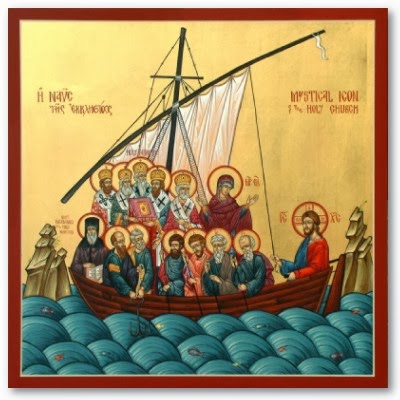
Known, perhaps, but not by very many. Not by enough, at any rate. It is an observance that is simply not very widely observed. I have attempted to plant some seeds among my ecumenical opposite numbers (Roman Catholic and ELCA) in the area where I live and work, but so far they haven't germinated.
Why? Is it because enough people don't care about keeping one more item on the calendar, or because enough people don't care about the underlying issue--unity among all who profess and call themselves Christians? A little of both, I suspect, but if there were more energy around the latter, the former would get more attention.
The number of distinct "brand names" of Christian bodies is staggering. It numbers in the tens of thousands. Given the manifest will of Jesus in his prayer "that they may all be one" (John 17:21), this reality ought to be scandalous beyond imagination. Yet, it isn't. Instead, we have normalized a situation that we don't see any hope of changing. We speak of the proliferation of denominations as representing healthy diversity, veritably a gift from God. Each has its market niche of ethnic or cultural or devotional proclivities, and isn't that wonderful, because then the gospel can reach a wider variety of people? Ecumenism is nice, but not an emergency. Not an emergency at all.
Almost 15 years ago, my own church entered into a "full communion" relationship with the principal Lutheran body in the U.S. We can now swap clergy and members with minimal bureaucratic impedance. In concept, that's a good thing. Ability to share the Eucharist and recognize sacramental ministries is the sine qua non of ecclesial unity. But what comes next in that relationship? It's as if Called to Common Mission has inoculated us against any urge to take it to the next level. We have blunted the scandal in one small corner of the Christian universe, but we have not removed it. There are no laurels to rest on.
Not surprisingly, the churches that remain doggedly, if lethargically, active in the ecumenical project tend to be those that already have a "higher" ecclesiology, to which concerns about church order, sacramental integrity, and historic continuity are organically part of their own identity. But I sense a consistent undertone of tamped-down triumphalism from older church toward those whom they look on (secretly, in most cases) as "spinoffs" from themselves, an attitude of "we'd happily take you back if [fill in the blank]." So Anglicans can look at Methodists, for example, and think (not say, usually), "Well, you're a chip off the old block anyway, right? The Wesley brothers both died Anglicans, after all! And we already sing some of your hymns. So, if you can just promise to be stricter about the historic episcopate and the integrity of your eucharistic rites, we can come together." And Roman Catholics can look at Anglicans and say very much the same thing, with the final condition amended to something like recognizing the universal primacy of the Bishop of Rome. Heck, in this era of Anglicanorum coetibus, they'll let us hang on to various bits of Prayer Book bric-a-brac and our clearly superior hymnody. Of course, the Orthodox can look at the churches in communion with, and under fealty to, the See of Rome, and replicate the same pattern, though I won't presume to articulate the condition.
What of free church Evangelicalism? In America, this represents a huge percentage of those who identify as Christians. Here we're talking about both those who participate in some sort of denominational structure, even if a loose one, wearing a brand label (some kinds of Baptists, for example), and those who either wear their denominational affiliation as an undergarment, or have none at all (including the Willow Creek-style mega-churches). I hope I'm not being either inaccurate or uncharitable if I say, among these groups, ecclesiology as a division of systematic theology barely creates a blip on their radar, so, in the absence of anything intentionally well-thought through, their default ecclesiology is rooted in the notion of the autonomy of the local congregation. Among these folks, many of whom I hold in high esteem because my own youthful roots as a Christian are in that tradition, my experience is that they have effectively mentally blocked out the existence of Christians who are not Christian like they are Christian. In their peripheral vision, they are aware of churches that are just weird (Roman Catholics, Orthodox, most Lutherans and most Anglicans--with passes give to the likes of Lewis, Packer, and Stott) and churches that have jumped the shark on moral issues (old-line Protestants). But, among themselves, they see no functional disunity. Each local congregation is pursuing its mission in its own context and in its own way, but if a bunch of pastors get together for a retreat, they won't think twice about having a communion service, and it wouldn't matter who presides or whether there's an epiclesis; such things just don't occur to them. That may be a good thing; I'm trying to make an observation, not a judgment.
Interestingly, in my last two cures, I was involved with the Greater Warsaw Ministerial Association and the Stockton Leadership Foundation. Both groups were dominated by the attitude I described in the last paragraph. On many levels, I felt a more authentic Christian bond among those colleagues than I do when I'm at a provincial gathering of my own church (General Convention, House of Bishops). But I was also usually frustrated when I was with them for the sheer lack of any ecclesiological substance in their thinking. I don't know how I would have even begun to articulate my concerns to them. There wasn't even enough of a common vocabulary from which to do so, and way too many divergent assumptions.
So we have blinded ourselves to the scandal, either by rationalizing our divisions, by partial measures like full-commuion agreements, by crypto-triumphalism in our ecumenical endeavors, and by severely limiting the section of the playing field that we pay attention to. But the scandal is still there. It still grieves the heart of Christ, and is therefore still an emergency.
A hermeneutic is a fundamental interpretive framework, the default lens through which we mentally process the stream of data on a particular subject. I have a Pandora station dedicated to organ music, and I have, with some effort, taught it to strain out anything that isn't organ music. It has pretty much gotten the algorithm right now, and has an organ music hermeneutic.
At the close of 2014's Week of Prayer for Christian Unity, my hope is that I, and anyone whom I might influence, will adopt a hermeneutic of ecumenism in what we say, what we write, and how we pray. To borrow the rhetoric of liberation theology, this implies a preferential option for ecumenism in our thinking and in our ecclesiastical discourse, as we take our share in the councils of the church.It means we train ourselves to unfailingly ask the question, What are the ecumenical implications if we do X or Y? And if doing X or Y will have an adverse ecumenical impact, we probably then decide not to do X or Y, even if, in our own internal life, it seems right and good.
This is what it means to "seriously lay to heart the great dangers we are in by our unhappy divisions" (BCP, p. 818). It means no longer rationalizing our "sad divisions" as a blessing. It means laying aside the notion that any part of the community of Christian communities possesses the fulness of ecclesial life, but we are, all of us, profoundly broken and incomplete in our state of broken or impaired communion, and that this state of brokenness is the the single most powerful impediment to the prosecution of the Church's mission of reconciling all people to God and one another in Christ. For our free-church Evangelical friends, it means waking up out of their ecclesiological torpor and engaging with more seriousness the fact that Jesus left a church behind when he ascended to the right hand of the Father. It means developing the capacity for restraint, bathing in St Paul's counsel to the Corinthian church that they "wait for one another" (I Corinthians 11:33).
The Church will never die this side of the eschaton. Of that we are well-assured. But that doesn't mean it won't die in Europe and North America, even as it died in North Africa and most of the lands that now comprise Turkey. This is one of the "great dangers" arising from our "sad divisions." When Christianity was the centerpiece of the culture, we could fool ourselves that there was nothing strange about churches of different brand names gracing all four corners of a downtown intersection. We can no longer afford that illusion. Blessed Peter and Paul, pillars of the Church, pray for us.
Now, a bit of a postscript for Anglicans (who are probably the great majority of anyone reading this post anyway): We have, of course, an "ecumenical situation" internally. This is to our great shame, and there are no innocent parties. We will never be able to simply walk back what has been done in the past decade, anymore than toothpaste can be put back into its tube. But we can still have a hermeneutic of ecumenism, a preferential option for unity, going forward, and in so doing, make it less difficult for the generation that comes after us to repair the breaches we have caused in our intemperance and haste. Among other things, this means disentangling ourselves from the secular legal system. Surely we can find those in another wing of the household of faith who can help us resolve our differences over property and other assets charitably and justly. HOB colleagues, I'm talking to you. ACNA friends, I'm talking to you. If you love Jesus, you will heed my advice. Because I'm pretty sure Jesus wants us to try something different, to cast our nets on the other side of the boat, because, whatever we're doing now, they're coming up empty.
Friday, January 24, 2014
Lord Jesus

I am an unrepentant kyrialist.
Yes, that’s pretty much a made-up word. It is not therefore insignificant, however. Quite the opposite.
A case can be made that the earliest Christian creed consisted of just two Greek words, Kyrios Iesus, which works out to three words in English: Jesus is Lord. The expression Kyrie eleison—Lord, have mercy—is one of the oldest bits of Christian liturgy we have. As the tradition of Christian worship developed on the Latin end of the decaying Roman Empire, it became formulaically customary to conclude most any prayer with per Dominum Jesum Christum—through Jesus Christ our Lord—before the Amen.
The word ‘Lord’ is so ubiquitous in Christian devotion and worship, and so rare in ordinary speech (at least, for English speakers outside the UK, where it continues to have some parlance), that it’s taken on the aspect of jargon, a bit of technical vocabulary with very little to connect it with anything outside what has come to be perceived as its native environment. When Christians began using the term, however, the opposite pertained. Everyone had a lord and everyone knew who their lord was. Even the lords had lords. There was a hierarchy of fealty that ran from the lowest rungs of society (slaves) to the highest (the emperor).
So when Christians started announcing that “Jesus is Lord”—indeed, the Lord of lords--they weren’t just indulging in insider religion-speak. They were making a highly political statement, something not only very profound in a theological way, but dangerously seditious. It was seen as a zero-sum game: If ‘X’ is “Lord," then’Y’ is “not Lord.” If X=Jesus, then Y=somebody else who already claims lordship. Ultimately, that somebody else was Caesar. Is it any wonder the first several generations of Christians were persecuted, and a great many put to death?
So, while “Lord” suffers from over-familiarity, it is central to the confession of the historic Christian and Catholic faith. It is central to the vows and promises we make at Baptism and Confirmation (including, for Episcopalians, the much-vaunted Baptismal Covenant).
In recent years, the notion of the Lordship of Christ is once again under attack, only this time from within the Christian community. Some, operating from a feminist perspective, have come to regard it as an emblem of patriarchal oppression, since the word inherently carries heavy masculine baggage. For them, it signifies more than itself; it points to an elaborate apparatus of male hegemony (one is tempted to say “domination,” but that is precisely the point at issue) in the Church, marginalizing and infantilizing half the human population, handicapping the gifts that women bring to the life of the Body of Christ. So there is pressure to, if not completely remove, at least drastically reduce the use of the word “Lord” in liturgical texts. In the Episcopal Church, the present edition of the Book of Common Prayer and the original edition of Lesser Feasts & Fasts came to life just early enough to escape this movement. But anything published since the mid-1980s—The Book of Occasional Services, all the Enriching Our Worship materials, and the proposedHoly Woman, Holy Men, reflects the trend of “de-kyrializing” the liturgy. “Lord” is consistently and nearly universally avoided (though, it has been done presumptively, stealthily, with no direct conversation over the issue).
I invite those who find kyrial language (no more quotes; it’s officially a word now after three uses) offensive to demonstrate any concrete damage it is alleged to have done. I further invite them to weigh that alleged damage against the weight of the Tradition—in scripture, in liturgy, in theology, and in devotion. Yes, I will acknowledge the possibility that certain persons—mostly women, in all likelihood—who have had particular life experiences that are unfortunate, even tragic, but, to the benefit of all, quite rare, may not be helped by associating any notion of God with the word “Lord.” But, I would submit that this is not sufficient grounds upon which to overthrow two millennia (more if you count the Old Testament as it has been mediated to us via Greek and Latin) of tradition.
Liturgy drives theology—or so goes the contemporary wisdom. If we de-kyrialize our worship, we may not be saying right away that “Jesus is not Lord.” Not right away. But we will be opening the door to such a move by the next generation. As our society rapidly secularizes, Christians will need more ways, not fewer, by which to demarcate their identity over against the “Caesars” of consumerism,. nationalism, hedonism, and all the other false gods that demand just a harmless pinch of incense at their altar. Rather than laying aside the notion that Jesus is Lord, we would do better to double down on it, to explain it in ways that don’t cause unnecessary trauma to anyone’s psyche, and enable the baptized faithful to be more clearly and confidently who they are—the redeemed of God, the harbingers of the Kingdom of Heaven.
Kyrios Iesus.
Saturday, January 18, 2014
Oh, Hell ...

Within the context of this maelstrom, of course, certain controverted issues are bound to come up--issues around sexuality and fecundity, for the most part. Of late, cyberspace is abuzz with commentary and speculation about Pope Francis, who has, inside of a year, pulled off an astonishing shift in the tone of what emanates from the Vatican. Some in the journalistic community--mostly representing the secular media "covering" religion, but also some others who should know better--have inconvenienced billions of electrons with their prognostications that, any day now, the Holy Father will take a neutral stance on abortion and shrug his shoulders in a sort of "whatever" assessment of homosexual behavior.
Aside from the amazing and completely vincible ignorance that underlies such wishful thinking, what I find both mystifying and unsettling is the way it's all inevitably tied to Heaven and Hell, as if that's what it's all ultimately about when we cut to the chase and dispense with technicalities and small talk. The Pope says, "Who am I to judge [gays and lesbians]?" and right away the story is about how the Catholic Church no longer teaches that gays and lesbians are going to "burn in hell." Secular journalists and bloggers ineluctably reduce inter-religious differences, and even theological differences between the array of Christian groups, to an issue of who gets into Heaven and who goes to Hell.
Maybe it's my unique perspective, but I see more of this reductionism coming from outside faith communities than from inside. Yes, I know it's possible to find more than a few individual Christians, and the marginal sects and cults with which they are associated, who seem inordinately consumed with the question of who's going to Hell and how hot it will be when they get there. But, for the most part, I don't see much of this among mainstream Evangelicals, old line Protestants, Roman Catholics, Anglicans, or Orthodox. So it seems more or less a convenient hook on which largely secular scribes can hang their impressions of Christianity and other religions.
What a constricted and impoverished understanding of Christianity this is. What a constricted and impoverished understanding of the world this is. I wish Christians, along with those who devoutly practice other religions, would be more vigilant and more aggressive in calling out this fallacy. The reason more don't challenge this view, I think, is because it's not all that far from the views (secretly?) held by many Christians. It represents our Cultural Theology, even if it doesn't represent the formal teaching of any particular church. Hence, it has more of a hold on the imagination of Christians than do formal articulations of doctrine or the words of our worship. It's not what we're really supposed to believe, but it's what others think we believe, so it's what we quietly believe about ourselves.
Let me unpack that a bit. Our Cultural Theology teaches that "good people" go to Heaven when they die and "bad people" go ... well, not to Heaven, at any rate. How many times do we hear somebody caught doing what is by any measure a "bad" thing protest, "But I'm not a bad person!" Of course, well-instructed Evangelicals and well-instructed Catholics will push back on such sentimental claptrap, but, let's face it, how many Evangelicals and Catholics are well-instructed?
Of course, behind this binary Good People:Heaven/Bad People:Hell paradigm is an assumption of a philosophical concept that has been called the "immortality of the soul," i.e. that there is a "spiritual" element in the makeup of a human person that survives the death of the physical body, a continuing consciousness of some sort. Cultural Theology teaches that everybody automatically has this and the only question is the degree of happiness that will be attached to it in the "afterlife." Once again, this is sentimental claptrap, a caricature of a distortion of real Christian belief, and, to the extent that there actually is an upsurge in atheism, it against this intellectual train wreck that most "new atheists" are reacting. I don't blame them.
By contrast, the Christian hope is not anchored in the immortality of the soul. There is no line in any of the creeds about the immortality of the soul. The Christian hope, as we do say in the creeds, is in the resurrection of the body. My hope is not that I will "go to Heaven when I die." My hope is that, sometime after I die, I will be raised with Christ, and live in a body that is material but glorified, like the one in which Jesus appeared after his resurrection. Oh, we can go at it about whether there's an intermediate conscious state between death and resurrection, but that's a second-tier conversation, and it has rather little to do with whether souls are immortal.
In the meantime, there's a bigger picture that we do well to keep our eyes on. The universe is fallen and broken, and God, motivated by deathless love, and having long ago determined not to accept that state, is going about the business of stitching it back together, reweaving the fabric, redeeming it, making it better than it was to begin with. Jesus' incarnation, birth, life, passion, death, resurrection, and ascension--the complex of events we call the Paschal Mystery--is at the core of that redemptive project. Sadly, Cultural Theology and the Paschal Mystery have barely more than a passing acquaintance. If a critical mass of Christian were not deeply in thrall to Cultural Theology, the secular media would have to deal with the Paschal Mystery, and they wouldn't be able to reduce statements by Christian leaders to questions of who's going to burn in Hell.
Now, as a post-script: I do accept the notion of Hell as a logical necessity if one believes in human free will. If we are truly free, then we are free to reject God, to reject God permanently. Hell is the absence of God and the annihilation of the central feature of human identity--the image of God. Whoever is in Hell is there, not because of what they are, or what they've done or not done, or what they've believed or not believed--although those things are not unimportant--but because they have freely chosen to reject God's love. As to whether Hell is actually populated, or for how long, or whether it's a state of conscious suffering--that is its own quagmire, in which I will probably never be sufficiently interested to explore in a venue like this.
Friday, October 04, 2013
Smuggling the Gospel: Lectio Divina on II Kings 19
The Assyrian king Sennacherib is besieging Jerusalem. He boasts of all the kingdoms he has laid waste to; where are their gods, whom they trusted to protect them? King Hezekiah and the inhabitants of Jerusalem would be fools to believe that YHWH would succeed where multitudes of others had failed. Better that they just surrender and be well-treated in captivity rather than die resisting. Resistance is futile!
Hezekiah takes the written message from the Assyrian king and literally lays it out before YHWH in the temple. "What are we supposed to do now?" he inquires. Through the prophet Isaiah, YHWH's response comes: Stand firm. Do not surrender. Sennacherib thinks he's "all that," but the truth is, he's just a tool. He's been "played" by God and he doesn't even know it. All of his victories have happened because they have been in accord with the purposes of God, but the conquest of Judah is not among those purposes. That night, the Assyrian garrison is mysteriously decimated--185,000 troops just "wake up dead" the next morning, and Sennacherib returns to Nineveh (only to be assassinated by his own sons, we learn from other sources).
We see Jesus, the One Who Saves, the Word of the Holy One, present in this passage in the form of Isaiah's oracle; one might even say, in the person of Isaiah himself, which is hugely appropriate, given the significance of the document that has Isaiah's name attached to it in the development of both Jewish and Christian understandings of messianic deliverance.
The remnant of Christendom, if not Christianity itself, is besieged in the western world by the forces of secularization, manifested in a constantly-morphing dance between antipathy and apathy. The dancers seem to be at the heard of a juggernaut. They say to Christianity, "We have already trivialized you and made you irrelevant. Soon we will bury you, and you will be forgotten. You may as well just surrender and enjoy the dance rather than suffer and die resisting us. Resistance is futile!" Individual Christians and church communities are tempted by this invitation, and suppose they can at least buy some time by appearing to cooperate, by accommodating to the demands of secular society. But this is not a strategy for deliverance; it only prolongs the process of inevitable defeat.
Isaiah's oracle comes to us as powerfully as it did to Hezekiah: Stand firm. Do not surrender. Even now the risen Christ is hitching himself to the coattails of secularization, using the very forces that appear to undermine and threaten Christian faith and practice as tools, as "mules" by which the gospel is smuggled into unsuspecting environments. The invitation to the remnant of Christ-followers in the western developed world is to watch, to be alert, to begin to see how God is acting in the unlikeliest of places, in the very currents and trends that seem to be pulling the props out from under the Christian project.
We do well to remain quietly and confidently vigilant, seeking to discern not only how God is acting, but how we might ourselves learn to be smugglers of the good news that "God was in Christ, reconciling the world to Himself."
Hezekiah takes the written message from the Assyrian king and literally lays it out before YHWH in the temple. "What are we supposed to do now?" he inquires. Through the prophet Isaiah, YHWH's response comes: Stand firm. Do not surrender. Sennacherib thinks he's "all that," but the truth is, he's just a tool. He's been "played" by God and he doesn't even know it. All of his victories have happened because they have been in accord with the purposes of God, but the conquest of Judah is not among those purposes. That night, the Assyrian garrison is mysteriously decimated--185,000 troops just "wake up dead" the next morning, and Sennacherib returns to Nineveh (only to be assassinated by his own sons, we learn from other sources).
We see Jesus, the One Who Saves, the Word of the Holy One, present in this passage in the form of Isaiah's oracle; one might even say, in the person of Isaiah himself, which is hugely appropriate, given the significance of the document that has Isaiah's name attached to it in the development of both Jewish and Christian understandings of messianic deliverance.
The remnant of Christendom, if not Christianity itself, is besieged in the western world by the forces of secularization, manifested in a constantly-morphing dance between antipathy and apathy. The dancers seem to be at the heard of a juggernaut. They say to Christianity, "We have already trivialized you and made you irrelevant. Soon we will bury you, and you will be forgotten. You may as well just surrender and enjoy the dance rather than suffer and die resisting us. Resistance is futile!" Individual Christians and church communities are tempted by this invitation, and suppose they can at least buy some time by appearing to cooperate, by accommodating to the demands of secular society. But this is not a strategy for deliverance; it only prolongs the process of inevitable defeat.
Isaiah's oracle comes to us as powerfully as it did to Hezekiah: Stand firm. Do not surrender. Even now the risen Christ is hitching himself to the coattails of secularization, using the very forces that appear to undermine and threaten Christian faith and practice as tools, as "mules" by which the gospel is smuggled into unsuspecting environments. The invitation to the remnant of Christ-followers in the western developed world is to watch, to be alert, to begin to see how God is acting in the unlikeliest of places, in the very currents and trends that seem to be pulling the props out from under the Christian project.
We do well to remain quietly and confidently vigilant, seeking to discern not only how God is acting, but how we might ourselves learn to be smugglers of the good news that "God was in Christ, reconciling the world to Himself."
Tuesday, September 24, 2013
House of Bishops Day 6 (Fall 2013)
Morning Prayer: Pretty straight BCP Rite 2, but with Pascha nostrum as the single canticle set to a chant tune with some fairly funky harmonies ... only there was no accompaniment, and the pure melody imparted a distinctly uncelebratory tone to a quite festive text.
The morning session was entitled "Moving Diagonally," to which I must hereby offer a weak protest, since that's the name of my diary blog. I see now I should probably get the term trademarked. There was a panel, coordinated by Jeff Lee of Chicago and including Dan Edwards (Nevada), Diane Bruce (Suffragan, Los Angeles) and Todd Ousley (Eastern Michigan). Bishops Edwards and Bruce presented first, followed by table discussions; then Bishops Ousley and Lee, followed by more table discussions. (There was a break thrown somewhere in there as well.) I won't attempt to summarize what each one said, but the (assigned) theme concerned making lemonade--transforming loss into new opportunities. Each presenter told us a story of an experience of loss in his or her diocesan ministry, and then about an experience of unexpected blessing in the midst of that loss, growing out of that loss.
I find these presentations challenging on more than one level, not the least of which is their actual content. I'm constantly laying our nascent missionary efforts in the Diocese of Springfield alongside the stories my colleagues tell, looking for connection, validation, new insights, and hope. But I'm also continually aware of my outlier status whenever I engage the larger church. I hear talk of mission, but I realize that while, for me, mission cannot mean very much other than evangelization, it means something very different to many if not most of my colleagues in the House. I hear talk of interfaith cooperation, and then I'm aware that many around me might be aghast at a notion that I--along with the 1979 Book of Common Prayer, I might mention--take seriously: the universality of the gospel, that all people, everywhere and at all times, ought to come to repentance and faith in Jesus Christ in the company of the Catholic Church, and be baptized; put baldly, that it is God's will that everyone become a Christian. I hear talk of righteousness and justice, but then realize that, for me, that includes the sanctity of unborn human life and marriage as a lifelong covenant between one man and one woman, while many around me find those values abhorrent. I should hasten to add that the overwhelming majority of other bishops treat me with utmost kindness and courtesy, and, at times, genuine affection; I have no complaints in that department. And I recognize in them authentic Christian faith and discipleship, despite our profound differences. I honor those who sometimes accuse me and others of "sleeping with the enemy," for not simply writing off most of the HOB as hopeless heretics. But that's not where I am. I couldn't begin to do that. And this is precisely why experiences like the past week are full of what my college psychology professors taught me to name as "cognitive dissonance."
After lunch, we got down to business. Literally. First there was what we call a Town Hall, where various bishops with various pet projects or causes have a chance to address the House and make their pitch. Among these today was a group calling themselves Bishops Against Gun Violence, trying to drum up enthusiasm for a conference in Oklahoma City next year. Then, for the first time since arriving here last week, we formally convened the House of Bishops for a business session, with the Presiding Bishop in the chair and Roberts' Rules in effect. The most substantive item to be considered in this session was a proposal from the Office for Pastoral Development (Bishop Clay Matthews) that the House call for the drafting of a canonical change to be presented to the 2015 General Convention that would bar diocesan staff members from being elected to the Standing Committees of the various dioceses (and some would extend that ban to General Convention deputations and Diocesan Councils). I spoke against the proposal. While it might be laudable in principle, it can easily invoke the Law of Unintended Consequences in smaller dioceses where the "gene pool" is already pretty shallow. It seems to be in response to a particularly nasty situation that we were not told the details of. Is it not usually bad practice to let exceptions drive policy? And can't the dioceses be trusted to handle this sort of thing at a local level? Nonetheless, the motion carried by voice vote, though not by any means unanimously. We'll discuss it again, no doubt, in Salt Lake City in 2015.
I've been watching in horror as the number of emails demanding some action on my part has risen to about fifty. So I once again skipped the Eucharist so I could begin to make a dent, and I managed to get the total down to forty. We then got together as Class of 2011 bishops and spouses in the room of the Bishop of Wyoming and his wife for a little pre-happy hour happy hour. Again, I am remarkably grateful for the companionship and camaraderie we share as a class. It is something quite precious. That led to the actual happy hour (well, maybe not quite so happy, with $6 domestic beers and $9 glasses of wine), followed by the closing banquet (bison New York steak, no less), at which the members of our class were honored for having completed the three-year College for Bishops training and mentorship program. Yes, the strains of Pomp & Circumstance could be heard humming in the background.
The morning session was entitled "Moving Diagonally," to which I must hereby offer a weak protest, since that's the name of my diary blog. I see now I should probably get the term trademarked. There was a panel, coordinated by Jeff Lee of Chicago and including Dan Edwards (Nevada), Diane Bruce (Suffragan, Los Angeles) and Todd Ousley (Eastern Michigan). Bishops Edwards and Bruce presented first, followed by table discussions; then Bishops Ousley and Lee, followed by more table discussions. (There was a break thrown somewhere in there as well.) I won't attempt to summarize what each one said, but the (assigned) theme concerned making lemonade--transforming loss into new opportunities. Each presenter told us a story of an experience of loss in his or her diocesan ministry, and then about an experience of unexpected blessing in the midst of that loss, growing out of that loss.
I find these presentations challenging on more than one level, not the least of which is their actual content. I'm constantly laying our nascent missionary efforts in the Diocese of Springfield alongside the stories my colleagues tell, looking for connection, validation, new insights, and hope. But I'm also continually aware of my outlier status whenever I engage the larger church. I hear talk of mission, but I realize that while, for me, mission cannot mean very much other than evangelization, it means something very different to many if not most of my colleagues in the House. I hear talk of interfaith cooperation, and then I'm aware that many around me might be aghast at a notion that I--along with the 1979 Book of Common Prayer, I might mention--take seriously: the universality of the gospel, that all people, everywhere and at all times, ought to come to repentance and faith in Jesus Christ in the company of the Catholic Church, and be baptized; put baldly, that it is God's will that everyone become a Christian. I hear talk of righteousness and justice, but then realize that, for me, that includes the sanctity of unborn human life and marriage as a lifelong covenant between one man and one woman, while many around me find those values abhorrent. I should hasten to add that the overwhelming majority of other bishops treat me with utmost kindness and courtesy, and, at times, genuine affection; I have no complaints in that department. And I recognize in them authentic Christian faith and discipleship, despite our profound differences. I honor those who sometimes accuse me and others of "sleeping with the enemy," for not simply writing off most of the HOB as hopeless heretics. But that's not where I am. I couldn't begin to do that. And this is precisely why experiences like the past week are full of what my college psychology professors taught me to name as "cognitive dissonance."
After lunch, we got down to business. Literally. First there was what we call a Town Hall, where various bishops with various pet projects or causes have a chance to address the House and make their pitch. Among these today was a group calling themselves Bishops Against Gun Violence, trying to drum up enthusiasm for a conference in Oklahoma City next year. Then, for the first time since arriving here last week, we formally convened the House of Bishops for a business session, with the Presiding Bishop in the chair and Roberts' Rules in effect. The most substantive item to be considered in this session was a proposal from the Office for Pastoral Development (Bishop Clay Matthews) that the House call for the drafting of a canonical change to be presented to the 2015 General Convention that would bar diocesan staff members from being elected to the Standing Committees of the various dioceses (and some would extend that ban to General Convention deputations and Diocesan Councils). I spoke against the proposal. While it might be laudable in principle, it can easily invoke the Law of Unintended Consequences in smaller dioceses where the "gene pool" is already pretty shallow. It seems to be in response to a particularly nasty situation that we were not told the details of. Is it not usually bad practice to let exceptions drive policy? And can't the dioceses be trusted to handle this sort of thing at a local level? Nonetheless, the motion carried by voice vote, though not by any means unanimously. We'll discuss it again, no doubt, in Salt Lake City in 2015.
I've been watching in horror as the number of emails demanding some action on my part has risen to about fifty. So I once again skipped the Eucharist so I could begin to make a dent, and I managed to get the total down to forty. We then got together as Class of 2011 bishops and spouses in the room of the Bishop of Wyoming and his wife for a little pre-happy hour happy hour. Again, I am remarkably grateful for the companionship and camaraderie we share as a class. It is something quite precious. That led to the actual happy hour (well, maybe not quite so happy, with $6 domestic beers and $9 glasses of wine), followed by the closing banquet (bison New York steak, no less), at which the members of our class were honored for having completed the three-year College for Bishops training and mentorship program. Yes, the strains of Pomp & Circumstance could be heard humming in the background.
House of Bishops Day 5 (Fall 2013)
After Morning Prayer at our tables (an amalgam of BCP and Enriching Our Worship--sung guitar-accompanied Venite, said Psalm, Office Hymn sung unaccompanied), our morning panelists were introduced: Mary Frances, church planting director for the ELCA; Becca Stevens, a priest of the Diocese of Tennessee who runs a nationally-acclaimed ministry with women recovering from violence; and Tom Brackett, church planting staff member with 815. Their presentations were each quite compelling. From my standpoint as a small-diocese bishop always on the prowl for usable ideas, I thought Pastor Frances had the most red meat to offer. The ELCA process is quite methodical and structured, and I mean "structured" as in "helpful." As I shared with my table group, from-scratch church planting doesn't figure prominently for us in the Diocese of Springfield at present. We are straining toward a more organic approach in which existing Eucharistic Communities take responsibility for mission in their own geographic parishes, and plant satellite communities that are eventually hived off. But we don't have much to show for it yet, because we're in the process of marshaling our resources and laying foundations. By the time any of our work is visible above ground, we'll already have a strong root system.
Topic One in the afternoon was the ecumenical dialogue between the Episcopal Church and the United Methodist Church. The members of the bilateral group have put in years of work, and are now wanting to move forward toward a full communion agreement such as we have with the ELCA. They're trying to test the waters as to whether their work is ready for prime time at the 2015 General Convention, or whether in needs to ripen some more yet. I have a passionate commitment to ecumenism. There may be be no more important work that Christians do than to heal the visible wounds on the Body of Christ that undermine our witness to the world. And I also want us to do our work well, and not have a proliferation of "Oops" moments as we live into covenants that we agree to. What I will be looking for from our Methodist partners is some evidence that there is a critical mass of buy-in on this at the grassroots level. It matters little to sharpen our pencils and swallow horse pills in areas like ecclesiology and sacramental practice for the sake of ecumenism when clergy and laity "on the ground" in many Methodist congregations (depending on the area of the country) think and act much more like Baptists than like their Anglican forebears.
Topic Two in the afternoon was the sore subject of diocesan giving to the national church. There is no canonical mandate in this area, and a great many dioceses pay less--far less--than the 19% of diocesan income that is asked for. Opinions--and feelings--are all over the map on this. For a number of complex and long-standing reasons, Springfield is one of the very low givers to the DFMS. What might help move us along is if somebody could calculate our proportional share of the actual cost of running General Convention. As long as we continue to send Deputies and a Bishop, I think I could make a case that we need to at least meet that figure--it's only fair. Beyond that, getting into DFMS program, it becomes a much, much tougher sell.
I played hookey from the Eucharist in order to drive Brenda on a semi-urgent shopping expedition to Whole Foods, of which we are lamentably bereft in Springfield. Later in the evening, we met some old and dear college friends--Brenda's roommate and her husband, now living in Franklin--for dinner on the west end of of Nashville. It's rather amazing for four people who first bonded as college students to sit across a table from one another after four decades of life have intervened, and now be talking about our grown children and growing grandchildren. Rather sweet, actually.
Topic One in the afternoon was the ecumenical dialogue between the Episcopal Church and the United Methodist Church. The members of the bilateral group have put in years of work, and are now wanting to move forward toward a full communion agreement such as we have with the ELCA. They're trying to test the waters as to whether their work is ready for prime time at the 2015 General Convention, or whether in needs to ripen some more yet. I have a passionate commitment to ecumenism. There may be be no more important work that Christians do than to heal the visible wounds on the Body of Christ that undermine our witness to the world. And I also want us to do our work well, and not have a proliferation of "Oops" moments as we live into covenants that we agree to. What I will be looking for from our Methodist partners is some evidence that there is a critical mass of buy-in on this at the grassroots level. It matters little to sharpen our pencils and swallow horse pills in areas like ecclesiology and sacramental practice for the sake of ecumenism when clergy and laity "on the ground" in many Methodist congregations (depending on the area of the country) think and act much more like Baptists than like their Anglican forebears.
Topic Two in the afternoon was the sore subject of diocesan giving to the national church. There is no canonical mandate in this area, and a great many dioceses pay less--far less--than the 19% of diocesan income that is asked for. Opinions--and feelings--are all over the map on this. For a number of complex and long-standing reasons, Springfield is one of the very low givers to the DFMS. What might help move us along is if somebody could calculate our proportional share of the actual cost of running General Convention. As long as we continue to send Deputies and a Bishop, I think I could make a case that we need to at least meet that figure--it's only fair. Beyond that, getting into DFMS program, it becomes a much, much tougher sell.
I played hookey from the Eucharist in order to drive Brenda on a semi-urgent shopping expedition to Whole Foods, of which we are lamentably bereft in Springfield. Later in the evening, we met some old and dear college friends--Brenda's roommate and her husband, now living in Franklin--for dinner on the west end of of Nashville. It's rather amazing for four people who first bonded as college students to sit across a table from one another after four decades of life have intervened, and now be talking about our grown children and growing grandchildren. Rather sweet, actually.
Monday, September 23, 2013
House of Bishops Day 4 (Fall 2013)

Many of my "progressive" colleagues in the House of Bishops seem to be all gaga over Pope Francis. Yes, he has a different personal style than his predecessors. I find him a remarkable man, and am both humbled and inspired by his ministry. He is frighteningly Christ-like. But I also happen to agree with most of his positions on controverted issues. And here's the deal: He isn't proposing any changes in either the theological or moral teaching of the Roman Catholic Church. None. If I were a supporter of same-sex marriage, or abortion rights, I could find nothing in the Pope's statements that would lead me to hope that a change in church teaching in these areas is imminent. So why the sudden triumph of style over substance? I not only agree with his views, I also agree with the need he has expressed to change rhetoric and reassess priorities. But many of the same voices that are raised in adulation of the Bishop of Rome still see Episcopalians who share his views as outliers, and benignly and charitably (more or less) consign us to the margins of TEC. Just sayin'. Bit of a mystery here.
The only formal item on the agenda of the House of Bishops today was an evening "Fireside Chat" (the only fire in this case being the computer-generated image of a fireplace projected onto a screen). This is a free-form exchange. The Presiding Bishop usually makes a few opening remarks and then just opens the floor to comments and questions on ... whatever. It's a closed meeting, and is understood to be confidential. So I can't give any sort of narrative account of what was talked about there. I can, however, share my views on various current topics. Let the reader understand.
Earlier in the day, I preached at the two morning liturgies in Hendersonville, at the invitation of their rector, Fr Jody Howard, who contacted me way back in January to nail down this visit. It was a joy to worship with them. Afterward, Fr Jody and his wife Anna took us out to a place called Sopapilla's, which features New Mexico-style cuisine. We acquired a taste for fare of this sort on our vacation in Santa Fe last year. It was scrumptious.
The balance of the afternoon was consumed by lobby conversations with sundry colleagues and spouses, and then a nap.
Sunday, September 22, 2013
House of Bishops Day 3 (Fall 2013)
We began with the Eucharist for St Matthew's Day at 9am. The Bishop of Atlanta presided and Fr Simon Bautistia, one of the HOB chaplains, preached. I really do hate it that I find worshiping at meetings of the House of Bishops more alienating than uplifting. As a good Catholic, of course, I realize that it's not about how I feel. Indeed, if it were about how I feel, I would probably just silently absent myself. But it's not, so I go. Part of the alienation, no doubt, is my responsibility, and I need to own that. But I also need to name my irritation: It's just too laborious. Today the celebrant switched from English to Spanish and back several time--just during the Eucharistic Prayer! Prayer Book rubrics and texts are widely ignored or altered. Our musician, Dent Davidson, has talent oozing out of his pores; he is really good at what he does. But the music is a steady diet of the exotic with occasional smatterings of the familiar as a condiment. I would dearly love to see the proportions reversed: liturgies anchored in the center of the tradition, following Prayer Book texts and rubrics, seasoned judiciously with the exotic. I suppose others would then feel malnourished. What to do?
When we took leave of our spouses and reassembled in our meeting room, we heard first from the Bishop of Southern Ohio, Tom Breidenthal. He delivered a substantive address on the topic, Formation for Mission. It was a sheer delight: solid, rich food for the mind and the soul. It was profound, orthodox, christocentric, grounded in our liturgical praxis, and just plain meaty. He received enthusiastic applause, not just for his prepared talk, but for his extemporaneous responses to questions from the floor for about the next 30 minutes. If I could presume to identify his main point, it would be that mission is not so much something we can prepare for as something we are swept up into--almost involuntarily--in response to an authentic encounter with the grace of God in Jesus. And as a people "on a mission," we are always a people in transit, expelled into the desert in baptism, living on daily manna as we trek through the wilderness, always mindful that we have not yet reached the Promised Land. This meeting is not over yet, but Bishop Breidenthal's talk alone was worth the price of coming.
After a break, and on a rather more prosaic note, we heard a presentation from two representatives of the Church Pension Fund. Mostly, their subject was that beast known as the Denominational Health Plan (DHP). I will be the first to admit that my eyes glaze over pretty quickly when they're presented with spreadsheets and fields of numbers. It's not that I'm incapable of understanding them; I've been known to create a spreadsheet or two myself from time to time. But it takes extraordinary effort not to be terminally bored. Let me just say that I am extremely grateful to the CPG/DHP for what they have accomplished in bringing down the premiums for the Diocese of Springfield by significant amounts two consecutive years now (despite my personal best efforts to drive them higher by having open heart surgery).
Next we heard from Bishop Stacy Sauls, Chief Operating Officer of the Domestic and Foreign Missionary Society (DFMS), which is the Episcopal Church's public incarnation under New York corporation law. This is the infamous '815', the "national church." Bishop Sauls spoke of his desire to reorient the staff culture of the DFMS from a hierarchical model of a "home office" receiving financial resources up the stream and delivering program down the stream, to one of facilitation, connection, and coordination in support of ministry and program that take place at a local level. To push this cultural shift along, he has instructed DFMS staff to shed that moniker in favor of simply The Missionary Society.
My two cents: Even insiders, who know about the origin of the DFMS in 1835 and its evolution since then, have an awkward time articulating the precise relationship between the DFMS per se, and the prior and more fundamental (but unincorporated) entity known the Episcopal Church. The vast majority of Episcopalians are gratefully unaware that there is such a thing as the DFMS, and most clergy can't think of a compelling reason to make that the topic of the next Rector's Forum. I don't see how this branding change makes anything clearer. It may indeed have the opposite effect by adding another layer of nomenclature complication.
When we adjourned at 12:30, that was it for the day. We entered "Sabbath" time until tomorrow evening. After a lively lunch with my old friend, the Bishop of Northern Indiana, Ed Little, I returned to my room to process emails, grab a good nap, and take several vigorous laps around the perimeter of the hotel property en route to the 8500 step mark on my pedometer.
The evening was set aside for Class dinners. (I am a member of the Class of 2011, which includes all bishops who were elected in 2010.) Our class is currently the largest, with 12 bishops and 10 spouses. We're missing one bishop and spouse at this meeting, but there were still 20 of us to fill a long table at a nearby restaurant. If the metric is how much we all enjoy one another's company, and how supportive we are of one another, then the Class of 2011 is arguably the best class!
When we took leave of our spouses and reassembled in our meeting room, we heard first from the Bishop of Southern Ohio, Tom Breidenthal. He delivered a substantive address on the topic, Formation for Mission. It was a sheer delight: solid, rich food for the mind and the soul. It was profound, orthodox, christocentric, grounded in our liturgical praxis, and just plain meaty. He received enthusiastic applause, not just for his prepared talk, but for his extemporaneous responses to questions from the floor for about the next 30 minutes. If I could presume to identify his main point, it would be that mission is not so much something we can prepare for as something we are swept up into--almost involuntarily--in response to an authentic encounter with the grace of God in Jesus. And as a people "on a mission," we are always a people in transit, expelled into the desert in baptism, living on daily manna as we trek through the wilderness, always mindful that we have not yet reached the Promised Land. This meeting is not over yet, but Bishop Breidenthal's talk alone was worth the price of coming.
After a break, and on a rather more prosaic note, we heard a presentation from two representatives of the Church Pension Fund. Mostly, their subject was that beast known as the Denominational Health Plan (DHP). I will be the first to admit that my eyes glaze over pretty quickly when they're presented with spreadsheets and fields of numbers. It's not that I'm incapable of understanding them; I've been known to create a spreadsheet or two myself from time to time. But it takes extraordinary effort not to be terminally bored. Let me just say that I am extremely grateful to the CPG/DHP for what they have accomplished in bringing down the premiums for the Diocese of Springfield by significant amounts two consecutive years now (despite my personal best efforts to drive them higher by having open heart surgery).
Next we heard from Bishop Stacy Sauls, Chief Operating Officer of the Domestic and Foreign Missionary Society (DFMS), which is the Episcopal Church's public incarnation under New York corporation law. This is the infamous '815', the "national church." Bishop Sauls spoke of his desire to reorient the staff culture of the DFMS from a hierarchical model of a "home office" receiving financial resources up the stream and delivering program down the stream, to one of facilitation, connection, and coordination in support of ministry and program that take place at a local level. To push this cultural shift along, he has instructed DFMS staff to shed that moniker in favor of simply The Missionary Society.
My two cents: Even insiders, who know about the origin of the DFMS in 1835 and its evolution since then, have an awkward time articulating the precise relationship between the DFMS per se, and the prior and more fundamental (but unincorporated) entity known the Episcopal Church. The vast majority of Episcopalians are gratefully unaware that there is such a thing as the DFMS, and most clergy can't think of a compelling reason to make that the topic of the next Rector's Forum. I don't see how this branding change makes anything clearer. It may indeed have the opposite effect by adding another layer of nomenclature complication.
When we adjourned at 12:30, that was it for the day. We entered "Sabbath" time until tomorrow evening. After a lively lunch with my old friend, the Bishop of Northern Indiana, Ed Little, I returned to my room to process emails, grab a good nap, and take several vigorous laps around the perimeter of the hotel property en route to the 8500 step mark on my pedometer.
The evening was set aside for Class dinners. (I am a member of the Class of 2011, which includes all bishops who were elected in 2010.) Our class is currently the largest, with 12 bishops and 10 spouses. We're missing one bishop and spouse at this meeting, but there were still 20 of us to fill a long table at a nearby restaurant. If the metric is how much we all enjoy one another's company, and how supportive we are of one another, then the Class of 2011 is arguably the best class!
Saturday, September 21, 2013
House of Bishops Day 2 (Fall 2013)
After breakfast in the hotel restaurant with our friends Bishop Marty and Donna Field of West Missouri, the work day for bishops began at 9am with Morning Prayer at our meeting room tables, while the spouses headed out for a field trip to Thistle Farms.
We then got into our morning session, which featured four presentations followed by a panel discussion around the themes of justice and reconciliation. The presenters and panelists were Bishop Suheil Dawani of the Diocese of Jerusalem and the Middle East, Hisham Nassar, MD, also of that diocese; Rabbi Steven Gutow, Executive Director of the Jewish Council for Public Affairs; and Canon David Porter, the Archbishop of Canterbury's Director of Reconciliation. The Diocese of Jerusalem is in fund-raising mode, mostly to help fund their expansive educational and medical social ministry in four countries, mostly among non-Christians, and the presentations were aimed at supporting that project. I was particularly struck by one of Bishop Dawani's slides that quantified the decline of Christian numbers in the Holy Land over the past century. As recently as the end of World War II, Syria was one-third Christian and the city of Bethlehem has a solid Christian majority. Now, for a combination of reasons, there is a danger that Christianity will disappear from the land where Christianity was born. Rabbi Gutow was a compelling advocate for a fearless tenacity in the struggle for reconciliation between Israel and the Palestinians, and a two-state solution. Canon Porter, who is Scots-Irish from Belfast, brings impressive credentials to his new position on the Archbishop's staff. He ended with the sobering reminder that peace and reconciliation are usual quite costly. Usually, somebody who deserves justice doesn't get it. But embracing that difficult truth is preferable to perpetuating the cycle of violence, and lies at the very heart of gospel ministry.
As I shared with my Table 7 colleagues during our discussion time, I often feel more than a little bit hypocritical as I speak about the reconciling power of the gospel when I operate in an ecclesial environment that is still wounded and bleeding. The smoke may be cleared, but corpses and casualties still litter the field of battle. Whatever side of the Anglican Wars one sits on, there is still tremendous anger, grief, and pain all around. Sadly, there's also a lot of denial and demonization--in all directions. There are essential conversations to be had that aren't even on anybody's calendar yet. There are truths that need to be told, but there's no safe place in which they can be told and heard. The House of Bishops has the capacity to become such a place. But I don't see it on the agenda.
Taking advantage of the fact that I drove here, I got in my car and found some nice fast/comfort food for lunch.

 The first part of the afternoon was given over to a report from the bishop members of the Task Force for Reimagining the Episcopal Church, aka TREC. This group has an expansive mandate from General Convention 2012--probably an impossible mandate. We were briefed on their progress to date, and their expectations about how the process will continue to roll out over the next couple of years. We were then given the follow questions for table discussions:
We then got into our morning session, which featured four presentations followed by a panel discussion around the themes of justice and reconciliation. The presenters and panelists were Bishop Suheil Dawani of the Diocese of Jerusalem and the Middle East, Hisham Nassar, MD, also of that diocese; Rabbi Steven Gutow, Executive Director of the Jewish Council for Public Affairs; and Canon David Porter, the Archbishop of Canterbury's Director of Reconciliation. The Diocese of Jerusalem is in fund-raising mode, mostly to help fund their expansive educational and medical social ministry in four countries, mostly among non-Christians, and the presentations were aimed at supporting that project. I was particularly struck by one of Bishop Dawani's slides that quantified the decline of Christian numbers in the Holy Land over the past century. As recently as the end of World War II, Syria was one-third Christian and the city of Bethlehem has a solid Christian majority. Now, for a combination of reasons, there is a danger that Christianity will disappear from the land where Christianity was born. Rabbi Gutow was a compelling advocate for a fearless tenacity in the struggle for reconciliation between Israel and the Palestinians, and a two-state solution. Canon Porter, who is Scots-Irish from Belfast, brings impressive credentials to his new position on the Archbishop's staff. He ended with the sobering reminder that peace and reconciliation are usual quite costly. Usually, somebody who deserves justice doesn't get it. But embracing that difficult truth is preferable to perpetuating the cycle of violence, and lies at the very heart of gospel ministry.
As I shared with my Table 7 colleagues during our discussion time, I often feel more than a little bit hypocritical as I speak about the reconciling power of the gospel when I operate in an ecclesial environment that is still wounded and bleeding. The smoke may be cleared, but corpses and casualties still litter the field of battle. Whatever side of the Anglican Wars one sits on, there is still tremendous anger, grief, and pain all around. Sadly, there's also a lot of denial and demonization--in all directions. There are essential conversations to be had that aren't even on anybody's calendar yet. There are truths that need to be told, but there's no safe place in which they can be told and heard. The House of Bishops has the capacity to become such a place. But I don't see it on the agenda.
Taking advantage of the fact that I drove here, I got in my car and found some nice fast/comfort food for lunch.
The first part of the afternoon was given over to a report from the bishop members of the Task Force for Reimagining the Episcopal Church, aka TREC. This group has an expansive mandate from General Convention 2012--probably an impossible mandate. We were briefed on their progress to date, and their expectations about how the process will continue to roll out over the next couple of years. We were then given the follow questions for table discussions:- What do you want to hang onto? Let go of?
- What is the best possible TEC future? How does TEC look in 10-20 years? What is it known for?
- What initiatives are needed for TEC to reach this future state? Where does TEC need to innovate? Where does TEC need to reimagine how it works? What is your role: As a bishop? As the House of Bishops?
Our responses were tabulated. We will soon be asked to engage questions like these at the diocesan and parish level.
The second half of the afternoon was owned by the House of Bishops Ecclesiology Committee. Most of the bishops were not aware there was even such a thing as an HOB Ecclesiology Committee, and my impression was that most had not read the "primer" on ecclesiology that the committee had prepared and which was shared with bishops barely a week ago. This document sets forth an understanding of Episcopal Church polity that runs counter to that articulated by the Bishops' Statement on Polity, a 2009 document to which I and my Communion Partner colleagues are committed. After some opening remarks by committee chair Pierre Whalon, TEC in Europe, we were turned loose for table discussions. When we reconvened and feedback was solicited, there was a consistent theme of discomfort with the notion--whether set forth historically or theologically--that General Convention has metropolitical authority, that we have eschewed having an archbishop, but that General Convention is, in fact, our archbishop. There were several other technical and historical errors that were pointed out as well. So my sense is that this document has effectively been re-referred to the committee that produced it, and that we will probably hear from them again down the road sometime.
We adjourned in time to freshen up before coming back together for Eucharist at 4pm, observing the lesser feast of James Coleridge Patteson and His Companions. The Bishop of New Jersey presided, and Stephanie Spellers, one of our HOB chaplains, preached a rather fine homily. We were then all bused to the 28th floor offices of a downtown Nashville law firm for an elegant--and scenic--reception with drinks and hors d'oeuvres. When the reception wound down, Brenda and I ran off with our old friends Bishop Jay and May Ruth Lambert for dinner at the Nashville iteration of the Key West icon Margaritaville. Jay was my parish fieldwork supervising rector while I was in seminary, so we had a lot to catch up on. In the late 1980s, neither one of us would have imagined meeting under the circumstances that brought us together tonight.
Thursday, September 19, 2013
House of Bishops Day 1 (Fall 2013)
We gathered at 9am, with words of welcome from the Presiding Bishop. Then it was time for our customary "check-in" time with our table-mates. Table assignments are shuffled and re-dealth for the first meeting after every General Convention, then remain in effect through the next General Convention. So this is our second meeting with the current table assignments. I am with the Bishops of Missouri, Western North Carolina, El Camino Real, and Northwestern Pennsylvania.
After some further brief words from John Bauerschmidt, Bishop of the host diocese of Tennessee, and Gay Jennings, President of the House of Deputies, who is here as an invited guest, we adjourned to a nearby room for the Eucharist, commemorating the lesser feast of St Theodore of Tarsus, at which the Presiding Bishop was celebrant and preacher. All the liturgies at meetings of the House have, in my experience, tended to be wildly multi-lingual in text and song. Today we jumped between Spanish, French, Creole, Swahili, and, occasionally, English. I understand and endorse the motivation to be hospitable toward those in our midst who are not fluent in English, but I wish we would do so differently. Making every occasion of worship completely polyglot is distracting to the point of annoyance.

We reconvened afterward with our principal guest presenter of the day, the Revd Dr Elaine Heath, a United Methodist cleric and a professor of evangelism at Perkins School of Theology in Dallas. She is also the founder of the Missional Wisdom Foundation, an umbrella organization operating several different projects, all of which attempt to respond creatively to the challenge of a secularized post-Christian cultural context.
In many ways, the vision cast by Dr Heath hits my personal sweet spot. Anyone in my diocese with open eyes and ears has heard me talk about the imperative of making a mental shift from what the theoreticians call "attractional church"--expecting "them" to come to "us"--to "missional church"--where we expect "us" to go to "them." She uses the J-word easily and naturally, and that's something I really like to hear. There is a great deal in the way she articulates her theology that I completely resonate with. I particularly appreciate her use of the translation of John 1:14 that talks about the Word becoming flesh and "mov[ing] into the neighborhood." Reclaiming the incarnational dimension of mission is spot on. So I am more than a little intrigued by what the Missional Wisdom Foundation is up to, and I encourage you to explore their website. To those in the Diocese of Springfield: There are some potential ideas for us here.
Still, I left the afternoon session with some uneasiness. Dr Heath gave us the following definition of evangelism:
The holistic process of initiation of persons into the reign of God, revealed in Jesus Christ, empowered by the Holy Spirit, anchored in the Church, for the transformation of the world.What do you think? To one who thinks in Catholic terms, as I endeavor to do, "initiate" strongly connotes baptism, and baptism connotes repentance, faith, and conversion. Yet, I heard our presenter offer so many caveats and qualifications, so many assertions of what evangelism is not (coercive, exploitative, etc. etc.), that I was left wondering how she recommends that we actually ... you know ... close the deal. I'm all for doing deep listening and building authentic relationships, but at some point somebody needs to pop the question, "Would you like to become a disciple of Jesus?" ... and then proceed to catechesis and the font. Maybe she gets to that stuff and just didn't have time to today. That could well be.
But my bigger problem is with the last line: "... for the transformation of the world." I get really quesy when I hear the suggestion that "making the world a better place," or "realizing God's dream" is the end product that validates everything we invest into the engine that supposedly produces it -- like evangelism, prayer, worship, spiritual formation, and even social ministries. "Transforming the world" is not the mission of the Church and it is not the point of the Gospel. The biblical vision is not of a transformed world, but of a cataclysmically destroyed world that is re-created, made new. There are foreshadowings of divine redemption in the world we live in; in fact, what the Church is supposed to be up to is modeling in her own life that new world, offering a sneak preview of coming attractions. But it is God who makes it happen, and pretty much without even our cooperation, let alone our help, and after a fearsome crisis of some sort. Read II Peter. Read the gospel parables about how the Kingdom of God comes.
Evensong (of a sort) followed. Then, after some down time, social hour and banquet-style dinner, all very nice. The after-dinner entertainment was singer-songwriter Kate Campbell, a country musician who is actually from Nashville. She was very engaging, and I found a couple of her songs actually quite moving.
Friday, August 02, 2013
Oh Canada


On the way to that abundant grace, however, there were some moments of anxiety. One was when we got around to making air travel arrangements and discovered Porter Airlines, whose fares to Halifax were enough lower than those of the standard brand names that we couldn't just ignore it. Our fear was that it was built on the model of "low cost" airlines that snag passengers with low published fares, but then charge for every conceivable amenity. At first, this suspicion was borne out, as we did have to pay extra to book seat assignments online at the time we purchased the tickets. But on the day of travel, we were mightily impressed: very short check-in line at Midway (and no kiosk to deal with ... straight to a human being), no charge for checked baggage, access to the priority line for security screening, a unique and very classy in-flight magazine, staff in "retro" uniforms, uncrowded seat distribution in the aircraft, and beverages served in real glass. All Porter flights either originate or conclude at their Toronto hub, which is the small island airport on Lake Ontario right in front of downtown, affording a spectacular view on every takeoff and landing. Presently, they only fly the same model of Bombardier turbo-prop on all their routes, but they are negotiating for permission to land jets in Toronto (a "quiet" Bombardier model), and expand their footprint to western Canada, California, and Florida. Three cheers (one-and-a-half each from Brenda and me) for Porter Airlines.
After a substantial layover in Toronto, and a fifteen minute "station stop" in Montreal (spectacularly impressive from the air; so much "waterscape"), we landed in Halifax around 6:45pm, Atlantic time (one hour earlier than eastern). After picking up our rental car, and making a wrong turn onto a freeway after exiting the airport because all of our electronic devices seemed to be on strike, this put us in the driveway of the property manager for our rental around 10pm, slightly frustrated but happy to have arrived. En route, we stopped in the community of Windsor to get something to eat because we'd had no serious food the entire day. We knew we weren't in Illinois anymore because the local McDonald's had a McLobster sandwich on the menu ... and because everybody in the McDonald's was ... so darn nice. This is a cliche about Canadians, I realize, but all stereotypes have to originate somewhere, and I can see where this one came from. It was our consistent experience during the entire trip.
Actually, Americans pretty much just don't know what to make of Canada. Here was have a geographically vast but sparsely populated country across our northern border, with a culture that seems substantially the same as ours, or, at least, with no greater differences than between the various regions of the U.S. To the attuned ear, they have a distinctive way of speaking English, but they are a lot closer to the U.S. standard accent than either of us are to our mutual British cousins. It's relatively easy for a Canadian to "pass" south of the border, as many have even while attaining celebrity status (Peter Jennings and Michael J. Fox, inter alia). But a bunch of them speak French, and all the official signs are in both languages. And they have learned to think in meters and grams and degrees of Celsius, all of which tend to vex most Americans. Their money is strange, but I found it much easier to get used to than in Britain. They have eliminated paper denominations lower than five dollars, but comfortably circulate one-dollar (the "loony") and two-dollar coins. More recently, that have begun to phase out the penny, rounding cash transactions to the nearest multiple of five cents. All this seems eminently reasonable, and I don't know why we haven't done it yet here.
As I said, we chose Annapolis Royal with no more intentionality than if we had thrown a dart at a map of the maritime provinces while blindfolded. (We would indeed have been delighted if the dart had landed on Prince Edward Island, on account of its Anne of Green Gables associations.) As it turned out, we ended up in what is arguably the birthplace of Canada. The first European settlement in what is now Canadian territory, a French fur-trading outpost just a few miles down the river basin from Annapolis Royal, was established in 1605. This is two years before the Virginia settlement at Jamestown and a full fifteen years before the Mayflower landed at Plymouth Rock. In fact, the French
 |
| A reconstruction of the 1605 French settlement. |
A group of Scots established Charlesfort on the current site of A.R. in 1629 (thus planting the seed for the enduring name of the entire region--Nova Scotia, New Scotland), only to abandon it to the French three years later, who renamed it Port-Royal. As such, it became the capital of the French colonial province of Acadia. But there was constant conflict, with the real estate changing hands several times, for the next 125 years. In 1755, with the British finally in permanent control, and the town having been renamed Annapolis Royal (a combination of the French name and homage to the current British monarch), the French community--the Acadians--were deported. Some of them found their way to the Franco-friendly territory of Louisiana, where they have since become known as Cajuns (a corruption of "Acadians").
 |
| Facsimile of Acadian cabin |
While reading the Toronto Globe & Mail on the plane while en route home, I ran across this op-ed piece that crystallized some of what I felt during our brief Canadian sojourn. Of particular interest was the author's comment about the lack of a dominant coherent narrative of Canadian history ... among Canadians. This came as news to me. Of course, as an American, most anything about Canadian history comes as news. I can recite a few factoids about Canadian politics since World War II, though not enough, but, as a student in suburban Chicago public schools in the 1950s and 60s, I was taught nothing about Canada. Zilch.
What I did learn was that the United States, by contrast, does have a compelling narrative of its own history: George III was an evil tyrant who mistreated his good-willed subjects in the American colonies (it never occurred to me to wonder about the British colonies in what is now Canada), leading the freedom-loving colonists to, reluctantly, declare their independence and set up the United States of America, a shining beacon of liberty and democracy that is an inspiration to the entire rest of the world. Brier Island (from whence we embarked on a whale-watching tour), a historical marker matter-of-factly refers to the leaders of the American Revolution as "rebels" and indicates that several families on the island yet bear the names of deported loyalists from the 1780s. That may not constitute a coherent narrative of Canadian history, but it is certainly a pretty coherent counter-narrative of the American Revolution!

Nova Scotia is shaped more or less like the head of a hammer, with two large peninsulas extending either direction from its connection to the mainland. The southern and western peninsula is separated from New Brunswick by the Bay of Fundy. (I have to confess ... I am so conditioned to hear "fundy" as a shorthand for "fundamentalist" that it was difficult to resist snickering when I saw commercial signs like "Fundy Electric" or "Fundy Cleaners" or the "Fundy Restaurant" in Digby, where we enjoyed a wonderful dinner of steamed lobster.) The Bay of Fundy is distinguished, due to a combination of geographical quirks, by being the locus of the highest tides in the world. And
 |
| Ebbing tide |
As I mentioned upstream, our lodging was in a "converted" (interesting re-purposing of religious language) church building. I anticipated feeling a little awkward about this, given that I superintend a handful of buildings that are potentially vulnerable to such a "conversion" sooner than we like to imagine. But I was gratified to find that those who have planned and maintained the makeover have endeavored to honor the building's first use even as they have done an outstanding job providing for its second use, and all without trivializing, cheapening, mocking, or exploiting. Not an easy needle to thread, but they did it.

 Yet, St Alban's is by no means unique in its status as a "redundant" church in the area. I was encouraged when I discovered that there is a functioning Anglican parish in Annapolis Royal, and certainly no longer a need for a "chapel of ease"in Lequille, not even a ten minute drive from St Luke's, in A.R. Indeed, the adjacent graveyard, still labeled "St Alban's Anglican Cemetery," is still very much in continuing use, welcoming as new guests Anglicans and others from the entire area. I have seen statistics indicating that, just a few decades ago, the observance of Christianity was higher among Canadians even than the population of the U.S. Judging from the number of church buildings that dot the landscape in the areas where I traveled, I can believe this. But it's safe to say that Canada is now generally further on down the road of post-Christian secularization than the U.S. is, which is pretty far. Probably a third of the buildings I saw that were originally constructed as churches were no longer being used as such. Some had been "converted" along the lines of St Alban's, some were maintained but with no signage or other indication of current use, and some were derelict.
We hope we can return to Annapolis Royal and to Nova Scotia. We didn't get to spend nearly enough time in the Kejimkujik National Park in the center of the southern/western peninsula. We missed the part of Nova Scotia that faces squarely into the majesty of the north Atlantic (though we did have a premium encounter with about six humpback whales in the Bay of Fundy). We also completely missed the city of Halifax, other than the airport. And I have about twenty dollars in Canadian cash that I still need to find an opportunity to spend.

Subscribe to:
Posts (Atom)