Thursday, November 30, 2023

Still Active

 Dear Google:

This is still an active account. Please do not delete it.

Dan

Monday, July 16, 2018

2018 General Convention: Wrap-Up

Back home now, recovering a sense of normalcy after the hothouse environment of General Convention, and getting ready to take myself out of action for a about a month later this week--annuel summer holiday. So, some quick thoughts while it's all still somewhat fresh.

This was my sixth convention, spanning fifteen years--three as a Deputy and now three as a Bishop. Of the six--and, frankly, also of the handful that I followed prior to 2003--I feel comfortable in saying that this one was, in terms of end results, the least horrible of the bunch. 

Let's be clear: the outcome was not in any way good. The Episcopal Church has arrogated to itself authority that it does not inherently have, and redefined a sacramental relationship that was instituted by God in creation. That is monumental hubris. And, to add insult to injury, it has deprived bishops of the authority of teaching and liturgical leadership that does properly inhere in the episcopal office. This is scandalous, and a source of shame.

All that said, the silver lining is that the "progressive'" juggernaut, for the first time in my memory, came away with significantly less than it had sought. They had aimed for quick insertion of the new marriage rites into the Book of Common Prayer, and amendment of the catechism. They got neither. They had sought to begin a formal process of comprehensive Prayer Book revision, culminating in a second constitutional reading in 2030. Instead, convention opted for an indeterminate season of creative liturgical anarchy for an by those who want such things, but with the current book enshrined as the constitutional standard indefinitely. And the Prayer Book is the locus of the doctrine of the Episcopal Church. This is not ground that will be held without a struggle. Vigilance is necessary. But we have evaded the ecclesiastical equivalent of nuclear war. This is reason to give thanks.

Friday, July 13, 2018

2018 General Convention, Day 11

It's over. And sooner than expected. While I was at lunch with some bishop colleagues, we learned that the House of Deputies had adjourned. When the HOB came back to order at 2:30, we had exactly one substantive resolution to concur with, and then the Committee of Dispatch informed the Presiding Bishop that we had completed our legislative agenda, and we adjourned before 2:45. This is the earliest adjournment I can remember from my six General Conventions.

There's lot that can be and needs to be written about this 78th such event, and I will have more to say over the weekend. For now, I'l simply observe that we try to do way too much, and therefore probably don't do a lot of it very well. As the HOB was flying fast and low this morning, I had about ten seconds to look at a resolution before being asked to vote on it. Yes, I could have done in advance, but ... in the name of all that is real ... when? So much of what we are asked to do is utterly unnecessary to the good order and common life of the dioceses of the Episcopal Church. 

We could start by banning all resolutions that have to do with public policy, because nobody cares! We're in an echo chamber pretending that we have the power to actually do anything, when we don't. Then, we could continue by banning all resolutions that merely "encourage" or "suggest" or "call on." Usually, they're about stuff that's already happening. Those who are interested are doing it anyway, and those who aren't are never even going to notice.

More later. But ... so glad this is behind us.

Thursday, July 12, 2018

2018 General Convention, Day 10

General Convention was doing its part to "keep Austin weird" today. Never before in my experience in the House of Bishops has legislative activity just ground to a halt. We spent probably two hours today just "standing at ease" with nothing to do, because we were all caught up on resolution for which the HOB was the "house of initial action," and the stream of legislation from the House of Deputies dried to a trickle, and then was gone completely. There was some speculation that there are so many new Deputies this time--more than 40%--that parliamentary discipline has eroded, with people lining up to "pile on" in favor of motions that are clearly going to pass, and opposing motions that are clearly going to either pass or fail, and this eats up time. At any rate, the bishops took advantage of this for a lot of informal collegial conversation. 

The really big and really hot resolutions are behind us now. I've already written about them at some length, and will have some summary comments when the convention is completely in the rear view mirror, probably after I'm home, sometime Sunday. On a second tier, we passed two today that I think are kind of problematic. 

One is a partially revised Book of Occasional Services. Much of the SCLM proposal was sent back to them for more work, but a great deal was considered by the majority ready to be let loose in the wild. I don't have the time right now to enumerate my concerns in detail, but most inevitably spring from the guiding hermeneutic of expansive/inclusive language, which means instances of masculine pronouns and images for God (Father, Lord, Almighty, inter alia) being ruthlessly redacted. It's the cumulative effect of such efforts that undermine the whole collection. Any single given instance of swapping our "Lord" in a prayer for "Savior," for example, is arguably innocuous. But when I look over the results from a balcony level, I'm not sure I recognize the faith of the Church Catholic. I just don't.

Concerns are similar for a collection of emendations of the Eucharistic Prayers for Rite II, putting them into the new non-offensive idiom, and authorizing them for trial use. This one was a fiarly hasty and recent effort by a single priest, who found some supportive Deputies to move it along. It had some egregious problems, some of which were fixed by the Deputies before we got it (kudos to them), but it's still half-baked and highly problematic. To my chagrin, they will now be authorized rites--of course, canonically subject to the authority of the Bishop.

Wednesday, July 11, 2018

2018 General Convention, Day 9

Convention has reached the point where anxiety rises about getting all the work done that's supposed to get done. Most of the committees have wound down; mine finished its work this morning at 8:30, after meeting for an hour. By contrast the legislative sessions are getting more frenetic. Time limits on debate are more strictly enforced--both the total time on any given issue and the time allotted to each speaker. Amendments are discouraged, because, by this time, each house is in the place of being asked to concur with an action already taken by the other, and with a time certain for adjournment of Friday at 5:00pm, there's limited time for legislative volleyball between the two houses. So, for me, the good news is that I can sleep in a bit tomorrow, since there's no committee meeting. The bad news is that the presiding officers have exercised their option of scheduling a legislative session for this evening (I write around 5:30).

The most significant debate in the House of Bishops today was on Resolution B012. It actually began life several months ago in the Task Force for the Study of Marriage. Its stated objective was to remove the ability of bishops to simply proscribe the celebration of same-sex marriage in their dioceses. In that form, it was named A085. Then, a couple of weeks ago, three moderate bishops introduced a resolution, which was named B012, that was intended to be friendlier to the conservative theological minority. It still mandated that SSM be made available "conveniently" to all who ask for it, but gave dissenting bishops the option of assigning the parish making the request to the oversight of another bishop (aka DEPO). 

In the legislative sausage grinder, A085 was folded into B012, with the language about DEPO significantly weakened (though not obliterated) and with a great deal of ambiguity about whether even rectors can decline to host such a celebration, apparently running afoul of canons that give rectors full control over what happens on their church property. The House of Deputies passed B012 in this form. Within the last 24 hours, the original movers of the original B012, along with the bishops on Committee 13, in consultation with the Presiding Bishop's chancellors, produced a slightly cleaned-up version that clearly retains the authority of a rector over church property, and it came to the bishops in that amended form. It passed on an overwhelming voice vote, and now goes back to the Deputies to concur (or not) with the amendment.

I am very pleased the B012 passed, and hope the Deputies concur. It is significantly less problematic than other versions of itself that were floating around the General Convention ether a few days ago. I am grateful for the charitable work of so many in moing toward a viable compromise. 

However, I did not vote for it. I abstained, when it became clear that my vote would not be needed for it to pass. It is unconscionably wrong to erode the authority of a bishop to exercise the ministry of chief teacher and chief liturgical officer in a diocese. I'm grateful that there's a path--a painful one, to be sure, but a clear one--for keeping the spiritual fingerprints of both the diocese and its bishop off a liturgical act that purports to be what it simply cannot be, and which denies the first article of both the Apostles' and Nicene Creeds, that God is "Creator of heaven and earth." As the Archbishop of Capetown reminded us yesterday, the male-female binary is part of creation. Marriage is not a human social construct. It is God-ordained. General Convention is presuming to deal with a matter well above its pay-grade.

So B012 was the "least bad" possible outcome. The church is a political animal, and politics, as has been said, is the art of the possible.

Among my concerns going forward is that both B012 and A068--the resolution on liturgical revision (it's not quite accurate to call it Prayer Book revision anymore), which is passed by the Bishops yesterday and concurred with by the Deputies today--will get spun in opposite directions by the two main sides (one much larger than the other), and we'll end up with a classic batch of "Anglican fudge." I'll probably have more to say about that in due course.

Tuesday, July 10, 2018

2018 General Convention, Day 8

A couple of vignettes from my committee meeting this morning are illustrative of the state of things in the Episcopal Church these days:
  • In revising the revision of the Book of Occasional Services, one member, a bishop, pointed out the conclusion to a prayer in one of the liturgies, a conclusion that was attempting to be trinitarian without using masculine language (Father, Son), so it read, "Creator, Word, and Holy Spirit." The bishop (rightly) observed that to use "Creator" as a surrogate for "Father" is theologically questionable, since all three Persons of the Godhead are involved in the act of creation. So he suggested "Fount" instead, citing ancient sources as precedent. This led to a longish time of vigorous debate, and the committee finally settled on "Holy and Undivided Trinity" instead of delineating the individual Persons. This is ridiculous, of course, because you can't indefinitely avoid saying "Father" when talking about God. You can temporarily do so for some individual instance--though, as we saw today, not easily--but eventually you have to come back around to "Father" or you lose your moorings entirely. As another bishop pointed out to me yesterday, "Jesus' devotion was focused on the Father. How can ours do anything less?"
  • There was, once again this convention, as there has been at least for the last two, a resolution asking for the study of the practice of offering Holy Communion to unbaptized persons. Pleas for it in testimony were quite passionate. But they were all completely non-theological, focusing rather on strategic and hortatory concerns like hospitality. In the end, I am grateful to say, the resolution was defeated among both the Bishops and the Deputies on Committee 12. It fails. But we will, no doubt, see it again in three years. It's an old friend.
The headline news of the afternoon was the Bishops' consideration of the Prayer Book revision resolution that we began discussing yesterday. Rather than a protracted and messy floor debate--rumor was that there were forty pre-filed amendments in the queue--the chair immediately recognized the Bishop of Texas, who moved a substitute resolution that, instead of calling for a process of Prayer Book revision, calls for retaining BCP79 as the authorized liturgical standard in TEC, but the development of a robust and ever-growing/changing collection of alternatives to Prayer Book texts that display some of the characteristic that the proposers of Prayer Book revision have been hoping to see. So, in terms of form if not content, this adopts the English and Canadians models, where the Prayer Books of 1662 and 1958, respectively, retain their status as the official liturgical standards, but are largely ignored in favor of collections of alternative services. 

There were a good many questions, and a relatively small amount of actual debate, but in a relatively short time, this substitute was adopted and became the main motion and was passed overwhelmingly, with scarcely audible opposition. I find this a surprising and positive development. It will allow Episcopalians in places that are minded to do so to continue worshiping in the familiar forms without the shadow of revision constantly looming over them. It will now go back to the House of Deputies, via a newly-appointed small conference committee, and Committee 13. This is an encouraging development. 

I should not fail to also mention that the readmission of the Diocese of Cuba back into union with General Convention, following a 52 year hiatus, passed overwhelmingly and joyfully. The Bishop of Cuba was immediately seated on the floor of the House.

Monday, July 09, 2018

2018 General Convention, Day 7

We've now reached that phase of convention where the big bits of legislative sausage are emerging from the committee grinder and are ready to be fried up in the pan.

Resolution A068, which calls for the beginning of the SCLM process for Prayer Book revision was passed, somewhat narrowly, by the House of Deputies yesterday. This afternoon, it floated to the surface in the House of Bishops. We spent about an hour on it in a committee-of-the-whole format--so, without actual parliamentary debate--including table conversation, questions and answers of the committee chair (Bishop Jeff Lee of Chicago), and statements from the microphones. Then it was time for recess.

My quick read--at this moment--is that it will either be substantially modified, or just be defeated, which is to say, way more spoke against it than for it. Of course, the energy behind the whole thing is is a desire for less (or no) masculine language for God, and a generally less patriarchal tone in liturgical diction. I've already shared my views on that subject. Most all but the handful of truly conservative bishops are conceptually in favor of this. However, there are countervailing forces, chief among which are concern about the cost, and concern that it represents a turn inward at a moment when TEC needs to be looking outward, that the process of liturgical revision will distract us from the Presiding Bishop's announced emphases on evangelism, racial reconciliation, and care of creation. So I'm not making any predictions, because I've been around long enough to know that the political winds can turn abruptly. One bishop could yet get up and push just the right rhetorical buttons during a two-minute floor speech, and incite a major shift of opinion. But it's by no means a done deal.

Many have suggested--and this would be my hope--that we follow the lead of the Church of England and the Anglican Church of Canada, among others, and create a new collection of liturgical resources, fully authorized, that would bleed off the energy around inclusive-expansive language texts, and leave the Prayer Book alone. It would certainly cost less, and be far less divisive churchwide. I expect something like this will come up in tomorrow's floor debate.

The other news today is that the House of Deputies passed an amended version of B012. There is still a lack of a clear consensus on just what it says or means. One reading of the language can quite plausibly be interpret to re-insert the concept of DEPO, though not the term itself, which was in the original version drafted by three moderate bishops. It's not as clear as I and my Communion Partner colleagues would like, but it's there, if interpreted generously (as a clause in the resolution encourages). It can also be plausibly read to reassure rectors that their canonical authority to decline to either preside at or even allow any wedding in their church for any reason is preserved intact. 

However ... the language of B012 is also capable of being spun in a way that would require a dissenting rector to step aside and allow another priest to come in and conduct a same-sex wedding if the demand is made. It actually sets up a canonical conflict. And the provision for dissenting bishops to turn responsibility for such an event over to another bishop is clear enough if you're just talking about "DEPO for the afternoon," but it's less clear about how a dissenting bishop might create even thicker insulation between him/herself and a parish that wishes to host same-sex weddings. This "alternative truth" narrative is being enthusiastically purveyed in social media by "progressive" voices.

So the fat lady has not yet sung on this one either. Tomorrow will be an interesting day.


2018 General Convention, Day 6

Life in the House of Bishops was pretty mundane today, so much so that we finished our agenda ahead of schedule. So I hung out in the gallery of the House of Deputies for about the last 40 minutes of their session. When the time ran out, they were in the middle of the alloted time for debating resolution B012.

B012 was originally authored by a trio of center-left "moderate" bishops, in consultation with the leadership of the Communion Partners. Their aim was to provide a viable alternative to the more draconian A085, which came out of the Marriage Task Force. A085 would simply mandate a right for same-sex marriage to occur in all dioceses, despite the objection of the Bishop, simply by inserting the new liturgies into a "quickie" revision of the Prayer Book, as well as by amending the catechism on the subject of marriage. B012, as originally drafted, still removes the Bishop's authority to forbit the rites, but leaves the Prayer Book intact, and gives the Bishop the right to insist that a parish wanting to do this accept oversight and supervision from another bishop, not just fot the narrow purpose of the wedding ceremony, but ... in general. B012 also called for the creation of a Task Force on Communion Across Differences, which would be charged with making actual canonical proposals to the 2021 General Convention that would solidify both access of those who wish it to same-sex weddings, and create structures that would enable those who hold the minority viewpoint on marriage to not only exist and survive, but flourish and thrive.

Committee 13 was charged with dealing with both A-85 and B012. They ended of laying A085 aside and sending B012 forward, but with significant amendments. On the plus side of the ledger, from my perspective, short-term insertion into the Prayer Book is taken off the table. But the committee gutted the language about alternative episcopal oversight. They have hailed this as a magnanimous gesture of compromise, but it is, in fact, no compromise at all, but, rather, the same rock disguised by a thicker coat of moss.

Much has been made of the conscience of the dissenting bishops, often in a derisive manner, as if these recalcitrant eight (plus the ones of Province IX) are somehow holding the rest of the church by the throat, merely for the sake of their individual consciences. The reality is, however, that most of these bishops were elected by dioceses that were fully aware of their views on sexuality and marriage. I know I was, and I am quite confident that if I were to be run over by the proverbial bus tomorrow, the 12th Bishop of Springfield would be someone who holds similar views. So it's not just the conscience of the bishop, but the integrity of the diocese, that is at stake.

But it goes deeper. A diocese, including the clergy, and its bishop are, in effect, sacramentally fused. The Bishop is the outward and visible sign of the diocese's inward and spiritual reality. St Ignatius of Antioch, writing in the early 2nd century, puts it this way:
See that you all follow the bishop, even as Jesus Christ does the Father, and the presbytery as you would the apostles; and reverence the deacons, as being the institution of God. Let no man do anything connected wit the Church without the bishop. Let that be deemed a proper Eucharist, which is [administered] either by the bishop, or by one to whom he has entrusted it. Wherever the bishop shall appear, there let the multitude [of the people] also be; even as, wherever Jesus Christ is, there is the Catholic Church. It is not lawful without the bishop either to baptize or to celebrate a love-feast; but whatsoever he shall approve of, that is also pleasing to God, so that everything that is done may be secure and valid. (Epistle to the Smrynaeans, Chapter 8)
Every liturgical and sacramental act of a priest implicates the Bishop, and bears the "spiritual fingerprints" of the Bishop. This is why some form of delegated oversight is critical for bishops and dioceses that maintain the received teaching on marriage. They (we, I should probably say) need a thick layer of insulation to give us plausible distance from a priest and a parish where a public liturgical event happens that, by the lights of most of the Christian world, is a fundamental offense against the gospel. 

In order for both parties to maintain their integrity, they must tread a painful course. If I want to maintain my witness to the gospel of Jesus Christ "as this church was received it" (from the ordination rites), then I must bear the pain of handing over my pastoral authority over a parish that believes itself called to celebrate same-sex marriage to another bishop. If a parish under my oversight wants to celebrate same-sex marriage, then it must embrace the pain of parting company with my pastoral care. This truly hurts, but such things ought to hurt, and hurt a lot, because anything less than that doesn't take seriously the gravity of what we're doing. Such a level of pain makes us think twice ... or three or four times ... about whether this is a line in the sand that we really need to draw. It is a token of the cost of our fidelity to the truth as we have discerned it.

When B012 is taken up again by the Deputies on Monday morning, there will be amendments offered that attempt to restore it to something more like its original form. If tat doesn't succeed, the same attempt will be made in the House of Bishops when we get it. May grace abound and the Lord have mercy.

Sunday, July 08, 2018

2018 General Convention, Day 5

The headline news coming out of convention today is that the House of Deputies, by a relatively narrow vote-by-orders, sent to the House of Bishops a resolution calling for a thorough process of revising the Book of Common Prayer. By all accounts, there will not be a first reading of a revision until 2027; hence, if this goes forward, it would become the 2030 Prayer Book. I will be 79 years old by then, so my personal stake is a diminishing one.

The bishops will get it sometime soon, maybe as early as tomorrow, certainly by Monday, I would say. I'm not going to handicap the outcome of that debate. Every bishop I've spoken with about it is skeptical at the very least, but I may just not be hanging out with the right people to get a different result.

In any case, this is very troubling. Again, no hard data to substantiate this, but the anecdotal evidence suggests that the primary impetus for revision comes from aging/aged Baby Boomers, and that the lower you go in the age demographic, support for revision decreases. I'm not a big fan of my own generation. Having been told we were "special" our whole lives--they even build a raft of new schools just for us--we were initiated into adulthood by bucking the establishment, and now as we still hold many (most?) of the reins of power across government and societal institutions, and before that power slips away, there seems to be a keenness to leave one final lasting mark in our wake. What's better than a Prayer Book that will shape the public prayers of at least a couple of generations?

I am not, in concept, absolutely opposed to the notion that the 1979 Prayer Book could be improved.  I have my own list of recommendations, though I expect they would not track very closely with those that the supporters of revision have in mind. 

But I simply have no confidence that the Episcopal Church of today, or of the next several years, is capable of producing a (literal or digital) volume that can bear the freight that it needs to carry. The 1979 book is the fruit of a sort of "perfect storm" of theological ferment, historical research, and ecumenical warmth that had been brewing for decades and peaked just a few years after it was issued. Now we are in an era of ideological purity instead of rich theology, academic stagnation instead of paradigm-shifting scholarship, and an ecumenical winter with the ecclesial rock from which we as Anglicans were hewn, the one with which we have the most in common in the area of liturgy and sacraments, the Roman Catholic Church. The Episcopal Church remains in sharp decline. We are battle-scarred from a decade-and-a-half of conflict and litigation. The great majority of those who voted in the House of Deputies today, and the great majority of now-sitting bishops, will be at least retired in 2030, if not pushing up daisies. How is this not the worst possible time to undertake something as arduous, incendiary, and expensive as revising the Book of Common Prayer?

As youth, Baby Boomers chafed under the authority of establishment adults. But we counted on the fact that there were adults, people who knew how to fix broken stuff, to take charge and make things happen. Now we're supposed to be the "adults in the room," but we're not. We may use a cane to walk, or be clients of the Scooter Store, but we too often behave like entitled young punks. We demand justice for every conceivable oppressed group, but we don't know how to actually be just. When I was 19, I was sure the "revolution" was coming. Now in my mid-60s, we finally seem to have confected it in the Episcopal Church, but I feel alienated from my own generation.

The reluctance of the majority to even be kind, let alone just, toward the theological minority in TEC arises, perhaps, from acute annoyance about the secular political environment. The progressive orthodoxy that is so regnant among Episcopalians, now having long shed the moniker "Republican Party at prayer," is deadlocked in a stalemate with the populist-conservative axis. Theological conservatives (some of whom are socialist-leaning Democrats!) present an appealing target for ths pent-up ire. Revolutions have little tolerance for ideological complexity, and they eventually consume their own. 

Of course, Prayer Book revision comes with a price tag, estimated to be nearly $2 million, just for the coming triennium. Multiply that by four for the length of the projected process, and that's without actually having printed a single copy of the new book! All resolutions that ask for funds in the budget of the DFMS eventually end up in front of the Joint Committee on Program, Budget, and Finance (PB&F). We're seeing several resolutions that call for the creation of new staff positions, each of which runs $300,000-400,000 for the triennium. There's eventually going to be a train wreck at PB&F. So, even if the Bishops follow the lead of the Deputies, Prayer Book revision still has to run that gauntlet. This is not a done deal yet. Or I may just be thinking wishfully.

Saturday, July 07, 2018

2018 General Convention, Day 4

It's very late and I'm very tired, so I'm just going to briefly mention one issue on which my committee spent a great deal of time today.

There was a resolution that would have added a sixth promise in the Baptismal Covenant, in the question following the creed, along the lines of, "Will you cherish the goodness and beauty of God's creation, and endeavor to protect its integrity?" We heard testimony on it yesterday, mostly in favor, and very passionately so. The proponents argue that, with the ecosphere as fragile and compromised as it is, creation-care is a first order concern. 

Opponents argue that, as critical as creation care may be, baptism is about the paschal mystery, dying and rising with Christ, and we should not elevate creation care to the level of becoming a condition of baptism, and that it is presumptuous of us to make a unilateral major change to the conditions of a rite so fundamental as baptism. Besides, doesn't persevering in resisting evil already cover whatever we might do on behalf of creation?

We worked on wordsmithing this for a very long time, for what to me felt like more than an hour. We crafted amendments and amendments to amendments. It was at the same time cumbersome (32 people on the committee), tedious, and passionate. It was a major endeavor, a significant expenditure of emotional and mental labor, and time.

When the moment came for a vote, I fully expected to be on the short end, and was already crafting my argument for the floor of the House of Bishops. The Deputies voted in favor, though not has heavily as I had anticipated (15-6). Then the bishops voted, and to my immense surprise, only two voted Aye, with four voting Nay. Since a resolution has to carry in both orders, it died a sudden death right there. While I believe that was the correct outcome, it kind of seemed a shame in the light of all the work that went into it.

Of course, I also monitored from a distance, with lots of emails, texts and hallway conversations, the progress of the sausage making re same sex marriage in Committee 13. Look around, and you can probably find news. It's still a fluid situation.

Thursday, July 05, 2018

2018 General Convention, Day 3 Supplemental

I gave testimony this evening in support of B012, which would require bishops like me to make provision for same-sex "marriage" by granting oversight of a parish wanting to have such a ceremony to the spiritual care, authority, and oversight of another bishop. Why would I support such a thing? Because it's less horrible than the alternative, which is to be required to simply permit it, with no restrictions.

The point is this: Such a practice is so sub-Christian, so destructive to the fabric of the Anglican Communion, so inimical to the gospel, that I simply cannot have my spiritual fingerprints anywhere near it. I cannot be the bishop of a priest or a community that wants to do that. Granting DEPO to a parish would be immensely painful--for me, certainly, and, I suspect, for the parish. But that pain is the lesser evil. Maintaining distance of this sort would allow me to continue being a shepherd in and among the clergy and faithful of the Diocese of Springfield, who elected me knowing full well how I would lead on this issue. So it's not just a matter of my personal conscience; it's about the integrity of the diocese.

I'm pretty much getting out of the predicting business. Testimony tonight was overwhelmingly in support of B012. But that, in itself, means very little.

2018 General Convention, Day 3

Though the legislative sausage-making has barely only begun, and it's way too early to make predictions, the "buzz" is that some move toward Prayer Book revision is getting more traction than I, personally, had expected. The SCLM's "Option Two" proposal (get better acquainted with the Prayer Book we have) appears headed for oblivion. 

Leaving the whole marriage issue aside, the energy toward revision emanates from the discomfort felt in some quarters with language that might be understood by someone with no theological formation as implying that God is "a guy in the sky," or, as a once-popular euphemism puts it, "the man upstairs." So the masculine pronouns--he, him, his--are the putative primary offenders here. (There is another stratum that objects to any pronouns, masculine or feminine, that support the notion of binary gender, but I won't go down that rabbit hole here). Closely following are terms that are felt to denote patriarchy--Lord, Kingdom, and the like. And, of course, there's Father, as in the First Person of the Trinity. While nobody in this conversation, to my knowledge, disputes that the Second Person of the Trinity became incarnate two millennia ago as a male human being, there is a resistance, when not referring specifically to the historical Jesus, to using Son. The Holy Spirit seems to get a pass.

I'm not going to solve this issue, or persuade anybody of anything, in a blog post. And I've paid attention to the arguments; this is nothing new. So all I want to do here is flag the idea that Christianity is a revealed religion. Literally, "you can't make this stuff up." We know nothing about God that God has not decided to make known to us. There is general revelation, in nature and in the human intuition. There is the supreme revelation of God in the person of Jesus Christ. And there is specific revelation about God, made available to us in the words of sacred scripture. (Ordinands in the Episcopal Church are required to profess belief that the Holy Scriptures of the Old and New Testaments are "the word of God.")

We didn't invent God. God has self-disclosed to us. And part of what God has self-disclosed is an identity as Father, the Father of the Eternal Son, who is Lord of lords and King of kings. That's what it is. That's the revelation of God. Does that information exhaust the reality of who God is? Heavens, no. Is God a man, or any sort of male? Certainly not. Christian tradition has been clear on that all along. Is God revealed in masculine gender categories, and not feminine or neuter gender categories? Yes, he is. Those are the cards we've been dealt, and it's above humankind's pay grade (to say nothing of the competency of the General Convention) to ask for a re-deal. 

I get it that some find this reality very troubling. It's not my place to dispute anybody's experience or analyze their motives. But, I believe our collective invitation is to engage things that are challenging, even sources of pain, with courage and faith, looking for a way through and not a way around. The language about God that is in our liturgical tradition, including all the masculine pronouns, is there, I dare say, because God put it there (by putting it in scripture). Even if it were possible to felicitously render our liturgical texts in ways that skirt the offensive language and somewhat resembles actual spoken English and does not fall into heresy, an aspiration yet to be demonstrated, we would be stepping outside to scope of our authority in doing so.

I expect to be pretty much a voice crying in the wilderness on this, but I had to get it out there.

Since I'm writing in the late morning, and there is more to happen today, there will probably be a supplementary post late this evening.

Wednesday, July 04, 2018

2018 General Convention, Day 2

The most intense and substantive portion of my day was devoted to the work of Committee 12: Prayer Book, Liturgy, & Music. We met from 0800 until noon--partly in plenary hearing testimony (only about 45 minutes), partly in plenary talking amongst ourselves, and partly in subcommittees. 

The two major items in front of Committee 12 are draft proposed revisions of the Book of Occasional Services and Lesser Feasts & Fasts. I serve on the subcommittee for the latter. The first obvious issue is that there are within the Episcopal Church quite divergent attitudes toward what a liturgical calendar even is and just what it means to include or omit someone. We experienced this divergence even within our subcommittee. What might be called the "low church" position is that those whom we include on a sanctoral calendar are exemplary witnesses to the gospel, whom all the faithful should endeavor to emulate. 

The counterpart "high church" position relies on a three-layer taxonomy: the Church Militant on earth, the Church Expectant in paradise, and the Church Triumphant in heaven. This the traditional Catholic vision. Those who depart this life are presumed to join the Church Expectant, a condition of purgation and sanctification--ongoing growth and refinement in holiness. It feels right for the Church Militant to persistently pray for members of the Church Expectant, that they will have the grace to continually yield themselves to the healing touch of the Great Physician, the "Shepherd and Bishop of [their] souls." (I Peter 2:25) The members of the Church Triumphant are those in whom the process of sanctification has been brought to completion, who can look in a mirror and see Jesus, who can behold the unfiltered presence of God and not be turned to dust. They do not need our prayers on their behalf, as they have attained perfection. But we can certainly benefit from their prayers for us. These are the ones whom the Church discerns to be capital-S Saints. 

As you might imagine, I advocate the high church viewpoint on this. My immediate subjective filter when I hear about someone proposed for the liturgical calendar is, would I be comfortable saying, "Blessed N. pray for us"? Not everyone sees it this way, however. They're more comfortable with a standard of "exemplary Christian (and the occasional exceptional non-Christian) who did great things, or is at least worth knowing about." So, it's with some surprise that I can report a possible way forward brewing that might address the substance of both notions of the calendar. Stay tuned.

Of course, while doing my own committee work, my ear is constantly to the ground about the work of a committee I am not on, but is dealing with matters that are of critical importance to me--namely, how the Episcopal Church's theology of marriage intersects with the process of Prayer Book revision. Procedurallly and politically, this is very complex, with multiple balls in play, and several different ways each of them can bounce. For my Communion Partner colleagues and me, the bottom line is to find a way, in the midst of a church that tolerates and encourages practices that we find questionable at best, the official teaching, even if it is widely flouted or ignored, remains orthodox. We're willing to live and let live. But we want to be an object of the "letting," and not just the subject. Our opponents seem determined to deprive us of any amount of wiggle room. Is it pathetic that we're here desperate just for "wiggle room." Well ... yeah. It is. But here we are, just the same. We need at least a toehold.

Tuesday, July 03, 2018

2018 General Convention, Day 1

I'm going to be numbering the days of our time in Austin relative to my own experience; hence this is Day 1, even though the only thing official that has gone on is committee meetings. 

Brenda and I left Springfield on the 0600 American Airlines departure to DFW, where we enjoyed/endured a three-hour layover before the short hop to Austin. Everything rolled out smoothly--cab ride to the Hampton Inn downtown, getting settled in our room, walking the one block over to the convention center to register and receive our ever-necessary name tags. (This photo of the convention center was taken from our room.) We accomplished that work with dispatch, running into people we know and wanted to connect with briefly at nearly every turn. Stepped across the street for a seafood lunch with part of the Springfield deputation. Took some time to get the lay of the land--cruised the exhibit hall, located the meeting room for the House of Bishops. Back to our hotel room to process some emails, then, finally, over to a ballroom in the nearby Hilton for a 5:30 organizational meeting of Committee 12: Prayer Book, Liturgy, and Music, of which I am a member. We didn't do anything substantive, just some ground rules and get-to-know-you stuff. The real work begins tomorrow, when the committee will hear testimony on all resolutions having to do with the sanctoral calendar. That's invariably something of a hot potato, so it should be interesting. We concluded our agenda a little past 7:00. Brenda and I caught a delicious meal at a Chinese restaurant right across the street from our hotel.

Wednesday, September 27, 2017

2017 Fall House of Bishops, Day 6

No dramatic or particularly compelling photo ops today. What you're looking at here is a fuzzy shot of the Rev. Robert Williams of the United Methodist Church, who flew all the way out from Philadelphia to advocate for the emerging full-communion agreement between the UMC and the Episcopal Church. This matter won't come before General Convention until 2021, but its proponents are doing all they can to get it on everyone's radar.

I'm of a double mind on this. I have a deep personal commitment to ecumenism. Reconciliation and unity are of the essence of the gospel. The way the proposal is being framed is that we are being asked to recognize one another as churches, and hence, one another's members and ministries. There is no assertion that we are to agree on every point of faith and practice. That said, I stumble over the Methodists' use of grape juice rather than wine in the Eucharist. That may seem like a picayunish detail, but it's not, particularly in view of the Chicago-Lambeth Quadrilateral's articulation of the use of "the elements ordained by [Christ]" when it lays out the benchmarks for Anglican ecumenical discussions.

But there's more. Liberals in TEC are queasy about the proposal because the UMC still officially holds to an orthodox understanding of sexuality and marriage. However, the only reason this is so is because the UMC includes within its ranks large numbers of Methodists in various African countries, who tend to hold traditional views. There is a big showdown scheduled for 2019, and it is anybody's guess what will happen. If the UMC remains intact as is, it will likely continue down the road of orthodoxy and therefore become unappealing to mainstream Episcopalians. If they split, opposition from the left will dissolve. The fat lady has not yet even begun to sing in all of this.

So, what else did we do today? We had a business meeting--an official session, with Roberts' Rules and all that goes with it. The most time-and-energy-consuming part of this meeting was the passage of a "word to the church" on issues of stewardship of the environment, with cognate intersections with racism and other issues of social justice. I don't have access to the "perfected" text just yet, but I'm sure it will be out in cyberspace shortly. I didn't vote against it, but I didn't vote for it either, so I guess that's an abstention. There's nothing glaringly egregious about it, but I think it's theologically weak and is riddled with imprecise language that weakens its impact. I didn't join the plenary wordsmithing discussion, mostly for reasons of keeping my powder dry for other battles. But I am concerned about a pattern of using language like "people of God" and "family of God" to seemingly refer to all people generally, rather than specifically to those who are "in Christ," the community of the baptized. This both flows from and abets sloppy thinking and sloppy biblical exegesis.

Everything else was pretty pro forma. We had the afternoon off, which I used to keep on top of the never-ending stream of emails. We gathered again for a closing banquet, and we're officially finished now. I write at mid-evening local time. Many of us are on a flight that is set to depart at 1:20am, so it's going to be a long night and a long day. Brenda and I have a substantial layover in Seattle and a just-plain-long one in Dallas. It will be bedtime Wednesday by the time we get home.

Tuesday, September 26, 2017

2017 Fall House of Bishops, Day 5

Every day during this week-long event, aware that I'm going to be blogging in the evening, I'm scouting about looking for a "cover photo" for my post, something that will best encapsulate the significance of the day.

So this is what I've got. It was hanging on the wall of Soapy Smith's, a downtown Fairbanks eatery where Brenda and I had dinner with three other couples from the Class of 2011--a calendar from 1910 promoting a restaurant in the Yukon Territory of Canada. Don't look for any hidden or subtle symbolism in the image, because there isn't any. It's pretty much a cipher, kind of like what went on in the official activities of the House of Bishops today--with one exception, which I will get to in due course.

In both our morning and afternoon sessions, we were asked to spend most of our time in table groups "unpacking" the experiences of the last couple of days--the drop-in visits to native villages on Saturday, and yesterday's potlatch in Nenana. We were supposed to focus on themes of racism and environmental justice. To be blunt, it was too little to do and do much time in which to do it. The afternoon session was noticeably depleted attendance-wise; I myself slipped away to process a mountain of email when I literally found myself alone at my table.

I don't mean to sound cynical (well, maybe a little). I was deeply moved by our experiences, particularly the visit to Ft Yukon on Saturday. It was worth a bit of peer group reflection. Maybe an hour's worth. But not the bulk of an entire day.

At 5:00, following the Eucharist, spouses and other observers were dismissed from the meeting room while the bishops had our customary "fireside chat" with the Presiding Bishop. This is an opportunity to be candid, speak in an "executive session" environment, and deal with sensitive issues. As it turned out, there was nothing brought up that needed sensitive treatment, It could all have easily been done in open session.

In the remarks that follow, I have the permission of those whom I mention or quote.
At one point, a bishop asked the Presiding Bishop if he had any comment on the latest statistics that track the continuing precipitous numerical decline in the Episcopal Church. This question evoked an extended and rather passionate response from Bishop Curry. I wish I had a transcript or a recording, because I would like to be more precise in how I characterize his remarks. But they were along the lines of, "If we concentrate on what we're supposed to be doing, making and forming disciples of Jesus Christ, people who know the Lord and follow him and live the way Jesus call his people to live, we won't have time to even worry about Average Sunday Attendance. That will all take care of itself. If we continue to navel-gaze, then we won't survive, and probably shouldn't survive." It was a clarion call to keep first things first, and focus on the work of gospel proclaiming and evangelization.

On the heels of this, the Bishop of Albany rose and wondered aloud whether there might be a way, at the next General Convention, to consider no resolutions save for those pertaining to the DFMS budget and necessary elections, devoting the rest of our time in Austin to workshops and seminars on how to fulfill the vision that had just been articulated so compellingly by the Presiding Bishop. Of course, there is no constitutional or canonical way to do that, and I suspect Bishop Love knew as much. But I know I'm not the only one who found it an arrestingly attractive notion. What a concept.


Monday, September 25, 2017

2017 Fall House of Bishops, Day 4

This being the Lord's Day, the morning was dedicated to worship. The visiting bishops and spouses were divided between (read: crammed into) three churches in the greater Fairbanks area. I was part of the group that attended St Matthew's, which was walking distance from the hotel, and which observed its patronal feast day today. The Presiding Bishop preached and the Bishop of Alaska celebrated. We were welcomed with over-the-top hospitality, and the entire occasion was altogether lively.

Shortly thereafter, we boarded buses and rode south and west on the highway toward Anchorage for about an hour, ending up at the village of Nenana, one of the 42 native villages in the interior of Alaska, and among those in which the Episcopal Church has been the major ecclesial presence and influence. There we were treated to a traditional potlatch, as the guests of honor. Feeding a couple of hundred guests in a room (the tribal hall) not designed to accommodate nearly that many was a feat of true logistical legerdemain. We were asked to remain seated--just in chairs, not at tables--while the young people of the community served a multi-course meal, the centerpiece of which was roast moose. (We were told that three animals were harvested for this occasion.) There were speeches galore by all sorts of tribal and ecclesiastical dignitaries, and lots of traditional singing and dancing, to the compelling beat of drums.

We got back to the hotel around 6:45. I gathered for light supper (most of us were still full from the potlatch) with seven other Communion Partner bishops and three spouses (there are more of us, but many aren't here). We have strategizing to do as the next General Convention looms on the horizon, and another House of Bishops in between, and a potentially shattering proposal to surgically amend the Prayer Book and catechism just with respect to marriage already formally in the pipeline.


Sunday, September 24, 2017

2017 Fall House of Bishops, Day 3


Here's the lovely Lady Brenda, along with Alaska's own Bishop Mark Lattime, boarding our principal mode of transportation today. It took us, along with the Presiding Bishop and his right-hand man Canon Michael Hunn, the Bishop of Wyoming and his wife, and the Bishop of Vermont and his wife, to the village of Fort Yukon, a little more than an hour north from Fairbanks by air (and well inside the Arctic Circle). This was but one piece of a large "apostolic progression" of bishops into several communities in the interior of Alaska. (Bishop Lattime, by the way, travels this way all the time; most of the places he visits can't be driven to.)

A word about the history of Christianity in Alaska is in order. The gospel was first brought to this part of the world by Russian Orthodox missionaries in the eighteenth century. But they tended to concentrate on the coastal areas and not pay much attention to the interior. It was other mainline churches--generally Roman Catholic, Presbyterian, and Anglican--that were hugely successful in evangelizing the native peoples of the interior in the nineteenth century. But since, in that era, churches were expected to take responsibility for hospitals and schools, the churches prudently decided not to compete with one another, and divvied up the territory. The sprawling plain known as the Yukon Flats became an Episcopalian enclave.

So visiting one of these villages is akin to visiting an English village 75 or 100 years ago. Separation of church and state is not one of their core values. We were greeted at the airstrip by the mayor, the village chief, and the parish priest. They bussed us directly to the village church, St Stephen's, which
was established more than a century ago by the legendary evangelist of the Yukon, Archdeacon Hudson Stuck. We entered the building to the strains of a string band of children and youth--fiddles and guitars--leading congregational singing. It was magical.

Because this  village shares a priest with another, they can't celebrate the Eucharist as often as they'd like, so it wasn't too difficult for them to prevail on Bishop Lattime and Presiding Bishop Curry to lead a somewhat impromptu celebration--again with the fiddles and guitars and a venerable reed organ leading the way. Bishop Curry did what Bishop Curry does by way of a sermon, which means that there were no dull moments.

We were then whisked off to the Tribal Hall, where we were given seats of honor and feted with moose soup, local king salmon from the Yukon River, and sundry side items. It was a feast. With the chief presiding, we were addressed by the mayor, the police chief, the parish priest, and all the members of the tribal council. Two things stood out for me: their sincere and abiding faith in Christ, and the oppressive weight of alcoholism, an epidemic of teen suicide, an anxiety over the prospect of environmental change making it ever more difficult to continue with their centuries-old way of life, which is organically bound up with the cycle of seasonal change, fish spawning, and caribou migration. Then there was more music, this time accompanied by some folk dancing, which they even persuaded YFNB to participate in. (Sorry, no pictures or video.)

We then, literally, went down to the river to pray On the bank of the Yukon, we offered a brief liturgy-of-the-word with the theme of stewardship of creation and blessing of the land. Many commented that they have never seen the water level so low, which only heightens their anxiety. (At that moment it felt to me like we were visiting December in September--it was about 40F, breezy, and overcast. Fortunately, we had been warned to layer up.)

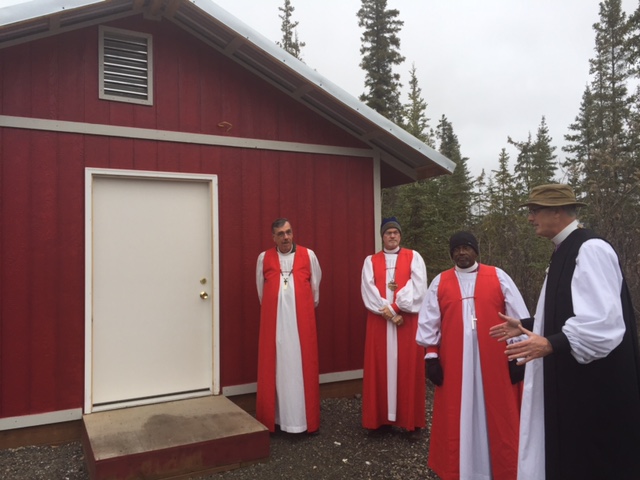
On our way back to the airstrip, we stopped twice: once to visit and offer prayers at the grave of Archdeacon Stuck, and then to bless a newly-constructed morgue building. This may seem a little odd, but burying a body in the midst of a long and frigid Yukon winter is no mean feat. The morgue, which is next to the church, is the place where the casket is constructed, and the body prepared for burial, and preserved (a natural cold storage) while the grave is dug, which is a lengthy and laborious process.

We were back on our single engine overwing aircraft around 4:00, and safely at our hotel 90 minutes later. It was rather an amazing day. Within this calendar year, I have visited Anglican Christian communities in Peru, Tanzania, and now the Arctic interior of Alaska. While there are huge differences between the three places, I find myself tracking a thread of commonalities among these "developing world" contexts. There is much to ponder.

Saturday, September 23, 2017

2017 Fall House of Bishops, Day 2

This is a view of the Chena River, the banks of which were once deemed "fair" by the explorer who first steamed up it. I snapped it while on a lunchtime pedestrian excursion with the Bishop of Tennessee. For some inexplicable reason, downtown Fairbanks is swarming with Thai restaurants. I made the mistake of cockily asking the server to make sure mine was spicy. My head hasn't stopped sweating yet. (The weather today was around 50F and drizzly. It feels like November in September.)

The morning consisted of more presentations by members of various indigenous peoples. A 96-year old tribal elder singing "I found my thrill on Blueberry Hill" in her native Athabascan language brought the house down. It was impressed upon us how much the ancient peoples of this land rely on a finely-honed eons-old pattern of relationship with nature revolving around the cycle of seasonal change. It's not only their cultural heritage; it's their food supply and their social fabric. There is great anxiety over the effect that proposed oil drilling in the Arctic National Wildlife Refuge would have on this delicate ecological balancing act.

The afternoon session was devoted mostly to preparing us for our various excursions to remote villages tomorrow, include a crash tutorial on videography and video editing on a smart phone. They're encouraging us to shoot lots of video and send clips to the communications wonks in New York, which they can harvest and edit toward the compilation of a collective video narrative.

This was the evening for "class" dinners (I'm in the Class of 2011, which is made up of all bishops who were elected in 2010, no matter whether they were consecrated that year or the following one.) As a class, we bonded extraordinarily well from the get-go, and very much enjoy one another's company.

Friday, September 22, 2017

2017 Fall House of Bishops, Day 1

This is the actual airplane flown by the third Bishop of Alaska, the legendary "flying bishop" Bill Gordon, who was elected in 1948 at the age of 29 and served until his retirement in 1974. The aircraft is on display at the Morris Thompson Cultural Center, a museum in downtown Fairbanks about a dozen blocks from the hotel where the House of Bishops is meeting through next Tuesday. Most of the bishops and spouses made a stop there as part of their afternoon activities. I found it an intensely interesting place.

Our day began with Morning Prayer at our tables in the main meeting room. We were then welcomed by Bishop of Alaska Mark Lattime, who, in turn, introduced two gentlemen from the indigenous peoples of the area, who addressed us at some length. I was particularly impressed by the first one, who maintains a profound sense of connection with the people who have inhabited this land for 10,000 years alongside an uncommonly rich, articulate, and well-formed Christian faith. He had some insights into the story of Melchizedek in Genesis that I had never heard before.

After a break, and the usual "check in" time with our table groups, we heard from Bishop of Central Florida Greg Brewer, speaking on behalf of the Task Force for Communion Across Differences. How can we as a House do a better job of making sure we hear--and actively listen to--all the voices in the room, including those which, for one reason or another, may be soft or silent? Bishop Brewer was speaking particularly of those who represent what has become a minority position on issues of sexuality and marriage, but which has been long held in our church and continues to be mainstream in global Anglicanism. Personally, I found his remarks to be the highlight of my nearly seven years in the House of Bishops. He spoke truth that has desperately needed to be spoken, but which has been either so unwelcome or so inaudible that it has been accorded no venue. I felt light a huge weight was beginning to be lifted.

We continued with discussion at our tables around these questions. As we face a General Convention next year at which there will be a proposal for a surgical revision of the Prayer Book that would articulate an understanding of marriage for which maleness and femaleness are irrelevant, it is essential that the bishops arrive in Austin already having had deep and prolonged listening to one another about the issues in general and the proposal in particular. Our first public conversation about it should not be when we are debating a question that is about to be resolved by means of a vote. In fact, it might behoove us--and I felt some energy in this direction--for us to think of ways of making decisions that do not involve voting of the sort that creates winners and losers. It is, of course, a huge challenge for democratically-conditioned Americans to even conceive of such a thing.

We got back together late in the afternoon for Eucharist in celebration of St Matthew's Day. The Presiding Bishop served as celebrant, and Todd Ousley, lately Bishop of Eastern Michigan and now the Bishop for Pastoral Development, a member of the Presiding Bishop's staff, preached. We then adjourned for a cocktail hour and returned to the same room and table for a banquet-style dinner.